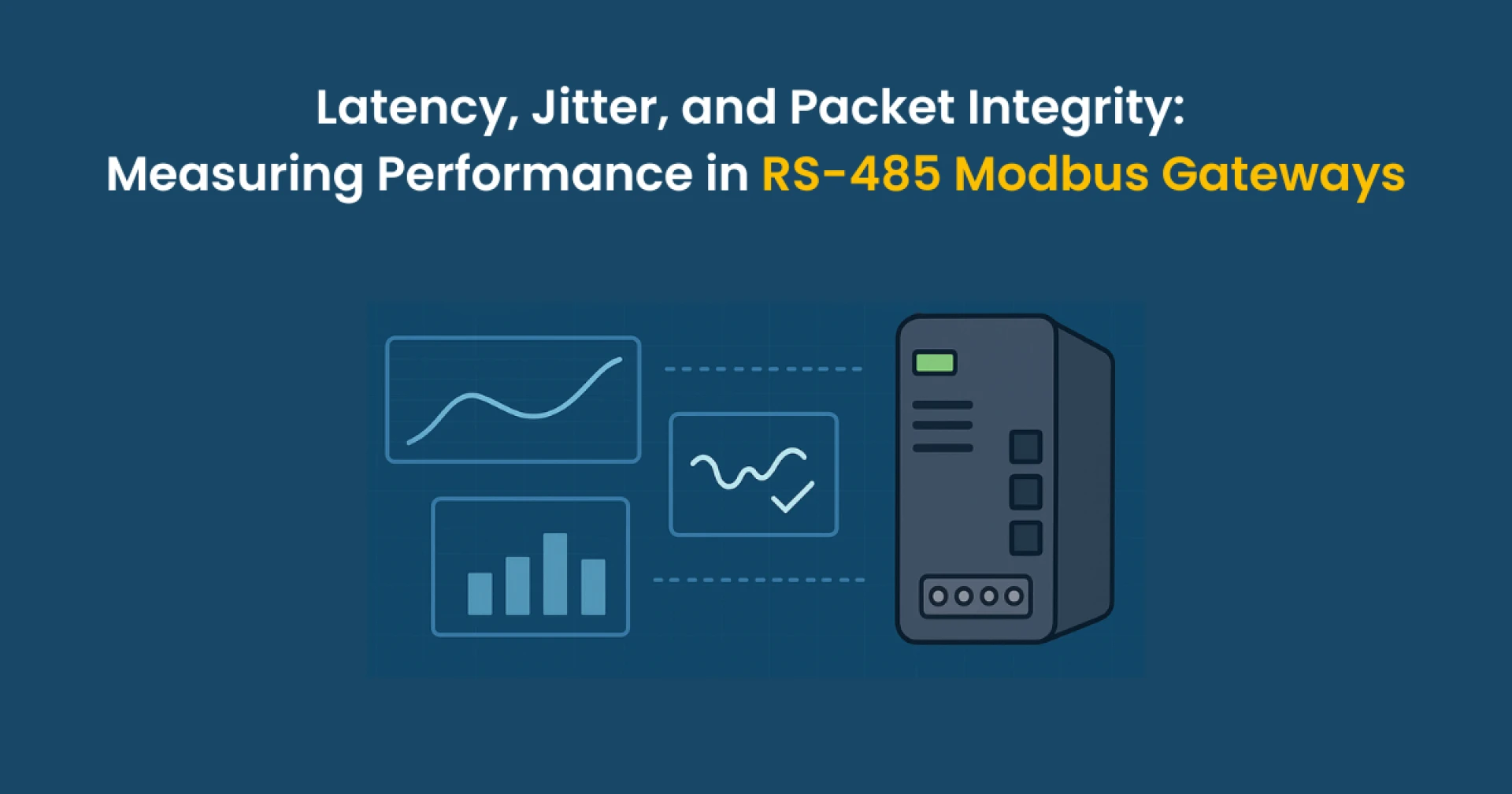

RS-485 Modbus gateways sit at the center of industrial communication, bridging legacy serial networks with modern Ethernet, cloud, or SCADA systems. Their efficiency determines how accurately field devices deliver the data that operators rely on. However, three fundamental metrics - latency, jitter, and packet integrity - dictate whether communication remains stable or begins to degrade under load, noise, or faulty wiring.
This extended guide offers a deeper look into how these metrics behave, what affects them, and how engineers measure and optimize them across RS-485 Modbus gateways.
1. Understanding Core Performance Metrics
1.1 Latency
Latency includes the complete turnaround time for each Modbus request. It is influenced by device processing speed, bus load, wiring conditions, and gateway configurations.
- Slow response cycles: Devices with older microcontrollers take longer to process Modbus functions like 0x03 or 0x10.
- Inefficient frame timing: Incorrectly configured t1.5 (inter-character) or t3.5 (inter-frame) delays introduce unnecessary silent periods.
- Low baud rates: High-density RTU networks running at 9600 bps can create 1–3 second polling delays when multiple slaves are polled sequentially.
- Gateway protocol translation delay: Converting RTU to TCP requires additional processing, especially when batching registers or handling multi-threaded request queues.
Real-world example: A gateway polling 20 slaves at 9600 bps may create 1.8s cyclic latency. Increasing to 38400 bps reduces cycle latency by more than 40%.
1.2 Jitter
Jitter is unstable variance in response time. Even when average latency appears acceptable, jitter can create unpredictable system behavior.
- Irregular device responses: Devices experiencing internal sensor delays or memory load cause inconsistent response gaps.
- Bus contention delays: Networks with more than one master cause collisions, forcing slaves to discard frames and respond unpredictably.
- Noise-induced retransmissions: EMI-heavy environments cause intermittent bit errors, triggering the gateway to retry commands.
- Mixed-baud devices (via converters): Some converters introduce buffering delays and mismatch timing across slaves.
Impact on operations: SCADA systems expecting data at precise intervals display erratic charts or alarm spikes when jitter exceeds 20–30 ms.
1.3 Packet Integrity
Packet integrity ensures each RTU frame arrives unaltered. It is the most critical metric for reliability, especially in long-distance industrial environments.
- CRC failures: Corrupt frames caused by EMI, ground loops, or reflections fail the 16-bit CRC validation.
- Bit-level distortions: Under terminination causes signal ringing, which alters logic levels at the receiver.
- Start/stop bit errors: Timing misalignment between slaves and gateway produces framing errors.
- Partial frame drops: Damaged wiring or poor connectors introduce random byte gaps.
High packet integrity = minimal retries, stable throughput, and consistent communication behavior.
2. Why Measuring These Metrics Matters
RS-485 is inherently strong and noise-resistant, but performance can drastically deteriorate if core metrics are not monitored.
- Delayed automation cycles: Slow or jittery communication elongates control loops, affecting machine responsiveness.
- False alarms in SCADA: Irregular timing or missing packets disrupt trend analysis and alarm thresholds.
- Incorrect actuator commands: Systems relying on real-time registers (e.g., tank levels or RPM feedback) may react too late.
- Reduced equipment lifespan: Gateways forced to retry constantly increase network traffic and device wear.
3. Tools and Metrics Gateways Use to Measure Performance
Modern RS-485 Modbus gateways incorporate powerful diagnostics that transform serial networks from “blind” infrastructure to fully visible communication layers.
3.1 Request–Response Timing
Gateways log the time taken for every Modbus command:
- Real-time latency graphs: Show how each slave performs under varying load conditions.
- Slow slave identification: Helps isolate devices with weak CPUs or overloaded internal tasks.
- Distributed system effects: Highlights how remote or wireless-connected converters introduce additional delays.
Gateways often classify responses into “normal,” “delayed,” or “timeout,” allowing faster root-cause analysis.
3.2 Scan Cycle Duration
Scan cycles reflect overall network performance.
- Cycle drift events: Slow devices or noise cause certain cycles to drift by 10–50%.
- Overloaded polling groups: Too many registers per cycle cause gateway buffers to overflow.
- Multi-thread congestion: Ethernet-to-serial conversions compete with internal tasks, extending scan time.
Monitoring scan cycles provides visibility into scalable network capacity.
3.3 CRC, Error, and Exception Statistics
Gateways track all types of failure events:
- CRC mismatch events: A sign of wiring, shielding, or EMI issues.
- Parity and framing errors: Often caused by mismatched serial configurations or electrical noise.
- Timeout spikes: Reveal device failures or dead branches in multi-drop RS-485.
- Exception code patterns: Repeated 0x02 or 0x03 errors highlight incorrect register maps or firmware bugs.
These statistics help detect failing devices long before they go offline.
3.4 Physical Layer Health Monitoring
Some industrial gateways include advanced PHY diagnostics:
- Weak signal detection: Detects when the differential voltage drops below RS-485 thresholds.
- Line bias imbalance: Reveals incorrect pull-up/pull-down resistor values.
- Temperature-induced drift: Highlights cable resistance changes and connector oxidation over years.
- Reflections and ringing: Identifiable through waveform irregularities captured by internal monitoring ICs.
This level of insight prevents catastrophic failures in critical industrial lines.
4. Common Causes of Poor Performance and Their Diagnostics
Below is an expanded engineering analysis of the most common RS-485 communication issues.
4.1 Excessive Cable Length or Poor Shielding
- Long-run signal attenuation: Weakens voltage differential, causing intermittent byte loss.
- High EMI exposure: Motors, welders, or high-frequency drives introduce noise bursts.
- Incorrect grounding schemes: Floating grounds increase susceptibility to induced voltage spikes.
- Cross-talk issues: Parallel cable runs introduce interference between adjacent cables.
Diagnostic sign: CRC error counter jumps during machine startup or relay switching cycles.
4.2 Incorrect Termination and Biasing
- Missing termination resistors: Result in reflections, echoing bits back into the bus.
- Excessive termination: Multiple terminators weaken signals excessively.
- Improper biasing: Network floats, causing random 0/1 transitions when idle.
- Asymmetrical impedance: Introduces variable time-smearing across long runs.
Field symptom: Packet integrity drops dramatically when more devices are added.
4.3 Device Overload or Slow Slave Behavior
- Firmware bottlenecks: Devices performing internal calculations delay Modbus responses.
- Queue flooding: Gateways send requests faster than slaves can respond.
- Large register reads: Reading 100+ registers in a single request strains slower devices.
- Non-RTOS devices: Single-threaded devices cannot manage internal tasks simultaneously.
Diagnostic sign: Latency logs show increasing response time for specific slave IDs.
4.4 Multi-Master or Hybrid Topologies
- Collision bursts: Occur when two masters attempt transmission simultaneously.
- Inconsistent timing: Different devices use different Modbus timing strategies.
- Star topology failures: Multiple branch reflections disrupt one another.
- Unauthorized additions: A technician adds a diagnostic device that unbalances the bus.
Common result: Jitter spikes from <5 ms to >80 ms in mixed-master environments.
5. Advanced Optimization Techniques
Below are deeper, field-tested optimization techniques used in high-demand industrial environments.
5.1 Tuning Serial Parameters Correctly
- Adaptive baud rate mapping: Use higher baud rates for shorter runs and lower for long-distance installations.
- Proper timeout ratios: Timeout should be ~3× average RTT to avoid premature retries.
- Function code optimization: Split large register reads into multiple smaller queries.
- Buffer-aware communication: Configure gateways to avoid dumping simultaneous queries to slow devices.
5.2 Improving Physical Layer Reliability
- Use shielded twisted pair (STP): Preserves differential signal integrity in noisy zones.
- Isolated gateways: Prevent ground-loop damage and protect Modbus transceivers.
- Industrial-grade connectors: Combat oxidation, vibration, and thermal cycling.
- Surge protection devices: Essential in outdoor or power-rich environments.
5.3 Optimizing Polling Logic
- Grouped polling strategies: Group high-frequency sensors separately from low-frequency registers.
- Event-driven data push: Use gateways that support on-change reporting instead of constant polling.
- Load balancing: Distribute heavy register reads across multiple cycles.
- Smart retry logic: Avoid retrying too aggressively on noisy networks.
5.4 Using Gateways with Advanced Intelligence
- Predictive maintenance tools: Some gateways forecast cable degradation or slave failure.
- Built-in oscilloscopes: High-end gateways show RS-485 signal waveforms.
- Edge computation: Gateways pre-analyze Modbus data before forwarding it to SCADA or cloud.
- Automated anomaly alerts: Detect rising jitter or CRC error trends before downtime occurs.
Conclusion
High-performance RS-485 Modbus gateway communication depends on careful monitoring of latency, jitter, and packet integrity. These metrics reveal early signs of wiring degradation, device overload, electrical noise, or improper network design. By leveraging modern diagnostic gateways, optimizing polling logic, and ensuring proper physical-layer design, organizations can build resilient, scalable, and high-throughput Modbus networks that operate reliably for years.




























Sign in to leave a comment.