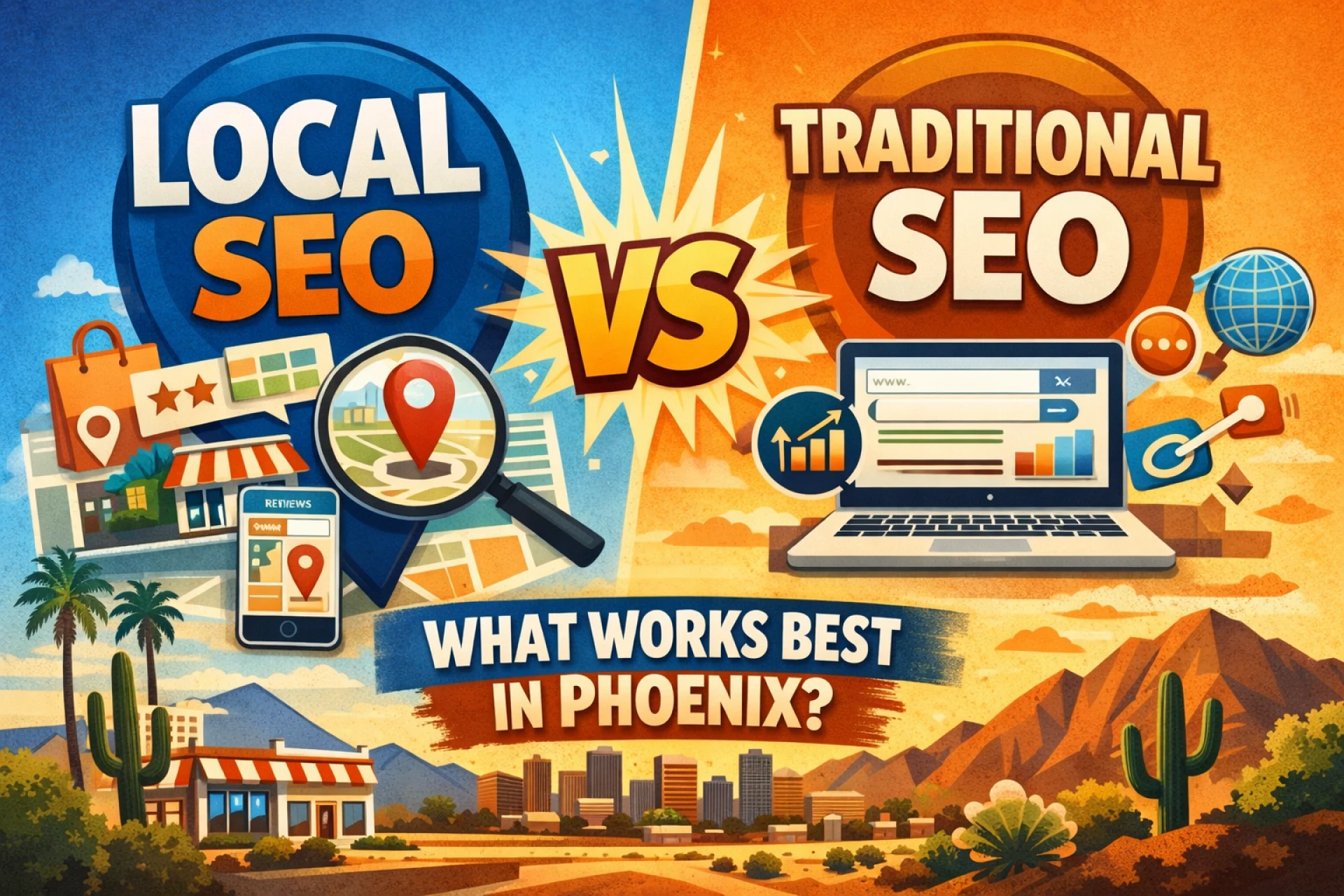

One of the most critical choices for Phoenix business owners is choosing between Local SEO and Traditional SEO when investing in professional SEO services in Phoenix. As competition grows across Phoenix industries, the right choice of SEO strategy may be the difference between a constant flow of qualified leads and the absence of online presence.
When you operate a local service, a restaurant, a medical practice, or a local retail store, your ranking in search results directly influences your calls, directions requests, and foot traffic. Conversely, when you sell statewide or nationally, you have to go beyond local Visibility in your strategy.
Which one works best in Phoenix, then? Let’s break it down clearly.
What Is Local SEO?
Local SEO aims to maximize visibility in geographically relevant searches, especially in Google’s Local Pack (Map results). This has a direct effect on businesses in Phoenix and can influence: Phone calls, Direction requests, Appointment bookings, and Walk-in customers.
Google Business Profile Optimization
Your Google Business Profile is your online frontier. Optimizing categories, services, business descriptions, images, frequently asked questions, and frequent updates enhances local relevance signals. In competitive niches such as HVAC or legal services in Phoenix, a fully optimized profile could be a decisive factor in achieving top 3 positions.
Reviews & Reputation Signals
Customers’ visibility and purchase decisions directly depend on reviews. When an individual is comparing two Phoenix businesses offering similar services, the one that has more recent 5-star reviews is nearly always clicked on. Review volume, recency, and engagement are elements of trustworthiness identified by search engines. Proactive solicitation of reviews and responding to them in a professional manner boosts rankings as well as customer confidence.
Local Citation and Consistency
Consider citations as online credits to your company. The more consistent the contact information displayed on reliable sites, the more search engines will be convinced of your presence to customers in the area. Incorrect or outdated listings may confuse either users or search engines, thereby lowering prominence in crucial local searches.
Proximity & Intent
Local SEO heavily depends on the physical location of the searcher. When two Phoenix companies provide the same service, the company that is nearer to the user is likely to be a top result on the map. That is why it is important to optimize so that it is relevant in terms of location and provides a clear offer of services.
What Is Traditional SEO?
Traditional SEO focuses on ranking in organic search results without geographic restriction. It uses broad, high-volume keywords that can attract traffic within the country or even worldwide. Traditional SEO is all about authority.
Content Depth / Topical Authority
Search engines give weight to sites that show expertise in a specific area. To compete, a company that deals in roofing systems aimed at businesses will need to produce detailed guides, case studies, and educational information. This aligns with search engine optimization. Search engines analyze content in terms of relevance, authority, and trust indicators and rank pages accordingly.
Backlink Profile and Domain Strength
Search engines also calculate trust by looking into who links to your site. Whenever your content is cited on credible and relevant websites, it enhances your overall authority. The stronger your sphere of influence, the more competitive search terms you can rank for easily. That is why the quality of backlinks is much more important than the quantity of backlinks in traditional SEO.
Technical Performance
A technically optimized site not only makes the website more visible, but it also makes it easier to use — bounces are minimized, and user engagement is maximized. Even minor technical inefficiencies can reduce ranking potential in wider search markets.
Traditional SEO is particularly useful for:
- SaaS companies that serve national markets.
- eCommerce brands that compete with each other using product-based keywords.
- Businesses that have their operations spread across cities.
- Businesses that use content marketing as an information-based strategy.
Local SEO vs Traditional SEO: Strategic Differences
Understanding the difference between local and traditional SEO isn’t just technical; it shapes budget, growth, and leads. A comparison of the two is provided below to assist Phoenix companies in making an informed decision.
| Factor | Local SEO | Traditional SEO |
|---|---|---|
| Primary Goal | Attract nearby customers | Build broader online visibility |
| Target Audience | People searching within a specific city or area | Regional, national, or global audiences |
| Search Intent | High intent (ready to call or visit) | Research, comparison, or broader buying intent |
| Key Ranking Factors | Google Business Profile, reviews, proximity | Backlinks, content depth, technical SEO |
| Competition Level | Limited to local market | Competes across wider markets |
| Speed of Results | Often faster for service businesses | Typically slower but long-term impact |
| Best For | Contractors, clinics, restaurants, local services | SaaS, eCommerce, multi-location brands |
What Works Best for Phoenix Businesses?
Phoenix is among the rapidly developing metro economies in the United States. The speed of population growth, new construction, and industrial development in the territory guarantees one thing to business owners: competition is becoming hard.
Visibility is not an option; it is a strategic advantage.
Local SEO can usually provide the greatest short-term return on investment for businesses whose main customer base is within the local area (i.e., contractors, dentists, med spas, law firms, restaurants, and home service providers). When a person is looking for a service in Phoenix, he or she is likely to take action. Booking at the point of desire is what makes calls, bookings, and walk-ins successful.
Traditional SEO becomes essential when:
- You sell products or services on a state or national scale.
- You use educational inbound marketing to generate leads.
- You prefer to develop brand strength in the long run.
- You operate in high-trust sectors where research is conducted before purchasing.
Under such circumstances, broader organic visibility enables long-term development beyond simple geographic demand.
The Hybrid Model (Recommended for Scalable Growth)
For growing businesses, settling on a single strategy is not a good option; a combination of both is more effective.
- Local optimization captures high-intent searches that require immediate action.
- Traditional SEObuilds domain authority, credibility, and organic traffic in the long term.
For example, a Phoenix-based SEO agency may rank locally for “SEO company in Phoenix” while simultaneously publishing in-depth guides on topics like technical SEO audits, AI-driven search optimization, and content strategy frameworks.
If you are not sure where to start or where you are lacking, a structured local audit of your Phoenix business can help identify areas where you are not utilizing all available opportunities, in addition to setting priorities for action.
What Is the Action Plan for Phoenix Businesses Starting SEO Today?
If a large portion of revenue is derived from local clients:
- Maximize and maintain your Google Business Profile.
- Create geographically oriented service pages.
- Adopt a standardized review acquisition process.
- Build Phoenix-related links and partnerships.
- Publish geographically relevant, community-based content.
If revenue is generated from wider markets:
- Create long-form content targeting high-value keywords.
- Build high-quality editorial backlinks.
- Improve site architecture and technical performance.
- Go beyond geographic modifiers in keyword targeting.
Clarity regarding revenue streams should dictate where most of your SEO budget is allocated.
Conclusion
If you are mainly targeting local customers, investing in local optimization is not optional. Even the most effective website may fail to generate consistent leads without strong local visibility.
If you have both local and broader audiences, a hybrid strategy is the smartest and most scalable investment. Local search captures buyers who are ready today, while traditional SEO builds authority that compounds over the years.
Successful businesses in Phoenix are not choosing between local and traditional SEO; they are strategically sequencing both.
When an individual searches for a service in the area, he or she is almost ready to make a decision. The only question is whether your business will be present at that point of intent.
In a city where growth and development continue at a rapid pace, visibility is no longer a marketing luxury but a competitive necessity.
FAQS
Is local SEO better than traditional SEO for small businesses?
Yes, for the majority of Phoenix small businesses. Local SEO delivers much quicker results, focuses on buyers with higher intent, and is less expensive than a full traditional SEO campaign.
What is the Google Map Pack?
The Google Map Pack refers to the three local business listings on the first page of the results when a local-intent search is made on Google. It displays a map, businesses, star ratings, hours, and phone numbers.
What is the price of local SEO in Phoenix?
Phoenix local monthly SEO retainers are usually between $500 to $3000 or more, depending on the company and the services provided.
Does traditional SEO support local rankings?
Yes. Strong domain authority can generate a positive effect on local organic rankings in combination with optimized local signals.



























Sign in to leave a comment.