

When you’re stuck in arguments, feeling distant, or simply want to strengthen your bond, you might wonder whether you should turn to a relationship coach vs. a therapist.

Both can help couples grow, but they’re not the same—and choosing the right one can make all the difference in whether you get the results you need.
In this guest post, we will break down the key differences between a relationship coach and a therapist and when each is the right choice for couples.
What Types of Issues are Better Suited for a Therapist?
Let’s be honest—some problems run deeper than just needing a few new communication tricks. If you or your partner is facing serious emotional struggles, a licensed therapist is usually the best choice.
Why? Because they’re trained to handle the roots of issues, not just the surface behavior.
Consider therapy if:
1. Mental Health Concerns Exist: Depression, anxiety, trauma, or substance abuse often show up inside a relationship. A coach isn’t equipped for these; therapy is.
2. You’re Dealing With Past Trauma: Unresolved childhood trauma or past abuse can seriously affect trust and closeness. Therapists can help you process this safely.
3. Fights Are Constant and Harmful: Do arguments keep spiraling into shouting or hurtful words? Therapy can help you break toxic cycles and learn where the triggers come from.
4. There Are Signs of Abuse: Any relationship with emotional, physical, or financial abuse should involve a licensed professional, not a coach. Safety comes first.
5. Sexual Concerns Link to Deeper Issues: If intimacy problems feel tied to emotional pain, fear, or medical history, therapy is the safest place to unpack them.
When in doubt, it’s wise to lean toward therapy. It’s not about being broken; it’s about choosing the best tool for the deeper work.
When Does Working With a Coach Make More Sense?
Not every couple needs to unpack childhood trauma to get unstuck. Sometimes, you simply need a plan and a push—and that’s where a relationship coach shines.
Coaching can be a smart move when:
A. You Want Actionable Tools
A coach can help you break down big goals—like better listening or fairer arguments—into small daily habits. They keep you focused and practicing.
B. You’re Generally Stable Emotionally
If there’s no active mental health diagnosis at play, coaching can help you move forward quickly without diving deep into your past.
C. You Want Clear Accountability
Let’s be honest—many couples know what they need to do but don’t do it. A coach checks in, sets deadlines, and makes sure you follow through.
D. You’re Focused on the Future
Premarital coaching, navigating parenting roles, or planning big life changes? Coaches can help you prepare, plan, and adjust as life shifts.
More and more couples today want practical tools, clear action steps, and support they can use right away, not just deep conversation about the past. That growing demand is one of the reasons coaching keeps expanding.
In fact, the U.S. life coaching market was valued at nearly $1.6 billion in 2024 and is expected to keep growing every year through 2030. (source)
Think of a coach as your practical guide, while a therapist is your emotional healer.
Relationship Coach vs. Therapist: How Do They Really Compare?
Sometimes, the easiest way to decide is to see the facts side by side. So, let’s compare the essentials clearly.
When you’re weighing a relationship coach vs. a therapist, here’s what you’re really comparing:
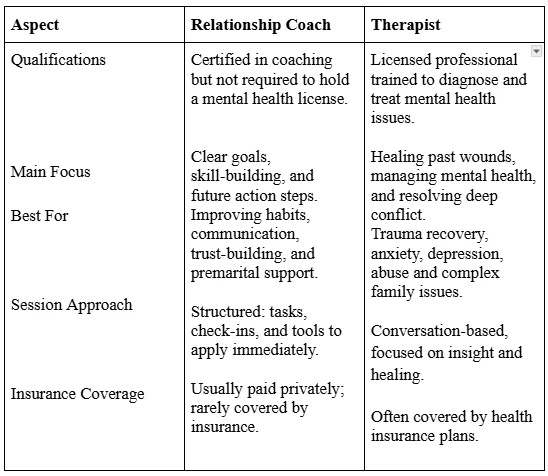
Once you see the difference clearly, you can match what you need to the support that fits.
How Can You Tell If Your Situation Needs Clinical Support?
Even with this comparison, many couples still hesitate: Do we really need therapy? Can’t we just learn some new tips and move on?
Here are some signs you shouldn’t skip therapy:
1. Your relationship stress spills over into daily life. Are you losing sleep, feeling hopeless, or struggling at work because of constant fighting?
2. Conflict feels unsafe or abusive. Any threats, control, or physical harm means you need licensed help—immediately.
3. You’ve tried coaching before, but patterns repeat. Sometimes people try coaching first, but deeper issues keep surfacing. That’s a signal for therapy.
4. One or both of you feel emotionally overwhelmed. If either of you feels stuck in sadness, fear, or anger, a therapist is better equipped to help you process it.
It is worth remembering that, according to a 2023 report, 99% of couples who attended therapy said it had a positive impact on their relationship. (source)
This shows how powerful the right professional support can be when deeper healing is needed. When in doubt, start safe: you can always move from therapy to coaching later.
What Should You Ask Before You Decide?
Choosing a relationship coach vs. a therapist can feel intimidating—but you have every right to ask questions. You’re inviting this person into your private life. Make sure they fit.
When you speak to a coach, ask:
- What is your training and background?
- Do you specialize in couples work?
- How do you handle situations that need therapy instead?
- What happens if we discover deeper issues mid-coaching?
- How do you measure success and progress?
When you speak to a therapist, ask:
- What license do you hold?
- How long have you worked with couples?
- What’s your general approach or style?
- Will we both attend every session?
- How do we know when it’s working?
A true professional will answer openly and welcome your questions. If they’re defensive or vague, keep looking.
Is It Possible to Switch If You Choose the Wrong Fit?
Yes—and it’s more common than you’d think! Many couples start with a relationship coach but realize they need deeper support. Others finish therapy, then move to coaching to focus on future goals with practical steps.
Here’s how you can make the switch smoothly:
- Talk about it openly: Be honest with your coach or therapist about what you feel is missing. Good professionals care about your progress—not keeping you stuck.
- Ask for a referral: Many coaches and therapists know trusted people in the other field.
- Plan a transition: Don’t leave big conflicts hanging—coordinate a handover so you feel supported the whole way through.
- Stay on the same page as a couple: Switching only works if you both agree it’s the right next step.
Final Thoughts: Which One Will You Choose?
At the end of the day, the question of relationship coach vs. therapist isn’t about picking the better option—it’s about choosing the support that matches what you and your partner need right now.
If you’re ready to break old patterns, communicate more openly, and build a relationship that feels secure and fulfilling, Camelot Life Coach is there for you.
Their coaching approach gives couples clear guidance, practical tools, and real strategies you can apply to everyday life.
They focus on action, accountability, and positive change—so you don’t just talk about problems, you solve them together. Call now!
Website : https://www.camelotlifecoach.com/
Phone No. : +1-3142760423
Email : [email protected]
Address : St. Louis MO 63105

























Sign in to leave a comment.