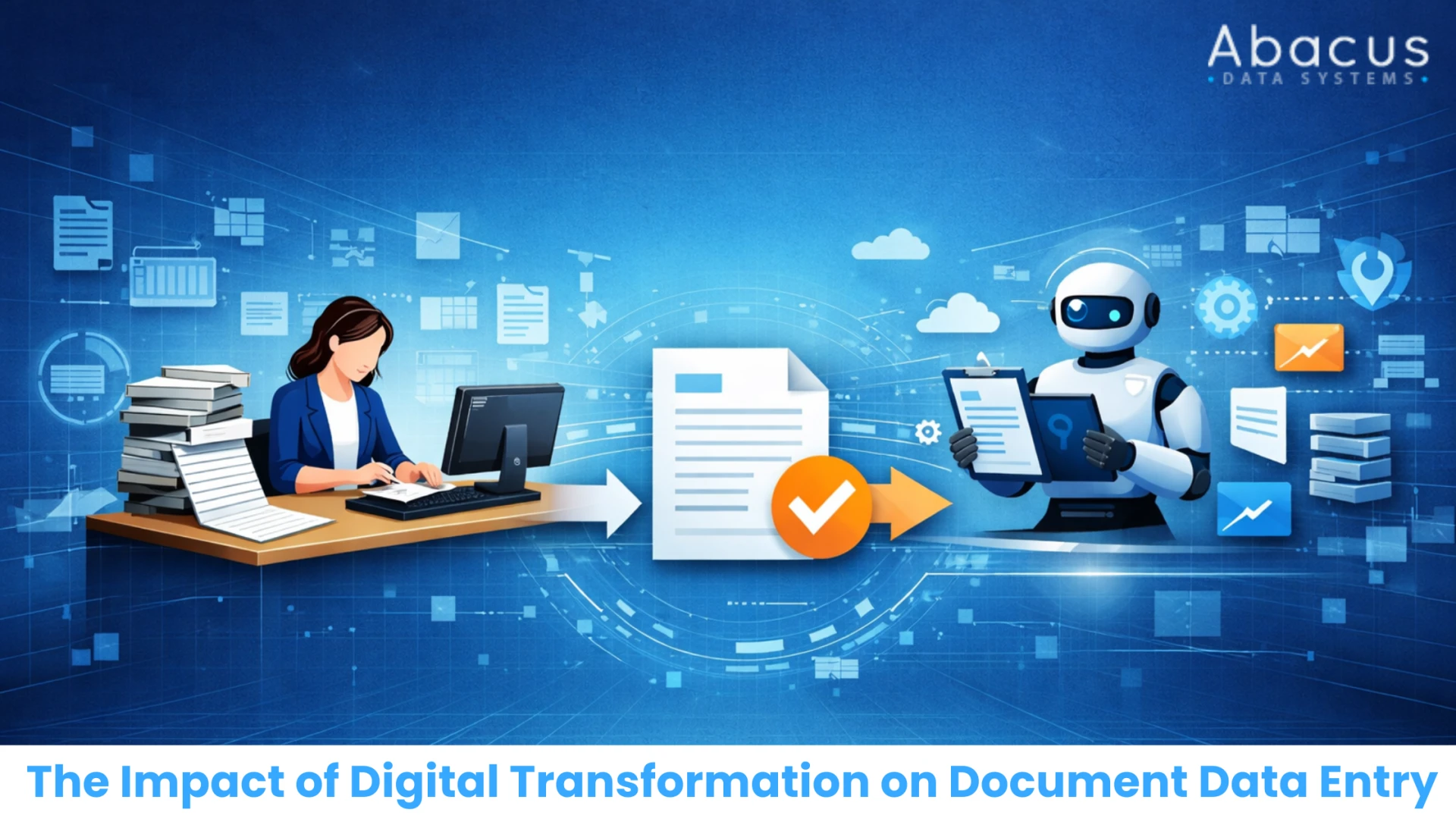

Are you looking for ways to convert physical documents into digital formats? The instant shift to transformation enables institutions to achieve greater accuracy by automating time-consuming, repetitive manual data entry. Each sector relies on the latest digital tools to align business operations, including document data entry.
Enterprises that previously relied on manual data entry are using the latest digital tools to manage and store information. With the growing need for speed and accuracy, document data entry has become a crucial part of advanced business operations, helping institutions save time and use resources more effectively.
Many organizations are turning to data entry services to streamline tasks and ensure their confidential data remains up-to-date and reliable. This detailed blog examines the impact of digital transformation on document data entry.
How Digital Transformation Completely Redefined Data Entry
Previously, data entry was manual. Employees had to manually enter data from paper documents into various systems, causing errors and a time-consuming process. Institutions rely on modern digital technologies that automate these repetitive tasks.
Multiple digital tools use optical character recognition and innovative document processing to store, extract, and split data directly from scanned or digital documents. Complete automation reduces errors and enables companies to handle large data volumes in real time.
These shifts from physical processes to digital documents have been a substantial transformation across industries such as finance, healthcare, logistics, and manufacturing, where efficiency is crucial.
Digital Transformation Shapes Data Entry In Various Ways:
Practical Data Insights That Boost Efficiency
The rapid shift to data processing has shaped how organizations operate. Nowadays, digital tools can capture and analyze information in real time, providing organizations with a clear, up-to-date view of their critical operations.
Project managers can visualize performance, detect errors early, and make informed decisions without expecting end-of-day reports. These insights help enterprises increase their in-house processes. Organizations can decrease redundancy, increase efficiency, and improve team performance by identifying the latest trends and restrictions.
AI and Machine Learning: Revolutionizing Document Processing
Using state-of-the-art artificial intelligence is essential for further document processing. The sophisticated AI-powered solutions can analyze text, extract key information, and process it with minimal human intervention. They learn from historical data patterns and become innovative over time when integrated with the advanced machine learning systems.
For instance, an AI tool is practically used for data entry, where AI reads invoices, contracts, and other relevant documents. When it reads more documents, it identifies structures and patterns. Every time AI reads documents, it completes the data entry task faster and more precisely. By using AI, businesses reduce costs by eliminating the need to hire data-entry professionals and improving efficiency.
Ensuring Strong Compliance and Data Security
As digital data volumes increase, companies should maintain strict compliance with industrial regulations governing data privacy and protection. Digital transformation enables the management and control of sensitive information through robust data encryption, access controls, and secure retention.
These online digital platforms include data audit trails that allow simple tracking of file access and edits. Automated compliance checks can ensure that all data matches regulatory standards. It decreases the risk of legal penalties and safeguards the company's reputation.
These systems automatically update as regulations evolve, helping enterprises stay compliant without additional effort.
Intelligent Data Validation and Efficient Information Management
One of the substantial advantages of digital transformation is data management. The difficulty of storing physical documents is the primary driver of the need for sufficient office space. The use of digital filing systems and cloud storage makes it easy to find information within seconds.
These secure data management platforms allow teams to store details while maintaining instant access for auditing, reporting, and decision-making.
Modern software supports data validation, confirming that each entry follows predefined rules and is valid. For instance, automated changes can identify missing values before information is saved. The process increases accuracy and decreases time spent in manually correcting and reviewing common data-entry errors.
How Automation Saves Time and Reduces Operational Costs
Time-saving is one of the most substantial benefits of digital transformation in document data entry. Automating business operations accurately streamlines repetitive tasks, freeing up staff to focus on priority work. By reducing manual data entry time, institutions can free up more time for better-informed decision-making and analysis.
As businesses outsource data entry, they reduce labor costs and hours by using limited resources to handle daily tasks. This higher productivity gives strong long-term returns on investment, scaling organization resources without adding team members.
Stronger Collaboration Through Connected Digital Workflows
Digital transformation is more than automating processes and connecting people. Cloud-based tools and distributed data management systems enable teams to collaborate from multiple locations. Teams can apply changes in real time and access records, eliminating the need for emails or duplicate entries.
Such data access brings accountability and transparency. When each team member works with the same dataset, the risk of misinterpretation and uncertainty is drastically reduced. Productivity also increases with data entry outsourcing because employees can spend time correcting mistakes rather than finding and entering data.
Building A Scalable, Future-Ready Data Environment
Organizations lay the foundation for long-term business growth by embracing digital tools. Digital transformation authorizes institutions to use scalable solutions that evolve with their needs. Integrating analytics, automation, and cloud computing creates a scalable environment that can adapt to new challenges.
A future-ready ecosystem focuses on improved accuracy and data accessibility. Business owners and decision-makers can obtain insights from digital data to support client engagement, marketing, and strategic planning. Accurate data gives desired results, whether for tracking inventory or predicting sales.
Why People Still Matter in a Digitally Transformed Workplace
People will remain in the central part when automation plays a decisive role. The success of digital solutions depends on employees' ability to adopt the latest technologies. Employee training and upskilling will help them to use the latest digital systems properly.
Once employees feel comfortable with the new technologies, they will be able to work smarter and faster. Rather than replacing staff members, automation enables them to engage in more innovative and critical thinking. This feature balances the advanced technology with human intelligence to increase sustainable business growth.
Achieve Optimal Productivity In Document Data Entry Using Scalable Data Entry Services
Digital transformation changed the way institutions handle document data entry. Each team will benefit from improving business operations to provide more accurate data insights. They focus on delivering real-time value through innovative automation, effective data management, and decision-making.
Partnering with a reliable data entry company enables institutions to make the most of these sophisticated technologies. Such institutions bring modern tools, proven methods, and professional expertise that simplify different processes while ensuring accuracy and data security.
As more enterprises adopt digital transformation, they create opportunities for continuous improvement, cost reduction, and enhanced service delivery. The future of document management looks safe, practical, and people-oriented, powered by modern technology and guided by skilled experts who use it effectively.


























Sign in to leave a comment.