




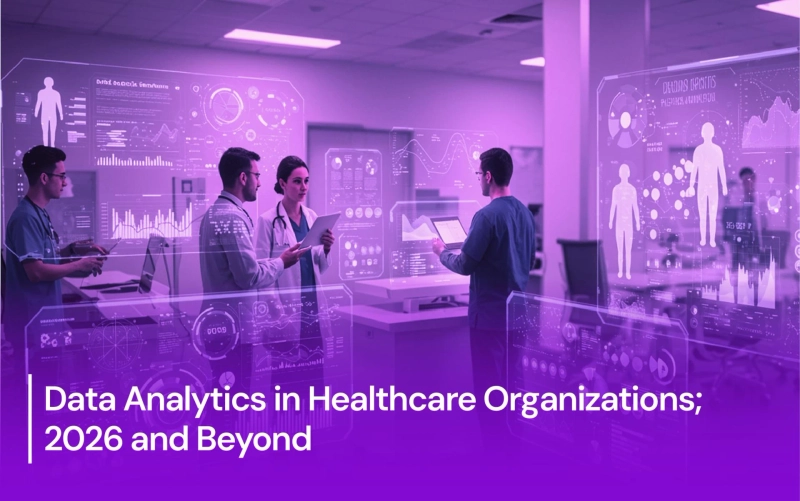
Healthcare organizations today operate in an ecosystem where clinical outcomes, operational efficiency, financial sustainability, and patient experience are deeply interconnected. At the center of this ecosystem lies data analytics in healthcare, the capability that transforms raw medical, operational, and patient data into actionable intelligence.
Why Data Analytics Has Become a Strategic Priority for Healthcare
The volume of healthcare data has grown exponentially: electronic health records (EHRs), claims data, imaging, genomics, wearables, and patient-reported outcomes. However, without the right analytical frameworks, this data remains underutilized.

This is where healthcare analytics plays a critical role by helping organizations:
- Identify care gaps
- Improve clinical decision-making
- Reduce operational inefficiencies
- Control costs
- Enhance patient engagement
Healthcare leaders today are not asking whether to invest in analytics; they are asking how fast they can scale it.
The Role of Health Data Analytics in Improving Patient Outcomes
At the clinical level, health data analytics enables care teams to move from reactive treatment to proactive care.
Key applications include:
- Early detection of disease progression
- Risk stratification of patient populations
- Personalized treatment recommendations
- Reduction in hospital readmissions
- Monitoring adherence and outcomes
By analyzing patterns across millions of patient records, healthcare organizations can deliver more precise, timely, and effective care.
Big Data Analytics in Healthcare: Turning Complexity into Clarity
Healthcare data is large, complex, unstructured, and fragmented across systems. This is where big data analytics in healthcare becomes essential.
With advanced analytics, organizations can:
- Integrate clinical, claims, and operational data
- Analyze unstructured data like physician notes
- Detect trends across large patient populations
- Improve population health management
- Support large-scale research and innovation
Big data analytics allows healthcare systems to operate with clarity instead of guesswork.
Healthcare Predictive Analytics: From Insight to Foresight
Traditional reporting tells healthcare teams what happened in the past. Healthcare predictive analytics goes a step further as it anticipates what is likely to happen next.
Predictive analytics is used to:
- Forecast patient admissions and bed occupancy
- Identify patients at risk of complications
- Predict disease outbreaks
- Detect fraud and anomalies
- Optimize staffing and resource allocation
This shift from reactive to predictive decision-making is critical for modern healthcare organizations operating under cost and capacity constraints.
The Growing Importance of the Healthcare Data Analyst Role
As analytics adoption accelerates, the demand for skilled healthcare data analyst professionals has increased significantly.
Healthcare data analysts help organizations by:
- Interpreting complex clinical and operational data
- Building dashboards and performance metrics
- Supporting clinical and business decisions
- Translating insights into action plans
- Ensuring data quality and governance
They act as the bridge between raw data and real-world healthcare impact.
Patient-Centric Intelligence: From Analytics to Consumer Understanding
Healthcare is becoming increasingly consumer-driven. Patients expect the same personalization and responsiveness they experience in other industries.
This is where tools like consumer insights software and a customer intelligence platform come into play.
These platforms help healthcare organizations:
- Understand patient behavior and preferences
- Analyze engagement across digital and offline channels
- Personalize communication and care journeys
- Improve satisfaction and loyalty
- Design better patient support programs
By combining clinical data with behavioral insights, healthcare organizations can deliver truly patient-centric experiences.
How Data Analytics Strengthens Healthcare Operations and Financial Performance
Beyond clinical care, data analytics in healthcare plays a crucial role in operational and financial optimization.
Organizations use analytics to:
- Improve revenue cycle management
- Reduce claim denials
- Optimize supply chain costs
- Monitor operational KPIs
- Improve workforce planning
Analytics-driven organizations are better equipped to manage margins while maintaining high standards of care.
Analytics as the Foundation for AI in Healthcare
Modern AI solutions, including predictive models, intelligent assistants, and automation platforms, depend heavily on strong analytics capabilities.
Without robust healthcare analytics pipelines:
- AI models cannot be trained effectively
- Insights cannot be trusted
- Automation cannot scale safely
Conclusion
The future of healthcare will be defined by how effectively organizations harness their data. From improving patient outcomes and operational efficiency to enabling predictive care and personalized experiences, data analytics in healthcare has become a fundamental capability.
Organizations that invest early and strategically in healthcare analytics, health data analytics, and advanced intelligence platforms will be best positioned to lead in an increasingly complex and competitive healthcare landscape.