The vision is clear: a thriving online marketplace where property owners and eager travelers connect. You've identified a niche, you understand your target market, and you're ready to disrupt the vacation rental space. But between that brilliant idea and your first successful booking lies a formidable challenge: the technology.
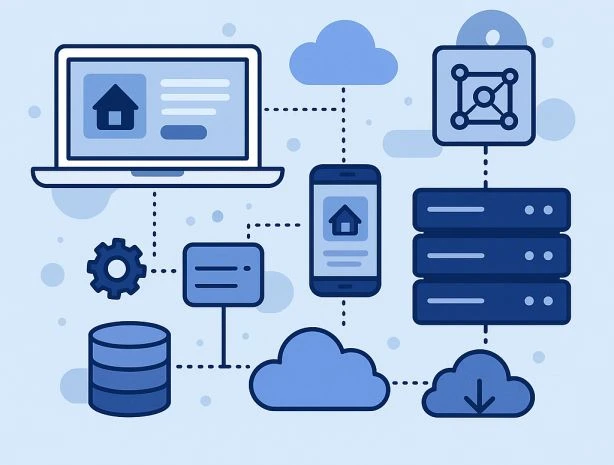
Building a modern rental platform is not simply about creating a website with a few listings; it is about constructing a complex, interconnected digital ecosystem. You need the technological foundation upon which trust, efficiency, and scale are built.
A Responsive Front-End
The front-end is your digital storefront. It’s what your users see, touch, and experience. In today's multi-device world, a "website" is not enough. You need a responsive web application that delivers a seamless, app-like experience, whether accessed from a desktop, tablet, or smartphone.
Front-end development involves a blend of technologies like HTML5, CSS3, and JavaScript frameworks like React.js, Vue.js, or Angular. The frameworks are crucial for creating dynamic, single-page applications (SPAs) where search filters, map updates, and calendar availability can change in real-time without requiring a full page reload.
A Powerful Back-End
If the front-end is the storefront, the back-end is the head office, warehouse, and logistics center all rolled into one. The server-side logic powers everything; this is where you handle user authentication, process bookings, manage availability calendars, and orchestrate communications.
Business Logic: Enforcing the rules of your platform (e.g., a property cannot be double-booked, a host must accept a booking within 24 hours).
Server Management: Ensuring your platform remains online and can handle traffic spikes.
Integration Hub: Acting as the central point that connects all the other pieces of your tech stack.
Choosing the right back-end architecture from the start is critical for performance, security, and your ability to add new features in the future.
A Secure Database
Every piece of information on your platform - user profiles, property details, booking histories, and, most sensitively, payment records - lives in a database. The choice and management of this database are non-negotiable aspects of your business's integrity.
A poorly designed schema can lead to slow performance, data corruption, and a nightmare of a migration process later on. Modern platforms often use relational databases like MySQL or PostgreSQL for their structured data and ACID compliance (Atomicity, Consistency, Isolation, Durability), which is essential for financial transactions.
Furthermore, security is paramount. The database must be fortified against common threats like SQL injection attacks, and access must be strictly controlled. A single breach can irreparably damage your brand's reputation.
Critical Third-Party APIs
No platform is an island. The magic of a modern rental site often comes from its seamless integration of specialized third-party services via Application Programming Interfaces (APIs).
For displaying property locations, calculating distances to landmarks, and providing interactive maps for users to explore areas.
Payment Gateways (Stripe, PayPal, Braintree): For securely processing credit card payments, handling escrow functions (holding guest payments until after check-in), and managing payouts to hosts. This involves strict PCI-DSS compliance.
For integrating email and SMS notifications to automatically confirm bookings, send check-in instructions, and facilitate messaging between guests and hosts.
For connecting to services like Google Analytics, Mixpanel, or CRM platforms to track user behavior and drive growth.
Integrating these APIs is a development task in itself, requiring a deep understanding of each service's documentation, authentication methods, and error-handling procedures.
Native Mobile Apps
While a responsive website is essential, a significant portion of your users will expect a native mobile experience. Travelers browse and book on the go, and hosts need to manage inquiries and bookings from their phones.
Developing native iOS and Android apps is a separate project altogether; it requires expertise in Swift or Kotlin, and often, a separate team or skill set from your web developers. Travel app development needs to ensure core functionality like push notifications, seamless in-app navigation, and a user experience that feels at home on a mobile device.
Build, Assemble, or Leverage?
As you survey this technological landscape, the scope of the undertaking becomes clear. You are not building a single piece of software; you are architecting a city, with its infrastructure, utilities, and public services.
The traditional path is to "build from scratch", which means hiring (or becoming) a team of expert front-end, back-end, and mobile developers, a database architect, and a DevOps engineer. The path offers ultimate customization but comes with immense costs, a timeline measured in months or years, and the ongoing burden of maintaining, updating, and securing every single component.
There is, however, a more strategic path for entrepreneurs who want to focus on business growth rather than technical debt.
The path recognizes that the core technology required for a rental platform - the responsive front-end, the powerful back-end, the secure database, the integrated APIs, and the native mobile apps is not a unique secret. The real competitive advantage lies in your branding, your community, your customer service, and your niche market focus.
This is where a well-built, comprehensive clone script from a reputable company becomes a powerful strategic decision. A solution like the Airbnb Clone is not merely a template; it is a pre-engineered, pre-integrated, and pre-tested version of the entire tech stack we've just described.
Instead of spending hundreds of hours and significant capital assembling these complex pieces, you start with a fully functional ecosystem. The secure payment gateways are already integrated. The map APIs are talking to the database. The responsive design and native mobile apps are ready for your branding. Ready to deploy solution dramatically reduces your time-to-market from over a year to a matter of weeks, allowing you to launch, learn, and iterate based on real user feedback.
Your resources are then freed to focus on what truly matters: curating amazing properties, crafting a compelling brand story, and building a trusted community of hosts and guests. In the high-stakes game of launching a rental platform, covering your tech stack with a proven foundation isn't just a convenience - it's one of the smartest business decisions you can make.


























Sign in to leave a comment.