




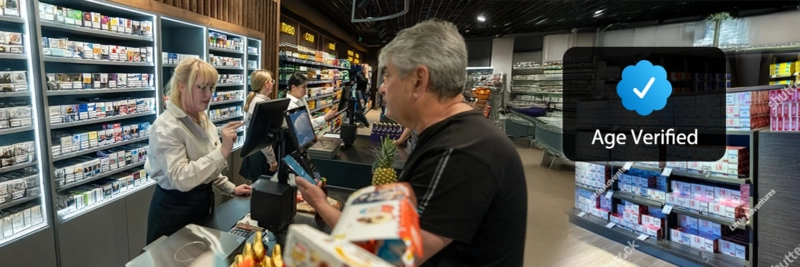
With growing concerns around youth access to tobacco and vaping products, regulatory scrutiny is at an all-time high. Governments are cracking down with stricter laws, surprise compliance checks, and steep penalties to prevent underage sales.
For retailers — especially those in the tobacco space — strong age verification is no longer optional. In today’s ever-evolving market, age verification for smoke shops isn’t just about checking a legal box; it’s key to protecting your reputation and staying compliant after obtaining a tobacco sales license.
Whether you’re launching an ecommerce site or running a brick-and-mortar store, secure and consistent age checks help ensure compliance, build customer trust, and minimize legal risks. These safeguards not only protect your business but also help prevent youth access to harmful products.
In this blog post, we’ll break down current age verification laws, examine the consequences of non-compliance, and explain how to implement effective systems for both in-store and online tobacco sales.
Understanding Tobacco Age Verification Laws
Tobacco age verification laws are essential for preventing underage access to tobacco and vape products. Businesses should stay compliant with federal and local regulations to avoid heavy penalties and protect public health.
1. Federal Regulations
In the United States, the Tobacco 21 law (which came into action in December 2019) has increased the minimum legal sales age for selling tobacco products, including e-cigarettes and vapes, to 21 years. Retailers are required to verify a customer’s age using a valid, government-issued photo ID for anyone under 30.
2. State and Local Laws
In addition to federal law, individual states and municipalities may have strict rules, including enhanced ID verification methods, signage requirements, and penalties. Some regions conduct regular compliance checks and require special retail licenses for selling tobacco or nicotine products.
Consequences of Non-Compliance
Non-compliance with regulations might result in financial penalties, license loss, reputational damage, and even criminal charges. These consequences can impact both the individual or organization involved and stakeholders.
Here's a more detailed look at the potential consequences:
1. Fines and Penalties
Regulatory bodies can impose financial penalties for non-compliance, which can range from minor to substantial based on the severity of the violation. For example, a healthcare facility might face a significant loss due to a Health Insurance Portability and Accountability Act (HIPAA) violation.
2. Loss of License
Depending on the industry and regulations, non-compliance leads to the suspension or cancellation of a license, halting business operations.
3. Reputation Damage
Non-compliance can severely damage an organization's reputation and cause a loss of trust from customers, investors, and other stakeholders. It can also negatively impact future business prospects and market share.
4. Criminal Charges
In severe cases, those involved in intentional wrongdoing or fraud, individuals or organizations, may face criminal charges, potentially leading to imprisonment.
5. Other Risks
Non-compliance leads to increased regulatory scrutiny and audits, leading to additional costs and operational disruptions. It results in the loss of market access, product delays, or the need to recall products.
Age Verification for In-Store Tobacco Sales
Age verification is a crucial part of responsible tobacco retailing, especially in physical stores, where compliance with federal, state, and local laws is mandatory. Retailers must follow strict procedures to ensure that tobacco products are not sold to any person under the legal age.
Best practices include mandatory ID checks, accepting only valid government-issued IDs, and training staff to spot fake IDs. Several stores now use electronic age verification devices integrated with their POS systems to improve accuracy and speed.
Surveillance systems and proper record-keeping also support compliance audits and protect businesses from legal risks.
1. Best Practices for Physical Stores
Retailers should create a store policy that ensures consistent ID checks, train staff regularly, and use clear signage to communicate legal age restrictions. A zero-tolerance approach to underage sales helps avoid penalties and builds trust with regulators.
a) Mandatory ID Checks
All customers under age 30 must be asked for valid identification before buying tobacco products. This step is the first and most important line of defense in age verification.
b) Acceptable Forms of ID
Only government-issued photo IDs like driver's licenses, passports, military IDs, or national identity cards should be accepted. Expired or damaged IDs are considered invalid.
c) Staff Training on Spotting Fake IDs
Train your staff to identify signs of fake or tampered IDs like incorrect fonts, mismatched photos, altered birth dates, or missing holograms. Role-play scenarios and ID-checking guides can reinforce confidence and accuracy.
2. Using Technology for Compliance
Implementing digital tools reduces human error and streamlines the age verification process. Technology also supports better documentation and audit preparedness.
a) Electronic Age Verification Devices
These devices can scan and validate IDs instantly, checking for expiration dates and legitimacy. They reduce reliance on manual inspection and provide a faster, more reliable check.
b) POS System Integration
Modern POS systems can be programmed to prompt ID checks automatically when tobacco products are scanned. This ensures your staff follows the proper process every time.
c) Surveillance & Record-Keeping
Closed-circuit television (CCTV) surveillance and digital records act as proof of compliance. They can protect your store during inspections or in the event of disputes about underage sales.
Age Verification for Online Tobacco Sales
As the sale of tobacco products moves online, strict compliance with age verification laws is more important than ever. Ecommerce tobacco businesses must implement age verification for tobacco shops.
They should have robust systems in place that meet federal, state, and technological standards to prevent underage access and ensure secure transactions.
1. Legal Requirements for Ecommerce
a) PACT Act Compliance
The Prevent All Cigarette Trafficking (PACT) Act requires online tobacco sellers to register with the ATF, collect taxes, verify buyers' age, and use specific shipping methods.
b) The FDA's Online Sales Rules
The U.S. Food and Drug Administration (FDA) mandates that tobacco and vape sales online must include strict age verification, accurate labeling, and child-resistant packaging.
c) State-Specific Bans on Online Tobacco Sales
Some states must completely or partially ban online tobacco or vape sales. Retailers must track which states they can legally ship to and adjust their systems accordingly.
2. Digital Age Verification Methods
a) Third-Party Verification Services
These services cross-check submitted user information with government records or databases to confirm age and identity before any purchase.
b) Database Checks
Online systems can compare customer-entered data against verified databases (e.g., credit bureaus or public records) for real-time verification.
c) Two-Step Verification
Some platforms require users to upload their photo ID and then complete a selfie or biometric scan to confirm that the identity matches the document
3. Delivery & Shipping Compliance
a) Adult Signature Required
Shipping services must ensure that an adult (21+) signs the package upon delivery, proving the item isn't handed to a minor.
b) Age Verification at Delivery
In some regions, couriers must verify the recipient's age with a valid ID at the time of delivery to stay compliant.
c) Restricted Shipping Zones
Retailers must stop shipping to states or zip codes where online sales are not allowed. They should also clearly show these restrictions at checkout.
4. Preventing Fraud & Identity Theft
a) Detecting Stolen IDs
Advanced verification systems can flag mismatched or suspicious data to prevent minors from using someone else's ID.
b) AI-Powered Liveness Detection
Liveness detection uses artificial intelligence to ensure that the user presenting the ID is physically present and not using a photo or fake video.
c) Regular Audits of Verification Systems
Ecommerce platforms should regularly review and test their verification processes to fix loopholes and stay compliant with evolving laws.
Wrapping Up
In today's tightly regulated environment, staying compliant with age verification laws is essential for online and in-store tobacco retailers. By combining clear policies, employee training, and modern technology, businesses can prevent underage sales while building consumer trust.
From robust ID checks to digital verification systems and secure delivery practices, every step counts. Investing in compliance not only protects your store from severe penalties but also supports responsible retailing for long-term success.