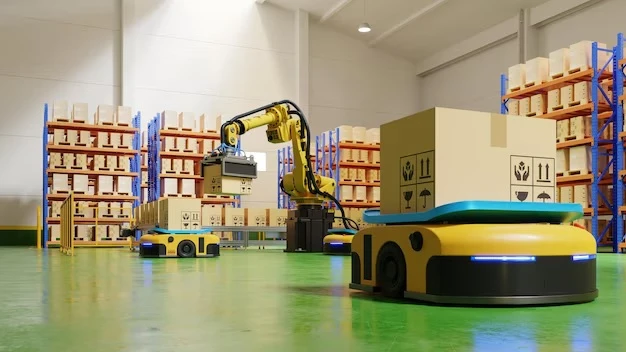
In today's fast-changing dynamics around logistics and supply chains, automation has become the bedrock for operational efficiency. Today, warehouses are dealing with thousands of products daily, and it is not possible to cope with the rising demands for speed, accuracy, and scalability with just manual labour. This is where warehouse robots enter, reshaping material handling. They deploy a fusion of robotics, artificial intelligence, and real-time data integration to facilitate seamless operations with minimal human dependence.
Key Warehouse Robots and Their Benefits
These days, warehouse robots come in several types designed for specific functions to help enhance storage, picking, packing, and transportation within facilities. The most common are autonomous mobile robots, automated guided vehicles, robotic arms, palletising robots, and sorting systems.
Autonomous Mobile Robots (AMRs)
Equipped with sensors and cameras, autonomous mobile robots move freely on warehouse floors, avoiding obstacles while ferrying goods to their correct destinations. Hence, AMRs work best in dynamic processes where changes of layouts are very frequent.
Automated Guided Vehicles (AGVs)
Unlike AMRs, AGVs follow a predetermined route, using a magnetic strip or track. They are best suited for repetitive tasks such as transporting pallets or containers between fixed points.
Robotic Picking Systems
These robots, fitted with vision systems and gripping mechanisms, recognise and select individual products from the shelf, increasing the accuracy of order picking and reducing picking errors.
Palletising and Depalletising Robots
These robots can handle heavy or repetitive lifting tasks, such as placing products onto pallets or unloading merchandise. They lessen the strain on the workforce and speed up throughput.
Sorting Robots
Sorting robots make use of AI and barcode scanning to route products efficiently to support high-volume e-commerce fulfilment.
These advantages are enormous: improved safety, reduction of labour costs, quicker operations, and high accuracy. Besides, the robots enable round-the-clock productivity that ensures timely dispatch even at peak demand periods.
How Robots Improve Material Handling Efficiency
Automation has transformed material handling from a purely manual activity to a seamless, information-intensive operation. The integration of warehouse robots optimises every stage, right from inventory management to shipment.
Robots remove human bottlenecks associated with tasks like sorting or transportation. This will free human workers to perform more strategic roles, including quality control or supervision. Further, autonomous mobile robots are able to plan routes dynamically depending on the traffic within the warehouse. In this way, congestion may be avoided, and increased speed in the movement of goods is achieved.
Another important advantage is precision: robots have consistent operations and do not get tired, and human error is avoided with the help of machine learning and sensors. All this will not only help improve the throughput but also workplace safety by reducing manual handling of heavy goods.
Advanced robotics businesses get real-time operational data. The insight it gives into the movement patterns, location of stock, and speed of processing assists managers in making better decisions. All this leads to continual process improvement.
Examples of Top Robots in Real Warehouses
Companies in logistics and manufacturing globally are deploying advanced warehouse robots to improve efficiency.
- Addverb's Dynamo AMR: An intelligent, Autonomous Mobile Robot used for pallet movements and order picking, among others; Dynamo integrates well into the Warehouse Management System to ensure smooth and real-time coordination.
- Kiva Robots: The orange robots, owned by Amazon Robotics, move the entire shelving units to the human pickers. This can reduce walking time by as much as 70%.
- GreyOrange Butler: A very flexible AMR that adapts to inventory fluctuations and optimises picking routes.
- AMRs from Locus Robotics: These robots collaborate with the human workforce by guiding them through optimised pick paths that increase productivity.
- Geek+ robots: They are flexible; hence, several leading brands around the world employ them for high-density storage and fast sorting.
Each of these technologies demonstrates a different way in which automation can redefine logistics efficiency. With the integration of intelligent systems, warehouses are able to achieve higher order accuracy, faster turnaround times, and improved safety.
Comparison of the Different Types of Warehouse Robots
The nature and structure of the warehouse differ for various warehouse robots. The AGVs suit structured environments where paths hardly change. They move along fixed tracks or magnetic tapes and do very well in repetitive movements of pallets between two points. However, that makes them less flexible for dynamic warehouses.
By contrast, AMRs use advanced sensors and cameras with AI-based navigation to enable them to move freely around the warehouse floor, adapt to changes in layout, avoid obstacles, and make independent decisions about routing. Hence, they are really efficient in such dynamic conditions with continuous inventory updates.
The robotic arms are designed for picking, packing, and palletising with high precision; though working from a fixed base, they are able to handle heavy or fragile items with great accuracy. Due to these reasons, they become indispensable in both assembly lines and packaging areas. Sorting robots, on their part, specialise in classifying and directing products with the use of vision systems and AI processes that are part of large-scale e-commerce fulfilment centres.
The term 'cobots' is also commonly used to explain the collaborative robots, operating alongside the work of human operators. They assist in the various stages of a manual process, making them considerably safer and more effective without actually replacing altogether the need for human intervention. While AGVs are reliable and structured, AMRs and cobots bring much-needed adaptability, allowing warehouses to scale operations without needing major layout overhauls.
Future Innovations in Material Handling Robotics
Breakthroughs in AI, machine learning, and the Internet of Things will shape the future of warehouse robots. Future trends will make robots more intelligent, autonomous, and interconnected. Next-generation AMRs will communicate among their peers for traffic flow optimisation and task allocation. Predictive maintenance, through its integrated IoT sensors, will detect any potential issues before they arise to assure continued operations.
Another very important development is the integration of robotics into digital twins: virtual models of warehouses that managers can use to simulate workflows and optimise layouts before physical implementation. This will definitely enhance decision-making and cost efficiency a great deal. Energy efficiency and sustainability are also en route to primacy. New robot designs now consume less power, with increased use of renewable energy sources.
Companies like Addverb contribute to this future by focusing on intelligent automation ecosystems that integrate robotics, software, and analytics. Their development reflects how Indian technology is emerging as a global leader in warehouse automation.
Conclusion
The rise of warehouse robots ushers in a new era of intelligent logistics. From autonomous mobile robots that can adapt in real-time, performing tasks with precision, to picking performed by robotic arms with utmost precision, each kind of robot plays a significant role in streamlining the material handling function. With robotics technology improving day by day, warehouses will increasingly move toward full automation-where machines, software, and human intelligence come together in perfect harmony.
The outcome is certain: speedier operations, safer environments, and substantial cost savings. The development of robotics in material handling is not a fad; it constitutes the bedrock of the next wave of supply chain excellence. Warehouse robotics incorporation for any business that hopes to be relevant in an increasingly digitalised economy is not an option but a strategic imperative.
























Sign in to leave a comment.