




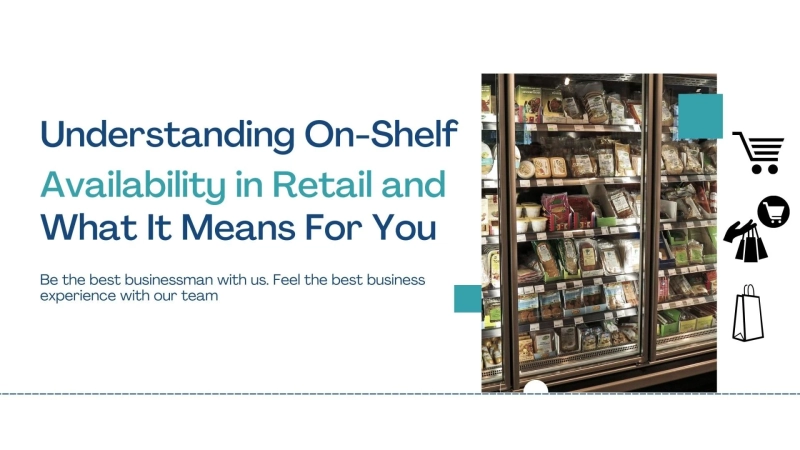
There are several phrases used in the CPG sector to describe problems with on-shelf availability. Unfortunately, inappropriate usage of some terminology can lead to misunderstandings. The ability of a product to be purchased by a customer at the time and location of their choosing is known as On-Shelf Availability (OSA). The supply chain as a whole, including voids, phantom inventory, and others, has an impact on it.
Many retailers still struggle to handle the fundamentals of store operations, sometimes as a result of a lack of data or their inability to interpret the data. Due to poor on-shelf availability (OSA) which arises from the lack of information, customers spend less since the items they want are out of stock.
Why on-self availability is such an important metric?
There is still no way to compare the experience of going to a supermarket in person, even in the digital age where individuals can now complete their entire grocery shopping online. That's also not going to alter in the near future.
However, customers are hampered by out-of-stock (OOS) items and are more inclined to spend less or perhaps start shopping elsewhere. When there is an OOS, a third of customers will purchase the item elsewhere, a quarter will purchase a different brand, and the remaining customers will either wait until a later time or choose not to make any purchases. Supplier, retailer, and customer all suffer losses in each scenario.
What are the challenges facing on-shelf availability?
For bettering the in-store experience, minimizing waste, and boosting your bottom line, monitoring and optimizing retail availability is crucial. Ignoring reliable on-shelf availability is not an option because it is one of the primary growth drivers in the CPG industry.
Despite this, a shortage of OSA continues to be a major issue for many retailers. The following are the main causes:
Slow replenishment
OOS issues can also occur further down the supply chain, although there are many instances when the issue is with the retailers themselves. For instance, even though there may be inventory at the warehouse, a staff member may not have yet observed that the store's shelves are empty. In other instances, OSA may suffer as a result of products being labeled or positioned wrongly.
Inaccurate forecasting
Every store sets purchases in advance based on their anticipated needs, yet frequently these orders are little more than educated guesses. In reality, improper demand forecasting is one of the primary causes of the massive volumes of perishable food that retailers discard each day. Conversely, underestimating demand leaves stores bare, much to the chagrin of customers. Retailers must therefore have a reliable forecasting system.
Improper management
Poor planning and communication between merchants and their suppliers are the main causes of many OOS situations. This is hardly surprising given the expanding complexity and worldwide distribution of supply chains. Reduced planogram compliance, the appearance of obsolete and discontinued products on shelves, and an inventory stock that is out of sync with demand are all effects of poor supply chain management. Automation has become crucial to supply chain management because of this.
How innovative technology offers greater control
Manual auditing, which is inevitably time-consuming and prone to expensive human mistakes, is the traditional method for managing and reducing OOS situations. Modern inventory management systems can be used to track sales, however, they frequently have inaccurate on-hand data. Insights from POS data can also help anticipate demand more precisely, but they might not be as effective for SKUs that sell more slowly than average.
Thankfully, cutting-edge technologies have developed recently that enable you to monitor the reality of your store shelves and contrast it with your planogram. By doing so, you can match the situation you actually wish to create with reality. For instance, picture recognition can offer current information about the condition of your store's stock. The analysis and conversion of this data into useful insights will enable you to precisely forecast demand and improve product positioning. Additionally, you'll always be informed of an OOS event before it occurs.
The Global On-Shelf Availability Solutions Market is anticipated to increase by 17.6 percent CAGR from USD 1.41 billion in 2021 to USD 3.18 billion by the end of 2028. Real-time data analysis demand is on the rise, and there are more eCommerce stores popping up all over the world, which is a good thing.
Image recognition works almost like an assistant for the field representative by immediately highlighting the missing SKUs on the shelf. The sales representative may correct the problem and improve retail execution because the OSA scores for that SKU are generated instantly.
Creating an effective OSA program
For their hero SKUs, brands should monitor eye-level OSA as a KPI. This can be a lever used to alter user behaviour and get them to try out new goods or upgrade to more expensive ones in order to raise ARPU. Additionally, new launches should be followed intensively to ensure product success under a different KPI called New Launch OSA.
Depending on the retailer, area, product category, the channel of distribution, and other factors, a list of must-have SKUs should be compiled separately. The list of essential SKUs for each channel can be readily communicated to field reps, retailers, and merchandisers using the right solutions. The OSA score can also be determined appropriately.
It's important to keep in mind that neither the list of necessary SKUs for OSA measurement is too long nor too short. The key is to keep the list aspirational yet as practically attainable as possible. A smart practise is to evaluate your OSA lists at least once every three months.
In order to stand out in a crowded market and expand their market share, CPG firms should leverage OSA, which is a crucial lever, in our perspective. Compared to other options like independent audits and self-reporting by field representatives, image recognition greatly increases the reliability of achieving high OSA.