



Bone injuries are among the most challenging conditions to treat, especially when patients need precise reconstruction or replacement of damaged bone structures. In recent years, 3D printing technology—also known as additive manufacturing—has redefined the possibilities of personalized bone repair. From chin implants to hip and knee replacement implants, this advanced technology allows medical professionals to “print” patient-specific solutions, offering stronger, safer, and more natural outcomes than ever before.
The Problem with Traditional Bone Implants
Conventional implants, whether for dental implant surgery or orthopedic reconstruction, often rely on standardized shapes and sizes. These generic parts rarely account for the unique anatomy of each patient, sometimes leading to imperfect fits, discomfort, or implant rejection.
Traditional manufacturing methods can also be slow and costly. Producing metal or ceramic parts through casting or milling requires considerable time and material, with limited opportunities for lightweight design optimization.
Enter 3D printing, which solves many of these challenges by bringing precision, customization, and speed into a process that directly impacts patient quality of life.
How 3D Printing Works in Bone Repair
3D printing in medicine begins with advanced imaging—using CT or MRI scans to capture a detailed digital model of a patient’s bone structure. This scan is converted into a 3D CAD (computer-aided design) model that guides the printer in building the implant layer by layer, either from metal powders such as titanium or from biocompatible polymers.
This personalized model ensures that even the most complex anatomical features are perfectly replicated. For example, in craniofacial reconstruction, surgeons can design chin implants that seamlessly match the patient’s facial symmetry. Similarly, orthopedic surgeons can create knee replacement implants that mimic the natural curvature and mechanical behavior of the patient’s original joint.
Precision Meets Personalization
What sets 3D printing apart is its ability to offer patient-specific implants (PSIs). Every bone, joint, and facial contour is shaped differently, and with additive manufacturing, no two implants need to be alike. Surgeons and engineers work collaboratively to plan each case digitally—enabling customized surgical tools, implant geometries, and surface textures that promote bone growth and faster healing.
For instance:
- Chin implants: 3D printing enables the creation of symmetrical and aesthetically matched chin shapes that blend naturally with facial contours, ideal for both reconstructive and cosmetic use.
- Dental implant surgery: Personalized titanium or ceramic implants can be fabricated to fit precisely inside the jawbone, reducing surgical error and improving recovery outcomes.
- Hip replacement implants: 3D-printed acetabular cups and stems replicate the exact curvature and structure of a patient’s hip, leading to more stable joint alignment and longer implant lifespan.
- Knee replacement implants: Custom-fit implants restore natural movement and balance, enhancing postoperative comfort and mobility.
- Trauma implants: In complex fractures—especially those caused by high-impact injuries—3D-printed plates, screws, and meshes can be shaped to the patient’s anatomy, ensuring stability and minimizing the need for future revisions.
Reducing Surgery Time and Risk
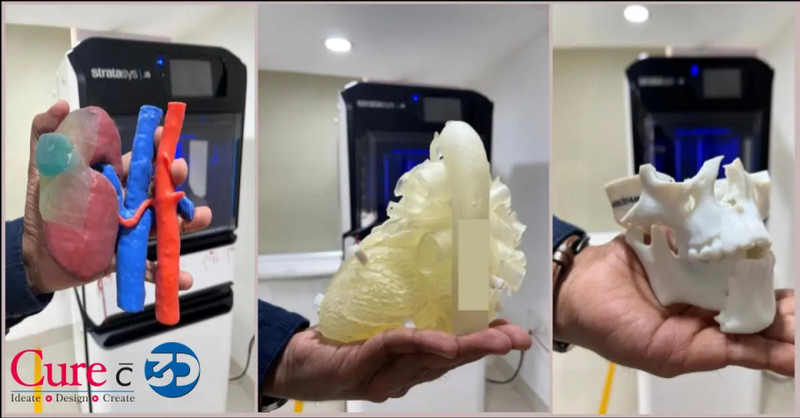
Beyond personalization, 3D printing plays a key role in surgical planning and simulation. Before a procedure, surgeons can print exact replicas of the affected bone, allowing them to visualize the operation, anticipate potential challenges, and practice complex maneuvers before entering the operating room.
This preparation results in:
- Reduced surgery time.
- Increased accuracy and predictability.
- Lower risk of infection or complications.
- Better patient outcomes and faster recovery.
For trauma cases where time is critical, 3D printing can rapidly produce custom trauma implants to stabilize fractures that might otherwise be too difficult to repair with conventional hardware.
Advancing Materials for Better Integration
Material science is another area where 3D printing shines. Titanium alloys are widely used due to their strength and biocompatibility, but new innovations in bioresorbable materials and ceramic composites are expanding possibilities even further. These materials mimic the porosity and stiffness of natural bone, encouraging cell growth and biological integration.
For example, 3D-printed knee and hip replacement implants now include lattice structures that allow bone tissue to grow through the implant, creating a stronger, more natural connection between bone and metal. This advancement reduces the risk of loosening or rejection—one of the biggest challenges in long-term orthopedic success.
The Future of Bone Regeneration
The most exciting frontier in 3D printing is bioprinting, where living cells are directly printed into tissue scaffolds that can regenerate bone. Early research shows promising results in printing stem-cell-infused scaffolds that gradually integrate into the body, replacing the need for synthetic implants altogether.
Imagine receiving a bone graft that not only replaces lost tissue but also grows, heals, and strengthens alongside your body. That future is not far away.
From Break to Build
3D printing is leading a complete transformation in bone repair—from how implants are designed and fabricated to how surgery is planned and performed. By merging imaging technology, biocompatible materials, and digital design, it replaces the one-size-fits-all model with precision, personalization, and patient comfort.
Whether it’s restoring a smile with advanced dental implant surgery, rebuilding confidence through chin implants, or restoring mobility with hip and knee replacement implants, additive manufacturing has proven that when it comes to healing, the best solutions are built—layer by layer—to match the individual.