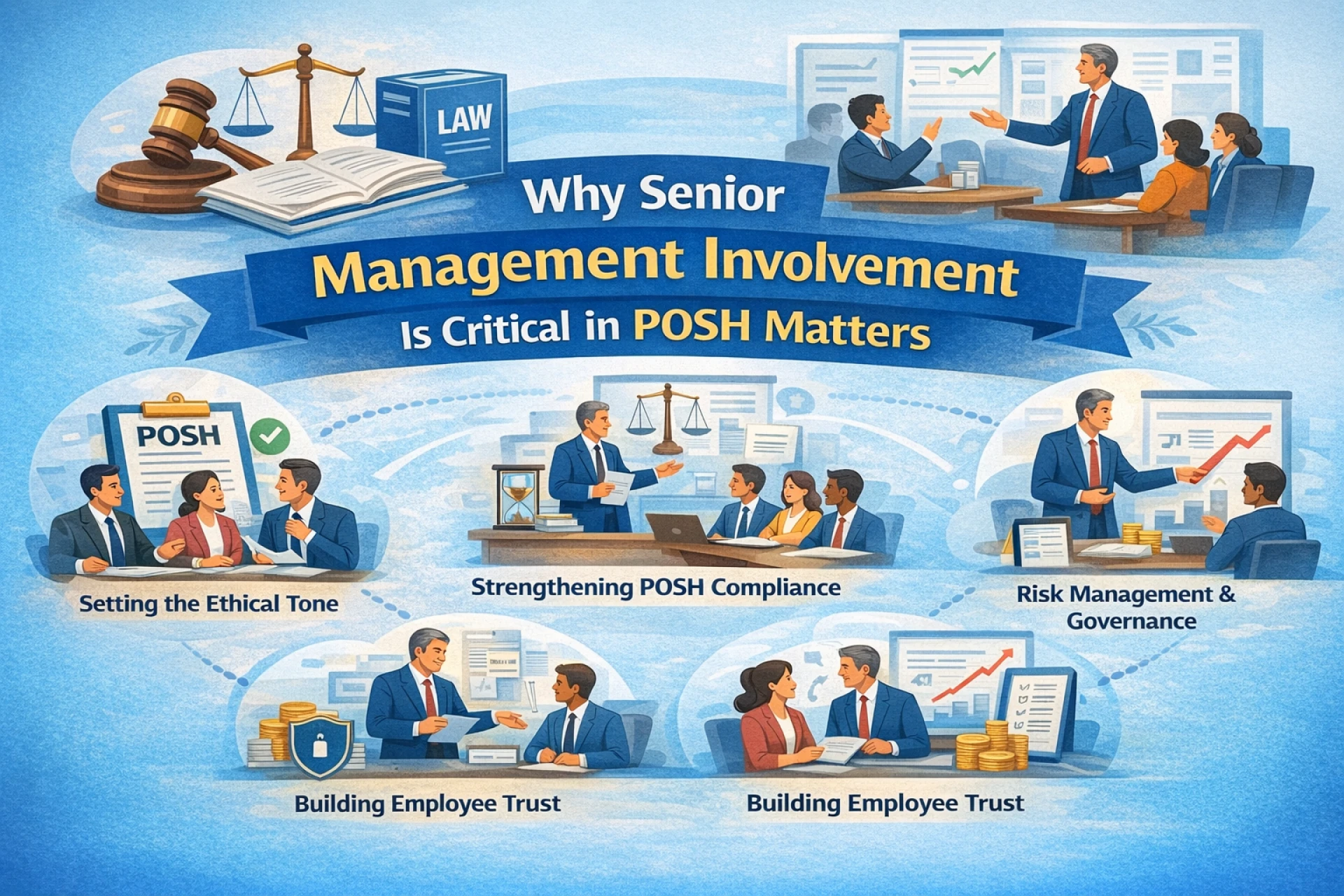

Workplace safety and dignity are no longer viewed as peripheral compliance issues. In India, prevention of sexual harassment at the workplace has become a central governance and leadership responsibility. While policies, committees, and procedures form the visible structure of POSH compliance, the real strength of any framework depends on active senior management involvement.
POSH matters often involve power dynamics, trust, and organisational culture. These elements cannot be addressed effectively through documentation alone. Senior leadership sets the tone, influences behaviour, and determines whether POSH remains a paper exercise or evolves into a credible protection mechanism.
This article examines why involvement of senior management is critical in POSH matters and how leadership engagement strengthens compliance, governance, and workplace integrity.
POSH Compliance Extends Beyond Human Resources
A common misconception is viewing POSH as an exclusive responsibility of the human resources team. While HR plays an operational role, POSH compliance is fundamentally a leadership obligation.
Senior management controls policy approval, resource allocation, and enforcement priorities. Without leadership ownership, Internal Committees often lack authority, independence, and confidence to function effectively.
When senior executives visibly support POSH initiatives, compliance gains organisational legitimacy. Employees recognise seriousness and intent. This reduces fear, encourages reporting, and improves procedural fairness.
Leadership Sets the Ethical Tone
Organisational culture flows from the top. Employees observe how leaders speak, act, and respond to sensitive issues. Silence or indifference from senior management often signals tolerance of misconduct.
In POSH matters, ethical leadership plays a decisive role. When senior management communicates zero tolerance for harassment, it creates behavioural boundaries across levels. Respect, accountability, and professionalism become non-negotiable standards.
Such clarity cannot be achieved through policy circulation alone. It requires consistent messaging and conducts from leadership.
Credibility of the Internal Committee
The effectiveness of the Internal Committee depends heavily on management backing. Committee members require freedom to conduct inquiries without fear of influence or retaliation.
Senior management involvement ensures:
- Independent functioning of the committee
- Adequate training and support
- Protection of committee members from pressure
- Implementation of recommendations without delay
When leadership undermines or ignores committee findings, the entire POSH framework collapses. Courts often scrutinise management conduct in such situations, leading to adverse legal consequences.
Risk Management and Legal Exposure
POSH matters present significant legal and reputational risks. Complaints handled poorly often escalate into litigation, media scrutiny, and regulatory action.
Senior management plays a vital role in risk mitigation. Timely review of compliance gaps, inquiry timelines, and corrective actions reduces exposure. Leadership involvement also ensures alignment with evolving judicial expectations.
In many cases, courts assess whether senior executives acted responsibly once complaints reached their notice. Proactive involvement often works in favour of the organisation.
Building Trust Among Employees
Employees report harassment only when they trust the system. Trust is built when leadership demonstrates seriousness, confidentiality, and fairness.
If senior management dismisses concerns or treats complaints as inconvenience, employees disengage. Underreporting increases, misconduct continues, and organisational liability grows silently.
Visible leadership involvement reassures employees that complaints will receive impartial attention. This strengthens internal grievance redressal and prevents external escalation.
Preventing Abuse of Power Dynamics
Sexual harassment often involves imbalance of authority. Senior management involvement becomes essential when allegations concern supervisors or senior personnel.
Without leadership intervention, Internal Committees may face subtle resistance or non cooperation. Senior executives ensure compliance with inquiry processes regardless of hierarchy.
This reinforces the principle of equality before organisational rules. It also protects the organisation from allegations of bias or cover up.
Training and Capacity Building
POSH training is effective only when leadership participates and endorses it. When senior executives attend sessions, the message carries weight across teams.
Leadership involvement ensures training budgets, expert facilitation, and periodic refreshers. It also encourages managers to internalise responsibilities rather than delegating them entirely.
Many organisations engage POSH Training in Delhi as part of leadership development programmes. Such initiatives integrate compliance with managerial accountability and ethical conduct.
Accountability and Disciplinary Action
POSH compliance loses credibility when inquiry findings are ignored or diluted. Senior management holds authority to enforce disciplinary measures and corrective actions.
Timely implementation of committee recommendations demonstrates organisational integrity. It also deters future misconduct.
Leadership hesitation or selective enforcement often results in judicial criticism and compensation orders. Courts expect employers to act decisively once misconduct is established.
Alignment with Corporate Governance Standards
POSH compliance is closely linked with corporate governance. Boards and senior executives hold fiduciary duties to ensure safe working environments.
Investors and regulators increasingly view workplace harassment as a governance failure. Leadership involvement in POSH matters reflects risk awareness and ethical oversight.
Organisations with strong governance frameworks often integrate POSH updates into management reviews and board discussions.
Handling Reputational Sensitivity
POSH matters are sensitive and often attract public attention. Senior management involvement is critical in managing communication, confidentiality, and stakeholder confidence.
Careless handling of complaints can damage brand reputation permanently. Leadership oversight ensures balanced response without victim blaming or premature conclusions.
Crisis situations require calm, informed, and principled decision making. Senior executives are best positioned to provide this direction.
Role of External Expertise
Even committed leadership benefits from expert guidance. POSH compliance involves legal nuances, procedural safeguards, and evolving best practices.
Many organisations work with POSH Consultants in Delhi NCR, India to support senior management in policy review, inquiry oversight, and governance alignment. External expertise strengthens objectivity and reduces conflict of interest risks.
Leadership engagement with consultants also signals seriousness to employees and regulators alike.
Long Term Cultural Impact
Senior management involvement shapes long term workplace culture. It influences how future leaders perceive responsibility, respect, and accountability.
A leadership driven POSH framework creates a culture where misconduct is addressed early. Over time, this reduces complaints, improves engagement, and enhances organisational stability.
Culture built on trust and dignity supports sustainable growth and talent retention.
Consequences of Leadership Absence
When senior management disengages from POSH matters, consequences are severe. These include ineffective inquiries, regulatory penalties, judicial intervention, and loss of employee confidence.
Leadership absence often results in reactive compliance rather than preventive governance. Such environments remain vulnerable to repeated violations.
Conclusion
Senior management involvement is the cornerstone of effective POSH compliance. Policies, committees, and training succeed only when leadership takes ownership.
Active engagement strengthens ethical culture, protects legal interests, and builds employee trust. It also aligns organisations with modern governance expectations.
POSH matters demand sensitivity, accountability, and decisiveness. These qualities emerge only when senior leadership leads from the front. In today’s regulatory and social environment, leadership involvement in POSH is not optional. It is essential for credibility, compliance, and continuity.
































Sign in to leave a comment.