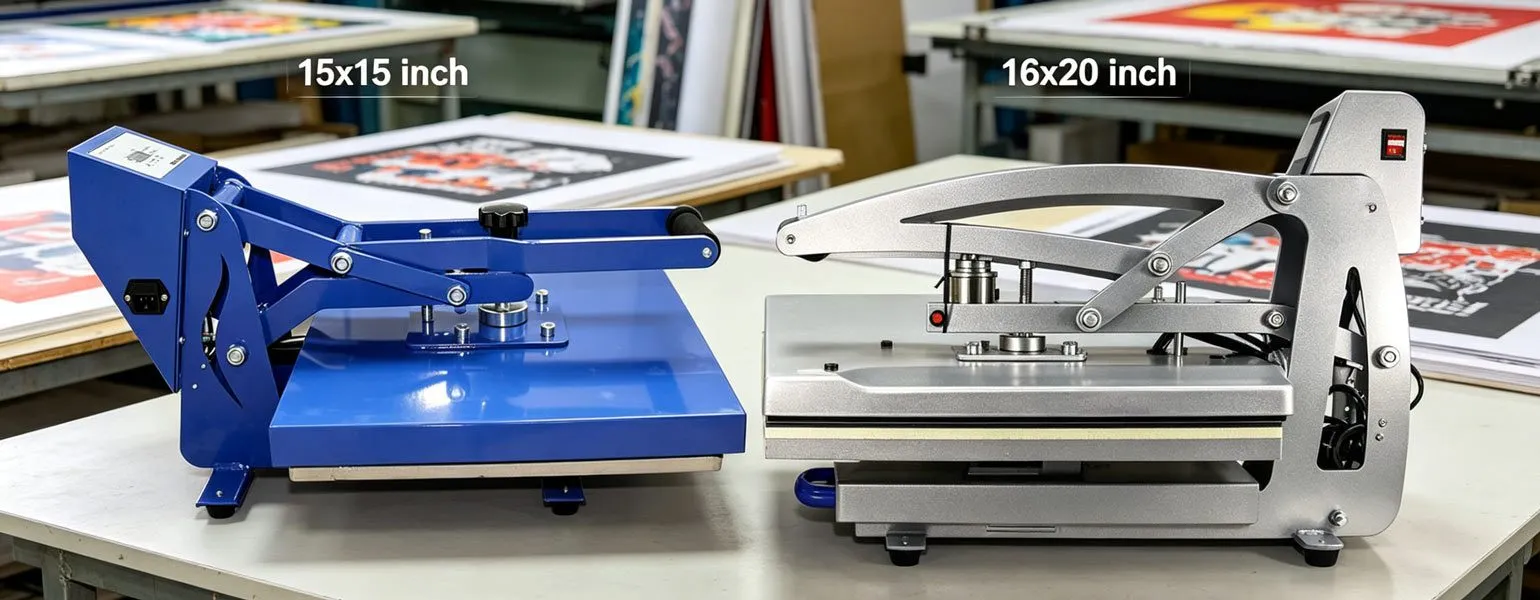

If you’re getting into sublimation or heat transfer printing, the heat press machine you choose will quietly shape how your entire workflow develops.
Most people focus on price, brand, or basic specs. But in reality, one of the most overlooked decisions is also one of the most important:
the platen size.
At first glance, 15x15 inch and 16x20 inch heat presses don’t look far apart. It feels like a minor upgrade. Just a few extra inches.
But once you start working with real orders, you quickly realise something most beginners miss completely.
Those few inches are not “small differences.”
They define how you print, what you can offer, and how fast you can grow.
The Hidden Role of Heat Press Size in Your Workflow
A heat press is often seen as a simple tool. Heat, pressure, time—done.
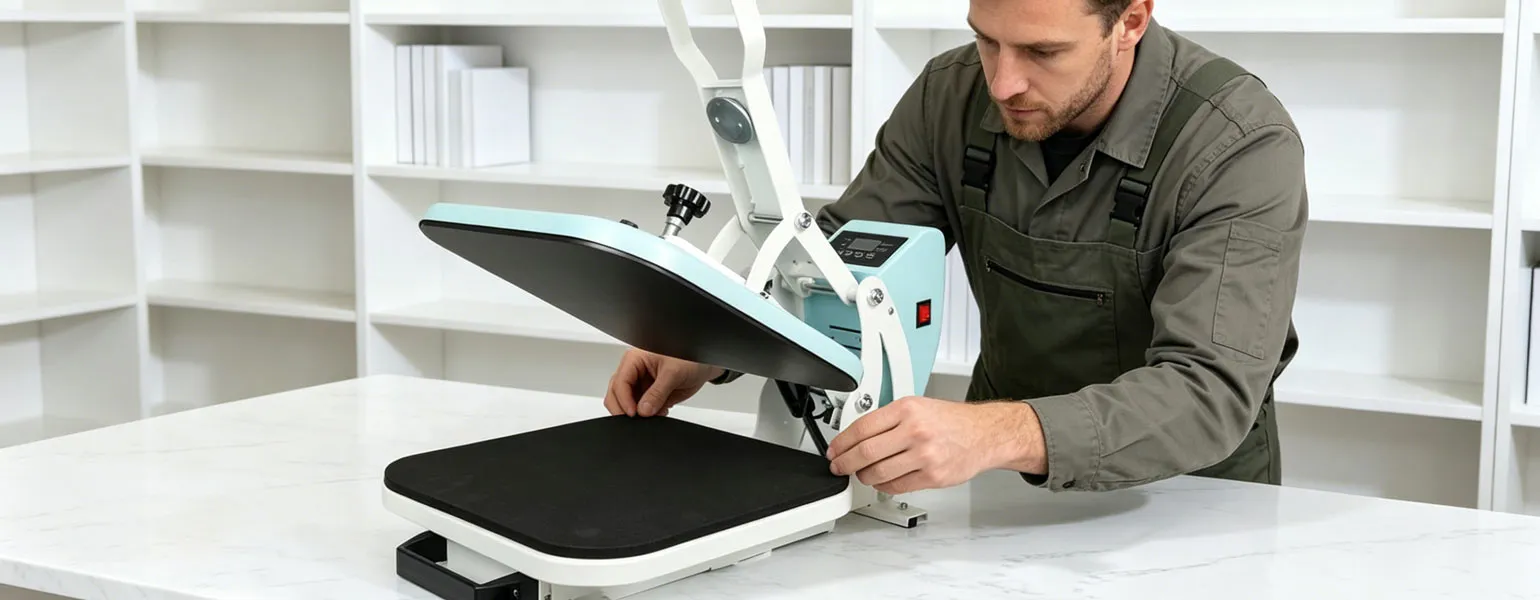
But in real production, it behaves more like a workflow system rather than just a machine.
Size is not just physical space
When people talk about machine size, they usually think about:
- What fits on the platen
- Maximum design size
- Work table space
But experienced users think differently.
They think about:
- How often you need to reposition garments
- How forgiving the setup is when alignment is slightly off
- How smooth your production rhythm feels across repeated jobs
This is where the 15x15 vs 16x20 decision becomes much more important than it appears.
Why the Industry Stays Focused on 15x15 and 16x20
If you browse heat press machines from most suppliers, you’ll notice something interesting.
The majority of flat presses cluster around just two sizes:
- 15x15 inch
- 16x20 inch
This is not random.
Two sizes, two production mindsets
These two formats represent two different stages of printing work.
15x15 inch – controlled and efficient production
This size is widely used because it balances:
- Low cost
- Compact workspace needs
- Reliable performance for standard items
It fits perfectly into small business setups or home studios.
But more importantly, it creates structure.
You naturally work within limits, which forces consistency.
16x20 inch – expanded production flexibility
The larger size is not just “bigger.”
It changes how you think about layout and production.
You gain:
- More freedom in positioning designs
- Less need for realignment
- Better handling of large-format prints
It feels less restrictive, especially when handling varied order types.
Real Working Difference Between 15x15 and 16x20
On paper, the difference looks small. In reality, it is not.
Surface area changes more than you expect
15x15 gives you 225 square inches.
16x20 gives you 320 square inches.
That is more than a 40 percent increase in usable working space.
And this is where the real shift happens.
Because in printing, space is not just space.
It directly affects:
- Layout freedom
- Workflow speed
- Error rate during positioning
What You Can Actually Print in Daily Use
Let’s move away from theory and talk about real usage.
15x15 inch heat press in real production
This size is commonly used for:
- Standard T-shirts
- Tote bags
- Cushion covers
- Mouse pads
- Baby clothing
- Small fabric accessories
It performs very well when your work is focused and predictable.
Where limitations start to appear
As soon as your designs grow larger, you begin to feel friction:
- Full front prints require repositioning
- Larger hoodie designs become harder to align
- Oversized graphics may need multiple presses
The machine still works. The process just becomes slower.
16x20 inch heat press in real production
This is where things open up.
You can comfortably handle:
- Large streetwear-style T-shirts
- Full hoodie front and back prints
- Larger tote bags and textiles
- MDF boards and signage
- Bigger sublimation panels
The biggest advantage is not size, but ease
Most people assume the benefit is “printing bigger designs.”
In reality, the bigger gain is:
- Easier alignment
- Fewer repositioning steps
- More stable workflow during batch production
It reduces friction in every press cycle.
Workflow Experience Most Beginners Don’t Anticipate
The difference becomes more obvious when you repeat tasks.
With 15x15, precision becomes critical
You often need to:
- Adjust placement carefully
- Recheck alignment before pressing
- Work within tighter margins
This builds discipline, but also slows down production.
With 16x20, the process feels more forgiving
You get:
- More room for error
- Easier garment positioning
- Smoother workflow during batch printing
It doesn’t make you better. It simply makes the process less restrictive.
Power, Space, and Real Operating Conditions
Size also affects the environment around your workspace.
Electricity and heat output
Smaller machines typically:
- Heat up faster
- Consume less power
- Produce less ambient heat
Larger machines:
- Require more energy
- Take longer to stabilise temperature
- Generate more heat in the workspace
Workspace requirements
A 15x15 setup fits comfortably into compact environments.
A 16x20 setup needs:
- More clearance space
- Better ventilation
- A more stable working surface
These are not disadvantages, but practical considerations.
The Mistake Most Beginners Make When Choosing Size
There is a very common belief in the industry:
“Buy bigger so you don’t need to upgrade later.”
It sounds logical, but it often backfires.
Bigger is not always better for beginners
If you are still learning, a larger machine can:
- Increase setup complexity
- Slow down your learning curve
- Take up space without being fully used
The smarter approach is matching your current workflow
A better question to ask is:
What will I realistically produce in the next 3 to 6 months?
Not what you might do someday.
A Simple Way to Decide Without Overthinking
Instead of focusing on specs, focus on output.
Choose 15x15 if
- You are starting out
- Your work is mainly T-shirts and small items
- You want lower cost and faster setup
- You value simplicity and efficiency
Choose 16x20 if
- You plan to work with hoodies or large prints
- You already have consistent orders
- You want fewer limitations in design size
- You are preparing to scale production
Why This Decision Matters More Than It Seems
A heat press is not just a purchase. It shapes your daily workflow.
The size you choose affects:
- How fast you work
- How flexible your products are
- How smooth your production feels
- How quickly you can scale
And most importantly, it influences how enjoyable the process is.
Because in real production, friction is what slows everything down.
Not lack of creativity. Not lack of demand. But small inefficiencies repeated hundreds of times.
A More Practical Way to Think About Heat Press Size
Instead of asking:
“Which size is better?”
A more useful question is:
“What kind of working experience do I want every day?”
Compact control with structure, or open flexibility with room to grow.
Once you see it that way, the decision becomes much clearer.

























Sign in to leave a comment.