
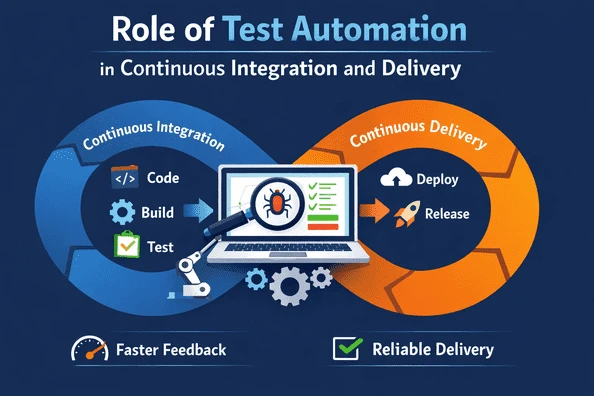
Continuous integration (CI) comes first in a pipeline created by automated software testing for continuous delivery, and continuous delivery (CD) comes next. A developer may then submit code into the pipeline, and the pipeline will handle the remainder, after which it is connected to the standard SDLC flow. To produce tests quickly, testers must script such automated test cases.
Here are a few recommended practices that the best qa testing companies implement to efficiently use the pipeline and the software.
Selecting A Suitable Tool
First, before starting to create test cases, always choose the best tool for your requirements. The production of the team may be greatly increased by an automation solution that can precisely and effectively combine CI and CD.
Transport the whole thing into the cloud
In recent years, cloud technology has improved and optimized significantly. It has important advantages, especially in a setting where more people work together and collaborate. You can work on any system and from any location if your arrangement is in the cloud. However, selecting a useful tool is crucial in this instance.
We need to make sure that the cloud tool supports all of these technologies when we need to move automated software testing for continuous delivery into the cloud. Support for automation programming languages, automation frameworks, and CI/CD tools are examples of these. Using cloud testing platforms can help you move all of your on-premise infrastructure to the cloud.
Digital experience testing platform lets developers and quality assurance engineers manually and automatically test web and mobile applications. It supports automated frameworks and tools like Selenium, Cypress, Playwright, Appium, and others for testing. You can test web and mobile app testing in real-world conditions with the real device cloud.
Apply Continuous Monitoring
A lot of the code is pushed automatically when continuous delivery is implemented and automated. This is good, but only if the code is all good and tested properly. Software development, on the other hand, cannot be guaranteed, and errors can occur at any stage. This is a very popular practice of the best QA testing companies.
As a result, we set up several checkpoints to keep things under control. Monitoring is a must and should always be done if automated testing is being done for continuous delivery. If the cloud-based tool supports automation, this can also be done automatically.
Inform Your Team about Each and Everything
Lastly, inform the team of anything that goes through the CI/CD. Even if everything is "green," it should be added up with the team to show them how well the pipeline is working. The team can quickly debug any issues, so the same holds for failure.
When testing software, we frequently hear the terms "automated testing" and "continuous delivery," as these terms have become an essential component of the system as a whole. Automated testing is utilized through practically all areas, while nonstop conveyance guarantees programming deliveries can be faster and smoother than previously. When we combine these two approaches, we get a sturdy system in which software delivery is automated and all we have to do is push the code into the pipeline.
The most efficient method to do this is to use the testers' experience with the best practices. In the end, don't forget to integrate your system with a cloud-based solution that allows automation and continuous delivery if you want it to be reliable and use the advantages of the cloud from any system.





















Sign in to leave a comment.