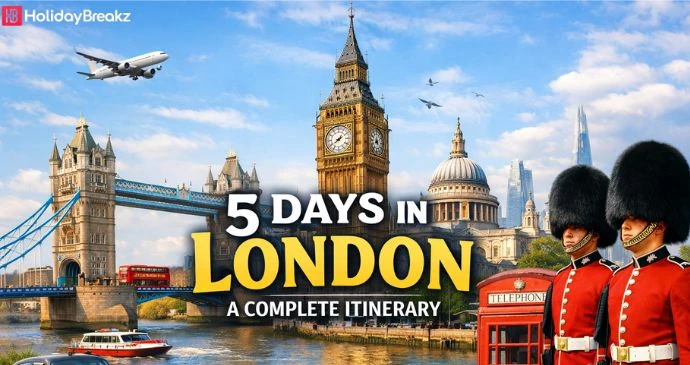

London is one of those rare cities that rewards every kind of traveller. History lovers can spend days inside the British Museum alone. Food enthusiasts can eat their way through cuisines from every corner of the globe without ever repeating a dish. Shoppers, theatre-goers, architecture fans, park strollers — London has a version of itself tailored for all of you, often within the same postcode.
Five days is a genuinely sweet spot. It is long enough to escape the tourist treadmill and start feeling like a temporary local. It is long enough to have slow mornings, spontaneous detours, and evenings that stretch pleasantly into the night. This itinerary covers the essential experiences, the under-the-radar gems, and the practical planning details you actually need — including the best way to get around, where to sleep, what to eat, and how to make the most of every single day without burning out.
Quick note on this guide: This itinerary is structured as a day-by-day plan but is not rigid. London is enormous, and the best trips involve a little improvisation. Use this as your backbone and let the city fill in the gaps.
Before You GoPlanning, Packing & Getting There
Good travel begins before you board the plane. A few hours of preparation can save you significant time, money, and stress once you land.
Best Time to Visit London
London is a year-round destination, but the timing of your visit genuinely matters for comfort and experience.
- Spring (March–May) — Arguably the finest time. The city blooms, the days lengthen, and crowds have not yet peaked. Temperatures hover between 10°C and 18°C, perfect for walking.
- Summer (June–August) — Long golden evenings, outdoor concerts, and vibrant street life. Also the busiest and most expensive period. Book well ahead.
- Autumn (September–November) — Quietly wonderful. Smaller crowds, beautiful foliage in Hyde Park and Hampstead Heath, and some of the best cultural programming of the year.
- Winter (December–February) — Christmas markets, festive lights, and a romantic atmosphere in December. January and February offer the cheapest prices if you can tolerate grey skies.
Getting Around London
London's public transport network is one of the world's best. For five days, here is exactly what you need to know.
- Get an Oyster card or simply use a contactless bank card to tap in and out of the Underground (the Tube), buses, and Overground trains. No need to buy paper tickets.
- The daily price cap means you will never pay more than a set maximum, regardless of how many journeys you make — excellent value on busy sightseeing days.
- Walking between nearby attractions is almost always faster and far more rewarding than taking the Tube one stop.
- Black cabs are safe and reliable but expensive. Rideshare apps are a cheaper alternative for late nights.
- Boris Bikes (Santander Cycles) are available at docking stations across the city and are brilliant for flat, central routes along the Thames or through parks.
Where to Stay
- Central London (Westminster, South Bank, Covent Garden) — Best for first-timers. Walking distance from major landmarks.
- East London (Shoreditch, Bethnal Green) — Trendier and often cheaper. Great nightlife and food scene, well connected by Overground.
- South London (Brixton, Bermondsey) — Increasingly popular, excellent restaurant and bar scenes, slightly less touristy.
- West London (Notting Hill, Kensington) — Upscale and elegant. Close to Hyde Park and excellent for families.
1DAY
Iconic LondonWestminster, Big Ben & the South Bank
Your first day is all about orientation and awe. Start with the landmarks that define London in the world's imagination, then let the South Bank carry you into the evening.
Morning: Westminster & the Houses of Parliament
Begin at Westminster Bridge just before 9am. The morning light on the Thames here is genuinely spectacular, and the crowds are thinner than they will be by mid-morning. From the bridge, the view takes in Big Ben (officially the Elizabeth Tower), the Houses of Parliament, and across the river, the beginnings of the South Bank.
- Walk through Westminster Abbey — one of the most historically layered buildings on earth. Book tickets in advance to skip the queue. Allow 90 minutes minimum.
- Stroll through St James's Park, London's oldest Royal Park, toward Buckingham Palace. The park itself — the pelicans, the lake, the views back toward Whitehall — is as memorable as the Palace.
- If the timing works, catch the Changing of the Guard at Buckingham Palace, which typically takes place at 11am on select days.
Afternoon: Trafalgar Square & the National Gallery
Head northeast toward Trafalgar Square. Have lunch at one of the cafés in the area — the National Portrait Gallery's café is a particularly good option — then spend the early afternoon inside the National Gallery. Entry is free. Even if you spend only 90 minutes here, seeing Van Gogh's Sunflowers, Turner's rain-drenched seascapes, and Velázquez's Rokeby Venus in person is genuinely moving.
Evening: The South Bank
Cross the Thames via Hungerford Bridge on foot. The walk itself — looking toward St Paul's Cathedral and the City skyline — is magnificent at dusk. Spend your evening strolling the South Bank.
- Visit the Tate Modern (free entry to the permanent collection) inside the transformed Bankside Power Station.
- Walk across the Millennium Bridge to St Paul's Cathedral and back for the views.
- Have dinner at Borough Market, which has extended evening hours on select days, or along the restaurant strip near Waterloo.
- Consider a show at the National Theatre or the BFI Southbank — both are excellent and tickets can be surprisingly affordable.
2DAY
History & CultureThe British Museum, Bloomsbury & Covent Garden
Day two dives deep into London's extraordinary cultural heritage, centred around one of the greatest museums in the world and one of the city's most beloved neighbourhoods.
Morning: The British Museum
The British Museum in Bloomsbury deserves an entire day of its own, but three focused hours will let you experience the highlights without museum fatigue setting in. Entry is free.
- Start in the Great Court, the magnificent glass-roofed atrium designed by Norman Foster — one of London's most beautiful interior spaces.
- The Rosetta Stone, the Elgin Marbles (Room 18), the Egyptian mummies, and the Sutton Hoo helmet are the unmissable highlights.
- If ancient history is your passion, allocate additional time — the collections here are genuinely world-class and inexhaustible.
- Book a free guided tour from the information desk to get proper context for what you are seeing.
Afternoon: Bloomsbury, Covent Garden & Seven Dials
After the museum, explore the neighbourhood of Bloomsbury on foot. This is the London of Virginia Woolf, Charles Dickens, and academic London — bookshops, garden squares, Georgian terraces.
- Persephone Books on Lamb's Conduit Street is one of London's most charming independent bookshops.
- Walk south toward Covent Garden, the historic market district now packed with street performers, restaurants, boutiques, and the excellent London Transport Museum.
- Explore Seven Dials, a pedestrianised intersection of seven streets with independent shops and cafés tucked in every direction.
- For afternoon tea, Covent Garden has several lovely options at various price points — the tradition is well worth experiencing at least once.
Evening: Soho & Chinatown
Head south into Soho, one of London's most electric neighbourhoods after dark. Dinner in Chinatown is excellent value and genuinely delicious — the duck at Four Seasons on Gerrard Street is legendary.
- After dinner, catch live jazz at Ronnie Scott's in Soho — one of the world's great jazz clubs and a London institution since 1959.
- Or opt for a West End show. The Soho Theatre and nearby venues regularly stage remarkable productions alongside the mainstream blockbusters.
3DAY
Markets & East LondonBorough Market, Shoreditch & Brick Lane
Day three shifts the lens from classical London to its contemporary, creative, and multicultural identity. East London is where the city reinvents itself, and this part of your itinerary captures that energy perfectly.
Morning: Borough Market
Borough Market, just south of London Bridge, is one of the finest food markets in Europe. Open from early morning on Thursdays, Fridays, and Saturdays, it is the perfect place for a slow, indulgent breakfast and a glimpse of London at its most flavourful.
- Try a salt beef bagel from the Monmouth Coffee stall queue stretches but moves quickly — their flat whites are some of the city's best.
- Graze on Spanish charcuterie, fresh oysters, artisan cheeses, and sourdough bread from vendors who genuinely know their craft.
- The Brindisa chorizo roll — a grilled chorizo sausage with piquillo peppers and rocket in a crusty roll — is a Borough Market rite of passage.
- Walk across London Bridge for an excellent view of Tower Bridge downstream.
Midday: Tower of London & Tower Bridge
From Borough Market, it is a pleasant 15-minute walk east along the river to the Tower of London. Book tickets in advance — it is one of London's most popular paid attractions for very good reason.
- See the Crown Jewels, the Beefeaters (Yeoman Warders) who conduct free guided tours, and the medieval White Tower.
- Walk across Tower Bridge and pay for the glass walkway experience if heights do not bother you — the views over the Thames are extraordinary.
Afternoon & Evening: Shoreditch & Brick Lane
Head north by Tube or Overground to Shoreditch, the epicentre of London's creative and tech scene.
- The streets around Shoreditch High Street are an open-air gallery of world-class street art — Banksy, Stik, and dozens of international artists have left their mark here.
- Walk along Brick Lane, the legendary street famous for its Bangladeshi curry houses, vintage markets, and bagels from the 24-hour bakeries that have been here for over a century.
- Boxpark Shoreditch — a pop-up mall built from shipping containers — is an excellent place for a casual lunch or early dinner with a great atmosphere.
- In the evening, the bars and restaurants of Shoreditch and Dalston provide some of the best nightlife in London. The area hums with energy from Thursday through Saturday.
4DAY
Royal Parks & West LondonHyde Park, Notting Hill & Kensington
Day four takes you west to explore London's most elegant neighbourhoods, its greatest park, and one of the city's most photographed streets.
Morning: Hyde Park & Kensington Gardens
Hyde Park and its adjoining Kensington Gardens together form one of the great urban green spaces in the world — 625 acres of lakes, meadows, formal gardens, and ancient trees.
- Take a morning stroll or hire a bicycle and cycle around the Serpentine lake. The light here on a clear morning is magical.
- Visit the Serpentine Galleries — two contemporary art spaces within the park, both free, often showing world-class exhibitions.
- See the ornate Albert Memorial opposite the Royal Albert Hall.
- If you are visiting with children, the Diana Memorial Playground in Kensington Gardens, themed around Peter Pan, is genuinely wonderful.
Afternoon: Notting Hill & Portobello Road
Head north through Kensington into Notting Hill, one of London's most picturesque and affluent neighbourhoods. The pastel-coloured townhouses, private garden squares, and independent shops make it deeply pleasant to wander.
- Portobello Road Market runs every day but is at its biggest and best on Saturdays. Antiques, vintage clothing, fresh produce, street food — it stretches for over a mile.
- The famous blue door from the film Notting Hill (142 Portobello Road) attracts its own quiet pilgrimage of film fans.
- Have lunch at one of the many independent cafés and restaurants along Portobello Road.
- Browse the independent bookshops — Books for Cooks and The Travel Bookshop are both nearby and outstanding.
Evening: South Kensington's Museum Mile
Return south to South Kensington, home to London's extraordinary concentration of world-class free museums along Exhibition Road.
- The Victoria & Albert Museum (the V&A) is the finest decorative arts museum on earth. It stays open until 9:30pm on Fridays — a gift for evening visitors who want to explore without the daytime crowds.
- The Natural History Museum next door closes at 5:50pm but its Romanesque terracotta facade is spectacular even from outside after dark.
- Dinner in South Kensington's French-inflected restaurant scene is a pleasure — this pocket of London has been home to a large French community for generations, and the bistros reflect it beautifully.
5DAY
Greenwich, Views & FarewellThe Observatory, Canary Wharf & Last Impressions
Your final day takes you out of the tourist centre and into one of London's most historically significant and scenically rewarding areas: Greenwich.
Morning: Greenwich by River
The most romantic way to reach Greenwich is by river. Take a Thames Clipper from Embankment or London Bridge — the journey downstream past the City, through Docklands, and under the shade of Canary Wharf's towers is a miniature history of London told entirely through architecture.
- Disembark at Greenwich Pier and walk up through Greenwich Park to the Royal Observatory. The views from the top of the hill over the Cutty Sark, the Thames, and the London skyline are among the finest in the city — and they are free.
- Stand on the Prime Meridian Line, the point from which all time zones on earth are measured. It is a surprisingly moving experience.
- Visit the Cutty Sark, the world's only surviving tea clipper, and the National Maritime Museum (free), which tells the story of Britain's seafaring history with remarkable artefacts.
Afternoon: Canary Wharf & Crossrail Place
From Greenwich, hop on the DLR to Canary Wharf, London's second financial district. For a city that wears its history on its sleeve, the contrast here is deliberately jarring — and fascinating.
- Crossrail Place Roof Garden, above the Elizabeth line station, is a hidden gem — a free tropical garden contained within a stunning wooden lattice structure. Unexpected and beautiful.
- The Museum of London Docklands (free) occupies a Georgian warehouse and tells the story of the Port of London from Roman times to the present day.
Evening: Final Dinner & London at Night
For your last evening, choose a restaurant that feels like a proper celebration. London's dining scene in 2025 is arguably the best it has ever been — and the city's affordable holiday packages make it easier than ever to plan a return visit once you realise five days was never going to be enough.
Essential Practical Tips for 5 Days in London
- Museum strategy: London's national museums — the British Museum, National Gallery, Natural History Museum, V&A, Tate Modern, and more — are all free to enter. Plan around this; it is genuinely extraordinary and makes London one of the best value cultural destinations on earth.
- Book in advance: Westminster Abbey, the Tower of London, and the Crown Jewels experience sell out days in advance, especially in summer. Book online before you leave home.
- Oyster card vs contactless: A contactless bank card works exactly like an Oyster card on all TfL transport, applies the daily price cap, and saves you the hassle of topping up.
- Walk whenever you can: Many of London's most memorable experiences happen between the places on the map. The South Bank alone is worth an hour of purposeless wandering.
- Pub culture is part of the experience: A traditional British pub is not just a drinking venue — it is a social institution. The Churchill Arms in Kensington and The Grapes in Limehouse are among the best.
- Free entertainment is everywhere: The South Bank has street performers year-round. Trafalgar Square hosts free concerts and events. Speakers' Corner in Hyde Park on Sundays is a uniquely British spectacle.
- Avoid the Tube at rush hour: Weekday mornings between 8am–9:30am and evenings between 5pm–7pm are genuinely miserable on the Central and Jubilee lines. Slightly adjust your timing and save yourself considerable stress.
- Sunday Roast: If your trip includes a Sunday, prioritise finding a great pub or restaurant offering a traditional Sunday Roast. It is one of the great British culinary experiences.
- Weather: London's weather is famously unreliable. Carry a compact umbrella at all times and dress in layers. Summers can surprise you with genuine warmth, and winters can produce a handful of clear, beautiful days.
- Tipping: 10–12.5% is standard in restaurants where table service is provided. Many venues add a service charge automatically — check your bill before adding more.
London on a Budget
Despite its reputation as an expensive city, London can be experienced affordably if you are strategic. The free museums alone could fill an entire week. Markets like Borough, Maltby Street, and Brixton offer extraordinary food at very reasonable prices. The parks, the river walks, the street art, the live music in pubs — so much of what makes London special costs nothing at all.
- Lunch at a market or street food stall will typically cost £6–£12 for an excellent, satisfying meal.
- Many West End shows offer day-of-performance cheap tickets at the box office, or via the official TKTS booth in Leicester Square.
- The Elizabeth line (Crossrail) is now fully open and dramatically reduces journey times between Heathrow, central London, and East London — use it.
- Free walking tours depart from various central locations daily — tip-based and consistently excellent.
Getting the Most from HolidayBreakz
Planning a trip to London can feel overwhelming given how much the city offers. HolidayBreakz specialises in helping travellers put together well-structured, value-driven packages that take the stress out of booking flights, hotels, and transfers — so that by the time you arrive, all you have to do is enjoy it. Whether you are planning a first family trip, a romantic city break, or a solo adventure, their London packages are thoughtfully curated with real travellers in mind.
FINALE
Five Days Well SpentAnd Why You Will Want to Come Back
Five days in London will not exhaust the city — it will barely scratch its surface. And that, honestly, is part of the joy. You will leave having seen remarkable things, having eaten brilliantly, having walked along one of the world's great rivers and stood in places where history was made. You will also leave with a long, handwritten list of things you did not get to.
The neighbourhood you spotted from the Tube window and never got off to explore. The restaurant someone recommended the night before you flew home. The small gallery, the hidden garden, the tucked-away pub with the remarkable beer garden. London saves these things for next time — and there is always a next time.
This itinerary is a foundation, not a ceiling. Follow it faithfully on your first trip and it will serve you well. On your second, tear it up entirely and let the city surprise you. That, more than any single landmark or restaurant, is what makes London one of the most endlessly rewarding cities on earth.





















Sign in to leave a comment.