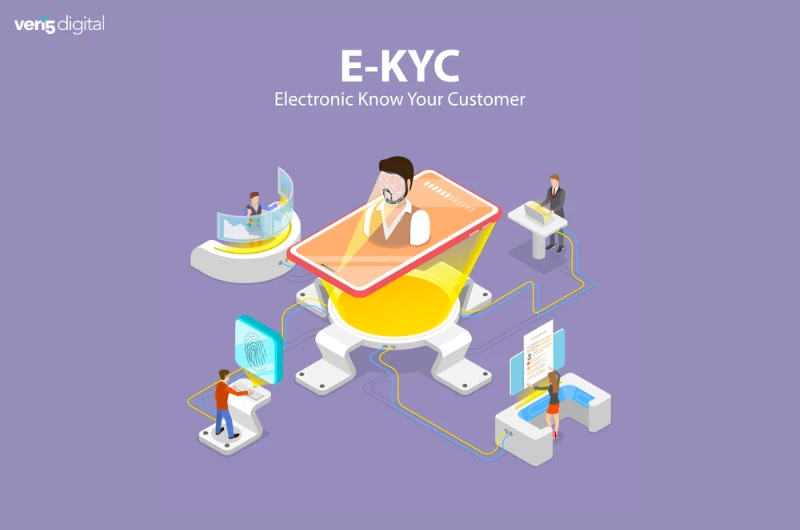

Living in the 21st century, in the digital age, things are not the same in the slightest as they were. The same is true for KYC, which used to be a physical process a few years ago but can now be done with a few clicks and tabs anywhere, anytime.
Digital KYC & eKYC have already simplified and unified the process of KYC authentication, from managing many identity proofs and signatures to uniting them through one single verification and biometric. The question that arises now is what impact this will have on the KYC process. Will it get more advanced?
With fast-paced technological advances, everything in the work sector is changing. While this is true for all, the fact that threats are increasing at the same pace cannot be ignored. The issues of privacy, data security, and identity theft are getting more complex, and malicious hackers are finding new ways to extract benefits.
Hence, safeguarding the whole process is mandatory. In this blog, future predictions for digital KYC & eKYC will be discussed, along with how this will impact all the different businesses, especially the banking sector.
Five Predictions on the Future of eKYC and Digital KYC
Talking about the future has never been more certain than now, when the future can practically be seen and predicted. Here are five major principles that might take place in the process of digital KYC sooner or later.
Integration of automation through AI: Artificial intelligence is the new future, which can be seen clearly with the increasing dependency on its tools. The same technology will be incorporated into the eKYC portal, which will then use some standard criteria to further the process. These criteria can be:
Font sizeLetter SpacingIdentification of photoshopped imagesMorphed identification numbers and QRsFinding expiration datesBlockchain for data storage: Blockchain will provide secure storage space for all eKYC online with developments in this technology. Blockchain's distributed ledger architecture offers enhanced security, immutability, and transparency, making it an ideal solution for storing sensitive customer information. This data, thus stored on the blockchain, will only be accessible with the consent of the customer.
Advancement through machine learning and IOT: IOT, or the internet of Things, is a system of connected devices and software that helps with the exchange of data. While this is in the initial stage of development, the integration of IOT and machine learning will not only make the KYC process easier but also a lot more risk-free.
Prediction and elimination of AML issues: some people or businesses shoulder more risk than others. For these entities, one-time KYC will not be enough; rather, their profiles should be regularly checked and updated. The number of people who are at risk of AML issues will be reduced by automatic predictions through:
Transaction histories and the amounts getting exchangedChange in business ownershipInvolvement of people and countries with high riskOnce these factors are automatically considered, banks and other institutions can easily identify them and get their memberships eliminated or removed.
Biometric authentication advancement: as cybercrime is at its peak, there is a requirement for technologies and systems that are unique to every individual. This is where biometric authentication comes in, as each identity has biometrics—a different set of biometrics—making it unique and arduous to regenerate. Hence, technological advancement and dependency on biometric authentication are going to be a very integral part of digital KYC & eKYC.
What will this mean for different sectors using KYC?
Every sector will gain a strong hold on storing and sorting documents through eKYC, but the most important change will be that of the banking industry. The industry uses a very integrated system of KYC verification and authentication, which can be bothersome for most customers given the details and the number of documents and visits required for the opening of an account or simply for changing or updating any change in the information.
Thus, the whole process will not only get easier but also more convenient for the parties involved. Machine learning and the integration of AI will further strengthen the process by eliminating the risk factor and identifying fraudulent customers from genuine onboarding customers.
Not only this, but these advancements will lead to a secure, intelligent, and transparent system of eKYC.
Conclusion
With each passing day, nationalities are facing the issue of getting a stronger KYC process. Governments all over the world are in search of techniques that will reduce money laundering issues while providing a stronger KYC front.
The rate of cybercrimes, attackers, data piracy, identity theft, and money laundering is skyrocketing, putting more pressure on governments and regulators to come up with more sure and accurate solutions. While advancement is helping achieve this goal, there are also malicious workers getting hold of the technology to crack this system.
At such a delicate time, the importance of digital KYC & eKYC is greater than ever before.
Veri5 is one such place where secure and safe KYC can be done. Offering not only a premium portal for KYC but many other services like bulk Aadhar masking, verification APIs, eNACH, eSign, and eKYC in many formats like video, digital, and even OTP based eKYC. This is a safe place for any business that wants to avail of the services while providing the security and data protection that are mandatory when dealing with huge documentation.









Sign in to leave a comment.