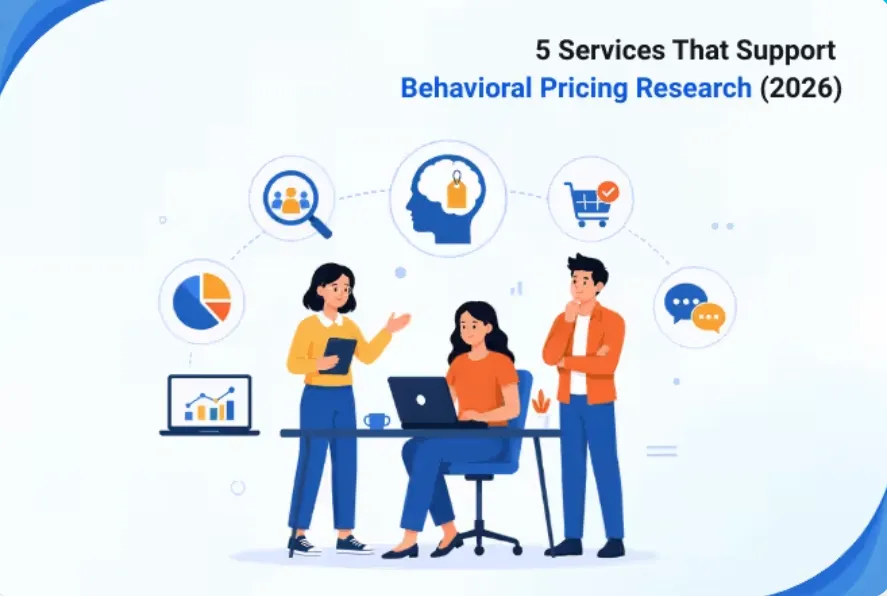

Pricing decisions built on gut feeling rarely hold up once real customer behavior gets involved, which is exactly why more companies are turning to specialized support. So, what are 5 services that support behavioral pricing research (2026)? The short answer: A/B testing, willingness-to-pay surveys, conjoint analysis, price sensitivity modeling, and behavioral data analytics. Each one uncovers a different piece of how customers actually respond to pricing, helping businesses set prices that reflect real demand instead of assumptions, and adjust with confidence as market behavior shifts.
Setting a price used to be a fairly simple exercise — look at costs, check what competitors charge, add a margin, and call it done. That approach still works for some businesses, but it leaves a lot on the table. Customers don't respond to prices the way spreadsheets assume they do. They respond to psychology, context, perceived value, and dozens of other subtle factors that only become visible when you actually study behavior instead of guessing at it. That's the gap behavioral pricing research is built to close.
1. A/B Testing
A/B testing is the most direct way to observe how real customers react to different prices, without relying on what they say they'd pay. Instead, it looks at what they actually do. Two (or more) versions of a price, offer, or page are shown to different segments of visitors, and the results are tracked in terms of conversion rate, revenue per visitor, and overall demand.
The strength of A/B testing lies in its simplicity and directness — no surveys, no hypothetical scenarios, just observed behavior. The tradeoff is that it requires enough traffic or transaction volume to reach statistically meaningful results, which makes it more practical for e-commerce platforms and SaaS products with steady user flow than for low-volume B2B sales.
2. Willingness-to-Pay Surveys
Willingness-to-pay (WTP) surveys ask customers directly what they'd be comfortable paying for a product or service, often using structured methods like the Van Westendorp Price Sensitivity Meter. Rather than asking a single blunt question, these surveys typically probe from multiple angles — at what price does this feel too cheap to trust, too expensive to consider, a bargain, or reasonably priced?
WTP surveys are especially useful early in a product's life, before there's enough transaction data to run behavioral tests. They give a directional sense of acceptable pricing ranges and help avoid the two most common mistakes: pricing so low that it signals poor quality, or so high that it kills demand before it starts. The limitation is that stated intentions don't always match actual purchasing behavior, so WTP data works best paired with real-world validation later on.
3. Conjoint Analysis
Conjoint analysis takes pricing research a step further by examining how customers make tradeoffs between price and other product features. Instead of asking "would you pay $50 for this," it presents respondents with different combinations of features, price points, and options, then analyzes which attributes actually drive purchasing decisions and how much customers are willing to trade off for them.
This method is particularly valuable for businesses with multiple product tiers, bundles, or feature sets, since it reveals which combinations customers value most — and which added features barely register with buyers at all. It's more resource-intensive to design and run than a basic survey, but the insight it produces (a clear picture of feature-price tradeoffs) is hard to replicate any other way.
4. Price Sensitivity Modeling
Price sensitivity modeling uses statistical and behavioral data to estimate how demand shifts as price changes — essentially building a demand curve specific to your product, market, and customer base. This can draw on historical sales data, competitor pricing movements, seasonal patterns, and even macroeconomic factors to predict how a price change will actually play out before it's implemented.
Where A/B testing shows you what happened in a specific test, price sensitivity modeling helps forecast what's likely to happen across a broader range of scenarios. It's especially useful for businesses making larger, less frequent pricing decisions — annual price increases, new market entry, or major repricing initiatives — where running a live test isn't practical or would be too risky.
5. Behavioral Data Analytics
Behavioral data analytics rounds out the picture by looking at how customers actually interact with pricing in the wild — not just whether they buy, but how they browse, hesitate, abandon carts, compare options, or respond to discounts and urgency cues. This includes analyzing clickstream data, cart abandonment patterns, time spent on pricing pages, and how customers move between tiers or plans.
This kind of ongoing analysis is what keeps pricing strategy from going stale. Customer behavior shifts with market conditions, competitor moves, and even seasonal mood, and behavioral analytics is the service that catches those shifts early, rather than discovering them months later in a quarterly revenue report.
Bringing It All Together
None of these five services work best in isolation. A/B testing tells you what's happening right now. Willingness-to-pay surveys and conjoint analysis help you understand the reasoning behind customer decisions before you commit resources to a live test. Price sensitivity modeling helps you plan ahead with more confidence. And behavioral data analytics keeps the whole system honest by continuously reflecting how real customers are actually behaving, not how they behaved six months ago.
Businesses that combine even two or three of these approaches tend to make pricing decisions with far more confidence than those relying on competitor benchmarking or internal guesswork alone. The market rewards prices that reflect real demand — and behavioral pricing research is how that reality gets uncovered, rather than assumed.





















Sign in to leave a comment.