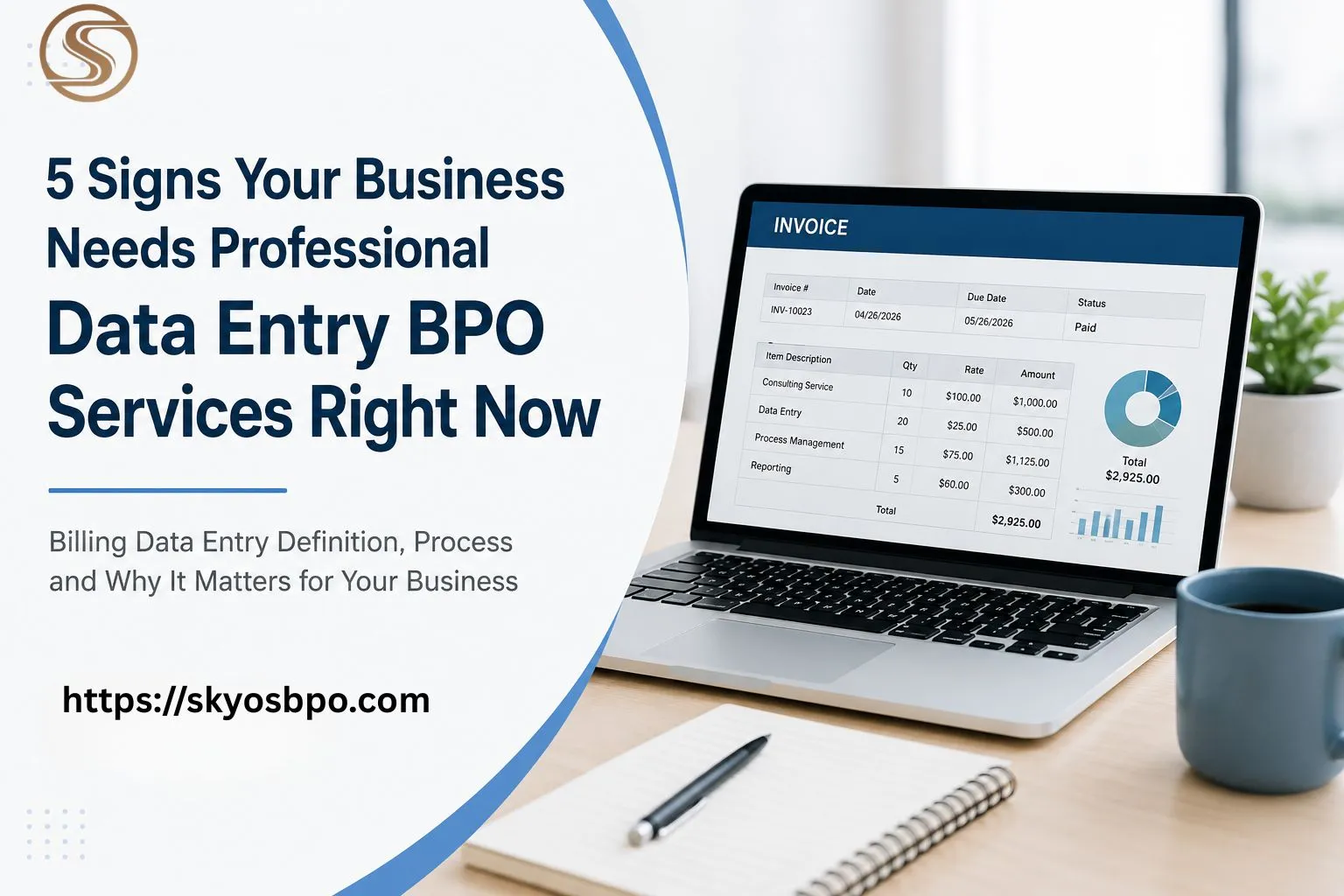

Most business owners reach out to a BPO provider after something goes wrong — a billing dispute, a compliance issue, or a data backlog that has quietly been building for months. By that point, the damage is already done.
This guide is for the business that wants to get ahead of that. Below are five signs that your data entry process has outgrown what your current team can handle — and why outsourcing to a professional data entry BPO service might be the smartest operational move you make this year.
We will also cover the billing data entry definition and process in plain terms — because it is one of the most misunderstood parts of back-office operations, and getting it right has a direct impact on your cash flow and client relationships.
First, What Is Billing Data Entry? Definition and Process Explained
Before we get into the signs, it helps to understand what billing data entry actually means — especially if you are evaluating whether to keep it in-house or hand it off to a BPO team.
Billing data entry definition: Billing data entry is the process of capturing, recording, and verifying financial transaction data — such as invoice details, client account numbers, payment terms, service charges, and tax codes — into accounting or billing management systems.
In simple terms: every time a service is delivered or a product is sold, someone has to translate that into a structured record that your accounting software can process, your client can receive as an invoice, and your finance team can use for reporting and compliance.
The billing data entry process, step by step:
- Collect source documents: invoices, purchase orders, delivery notes, or service records
- Capture and enter data: input all billing fields into the designated system — client name, amounts, dates, codes
- Validate entries: cross-check against source documents to catch errors, duplicates, or missing fields
- Quality review: a second-level check before records are submitted or sent to the client
- Finalize and archive: submit to the billing system and store records in an organized, audit-ready format
It sounds straightforward. But when this process is handled by non-specialist staff under time pressure, mistakes happen at every stage — and each one has a downstream cost. That is exactly why professional data entry BPO services exist.
| According to industry research, billing errors cost U.S. businesses hundreds of millions in delayed payments and dispute resolution every year. Most of those errors originate in the data entry stage. |
Sign 1: Your Core Team Is Doing Data Entry Instead of Their Actual Jobs
This is the most common sign — and the easiest to overlook, because it happens gradually. Your sales manager starts entering invoice details. Your operations lead is updating spreadsheets every Friday afternoon. Your HR person is manually keying payroll records because the process has not been automated yet.
None of this shows up as a problem on paper. But you are paying specialist-level salaries for work that should cost a fraction of that. And you are pulling your best people away from the work only they can do.
When you partner with a professional data entry BPO provider, your team gets that time back. The data gets handled by people who do this specifically — trained operators with quality controls in place — and your internal team focuses on growth.
Sign 2: You Keep Running Into Billing Errors and Invoice Disputes
If clients are coming back to you with billing corrections, if your finance team is spending hours reconciling mismatched records, or if you have had even one compliance flag related to financial data — that is a direct signal that your billing data entry process needs attention.
Billing errors are almost never random. They follow patterns: wrong tax code applied, duplicate invoice entries, missing line items, incorrect payment terms. These are not user errors — they are process gaps. And the fix is not asking your team to be more careful. The fix is building a proper process around it.
SkyOS BPO's Finance and Accounting Outsourcing service uses a two-stage verification model for all billing data — where every entry is independently checked before it reaches the client or the system. Their team reports a 98% accuracy rate across all data processing work.
Sign 3: Your Data Volume Has Grown but Your Process Has Not
Growth creates a hidden problem in data-heavy operations. When you were doing 200 invoices a month, your current process was fine. At 2,000, it is starting to strain. At 10,000, it breaks down entirely.
The issue is that most businesses scale their revenue without scaling the back-office infrastructure that supports it. The data entry process stays the same — the same team, the same spreadsheets, the same manual checks — while the volume quietly triples.
BPO providers are built specifically for volume flexibility. A team like SkyOS BPO can scale your data processing capacity up or down based on demand — handling seasonal spikes, new client onboarding, or expansion into new product lines — without you hiring, training, or managing a single additional person.
| BPO data entry teams typically operate 24/7 across time zones, which means high-volume jobs that would take your team three days can often be completed overnight. |
Sign 4: You Handle Sensitive Data Without a Verified Security Framework
This is the sign that most businesses miss until it becomes a legal problem. If your team is handling billing data, patient records, financial transactions, or customer PII — and there is no documented, audited security framework around how that data is entered, stored, and accessed — you are exposed.
GDPR and HIPAA are not optional. For businesses operating in the US, UK, and EU markets, data handling compliance is an active enforcement area, and regulators do not distinguish between intentional and accidental violations.
A certified BPO provider takes this off your plate. SkyOS BPO is ISO 9001:2015 certified and ICO registered, which means every engagement follows documented quality management and data protection frameworks. Encryption, NDAs, role-based access controls, and GDPR-compliant data handling are standard — not add-ons.
Their Healthcare BPO service is a strong example: medical billing data entry, claims processing, and patient record management all handled under strict HIPAA-compliant protocols.
Sign 5: Your Team Cannot Keep Up During Busy Periods
Quarter-end, tax season, product launches, new client onboarding — every business has peak periods where data volume spikes. If your team is regularly working late to process invoices, rushing through billing records to meet deadlines, or falling behind on data entry when things get busy, that is not a productivity problem. That is a capacity problem.
Hiring temporary staff for peak periods is expensive and unreliable. Training a temp worker in your billing process takes time you do not have during a crunch. And the quality of rushed, under-supervised data entry during those periods tends to create more cleanup work afterward.
Outsourcing your data entry BPO services to a dedicated provider means you always have the capacity you need — whether that is 500 records a week or 50,000. The provider absorbs the peaks. Your team stays focused.
What to Look for in a Professional Data Entry BPO Partner
Not every BPO provider is the same. Before you sign a contract, these are the things that actually matter:
- Verified accuracy rates: look for providers who publish performance data — 95% or higher is a reasonable baseline for professional data entry work
- Data security certifications: ISO certification, GDPR compliance, and HIPAA protocols are non-negotiable if you handle sensitive data
- Industry experience: billing data entry for a healthcare company looks very different from e-commerce product data entry — your provider should understand your specific requirements
- Scalability: confirm that their team can handle volume increases without a lengthy ramp-up time
- Communication and reporting: you should have visibility into accuracy metrics, turnaround times, and any issues — not just a monthly invoice
SkyOS BPO covers all of these. Their service portfolio includes back office support, data processing, finance and accounting outsourcing, healthcare BPO, and more — all delivered under ISO-certified processes with a 97% client retention rate.
Final Thoughts
The businesses that outsource data entry early tend to scale more cleanly than the ones that wait. Not because they have more money to spend on it — but because they stop treating back-office data management as something to push through internally and start treating it as a function that deserves proper infrastructure.
If you recognized your business in any of the five signs above, that is not a criticism — it just means the process has outgrown where it started. Professional data entry BPO services exist to fix exactly that gap.
If you want to understand what that looks like in practice, SkyOS BPO is a good place to start. They offer a free consultation, and their team can walk you through how the billing data entry process works end to end — including what it costs and how quickly you can expect results.






























Sign in to leave a comment.