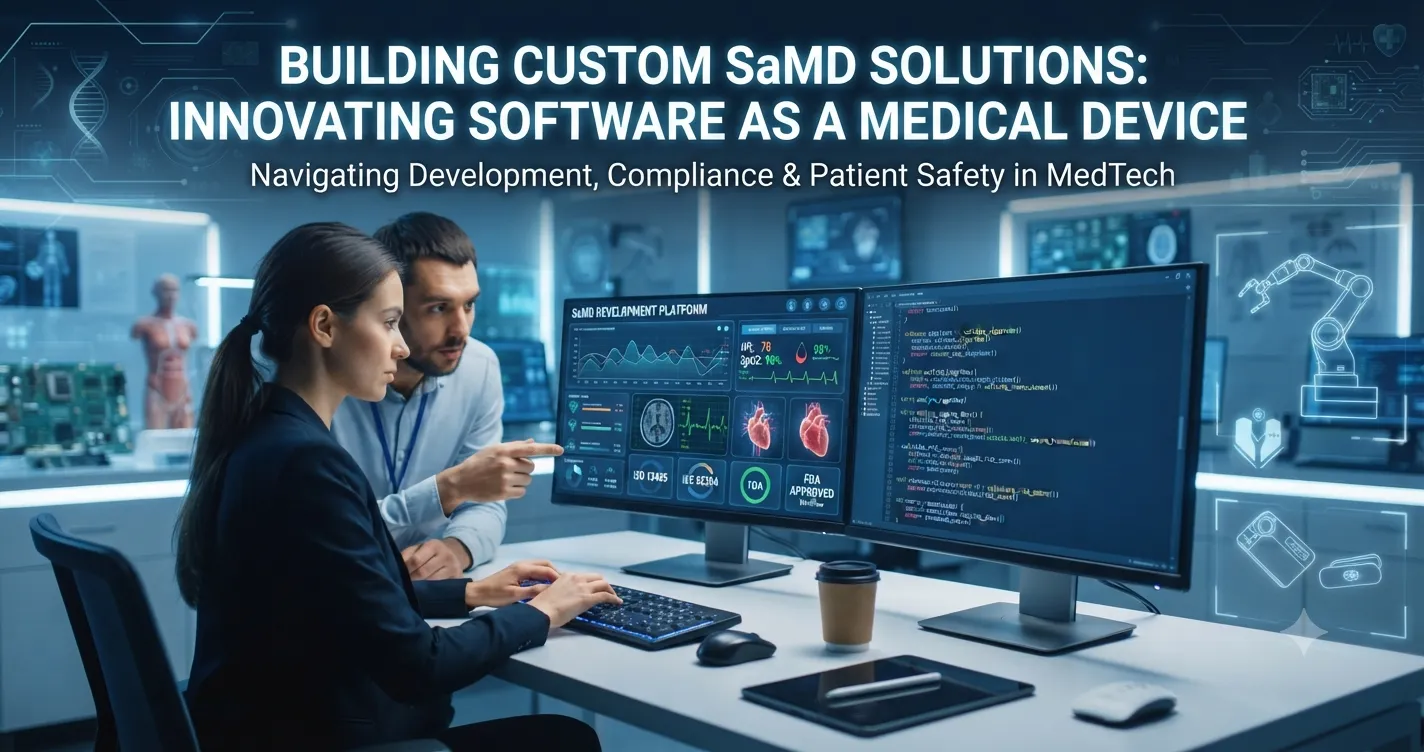

Software is increasingly becoming a core part of modern medical products. From clinical decision support and remote patient monitoring to diagnostic applications and digital therapeutics, software can influence how healthcare professionals make decisions and how patients receive care.
However, developing medical software requires more than building a technically functional application. When software qualifies as Software as a Medical Device (SaMD), organizations must consider regulatory requirements, patient safety, cybersecurity, interoperability, software quality, validation, and long-term maintenance from the beginning.
This is where custom SaMD solutions can provide a structured approach. Instead of adapting generic software to a medical use case, organizations can design software around specific clinical workflows, intended uses, regulatory requirements, and integration needs.
Before starting development, healthcare organizations and MedTech companies should evaluate several critical factors.
What Are Custom SaMD Solutions?
Custom SaMD solutions are medical software applications developed specifically around an organization's intended medical purpose, clinical workflow, user requirements, and regulatory needs.
According to the International Medical Device Regulators Forum (IMDRF), SaMD is software intended to perform one or more medical purposes without being part of a hardware medical device.
Examples can include:
- Clinical decision-support software
- Medical imaging analysis applications
- Remote patient monitoring platforms
- Diagnostic software
- Digital therapeutics
- AI-enabled medical applications
- Patient-specific risk prediction software
- Medical data analysis platforms
Because these applications may influence diagnosis, monitoring, treatment, or clinical decisions, development needs to account for safety and regulatory considerations from the earliest stages.
1. Clearly Define the Intended Use
The first consideration when developing custom SaMD solutions is the intended use.
Your intended use defines what the software is designed to do, who will use it, what medical purpose it serves, and how it will be used in a healthcare environment.
For example, software that simply stores patient information has a very different regulatory and risk profile from software that analyzes clinical data and provides treatment recommendations.
Before development begins, define:
- The medical purpose of the software
- Intended users
- Target patient population
- Clinical environment
- Inputs and outputs
- Intended clinical workflow
- Whether the software provides recommendations or decisions
- Potential consequences of incorrect outputs
A clearly defined intended use helps establish the foundation for regulatory classification, risk management, software requirements, validation, and testing.
If the intended use changes significantly during development, other requirements may also need to be reassessed.
2. Determine the Appropriate Risk Classification
Not every SaMD application presents the same level of risk.
The potential impact of incorrect information or incorrect software output should be considered when determining the appropriate risk category and regulatory pathway.
For example, software used to support a low-risk administrative healthcare function may have substantially different consequences from software used to support diagnosis of a serious condition.
Risk assessment should consider factors such as:
- Significance of the medical information
- Importance of the clinical decision
- Potential harm from incorrect outputs
- Intended patient population
- Degree of healthcare professional involvement
- Level of automation
- Clinical context
For organizations developing custom SaMD solutions, addressing classification early can prevent costly changes later.
A regulatory strategy should ideally be established before substantial software development begins. This allows technical architecture, documentation, verification, validation, and quality processes to align with the expected regulatory pathway.
3. Build Cybersecurity Into the Architecture
Cybersecurity should not be treated as a final-stage feature.
Medical software may process sensitive patient information and connect with hospitals, medical devices, cloud platforms, EHRs, APIs, and other healthcare systems. A security vulnerability could therefore create both privacy and patient-safety concerns.
Cybersecurity considerations for custom SaMD solutions can include:
- Identity and access management
- Authentication and authorization
- Encryption
- Secure API communication
- Data protection
- Vulnerability management
- Security logging
- Threat modeling
- Secure software development practices
- Incident response
- Software update mechanisms
Organizations should consider security throughout the software lifecycle rather than relying only on penetration testing immediately before deployment.
A secure architecture can also make future maintenance and regulatory updates easier to manage.
4. Plan Interoperability From the Beginning
Modern medical software rarely operates independently.
A SaMD application may need to exchange information with EHRs, laboratory systems, hospital information systems, medical devices, patient apps, cloud platforms, or analytics systems.
For this reason, interoperability should be considered during architecture and requirements planning.
Depending on the use case, custom SaMD solutions may need to support healthcare interoperability standards and technologies such as:
- HL7
- FHIR
- DICOM
- REST APIs
- SMART on FHIR
- OAuth-based authentication
- Healthcare information exchange interfaces
Interoperability planning should cover more than simply connecting two systems.
Organizations should also define:
- Data formats
- Data mapping
- Data validation
- API security
- Error handling
- Synchronization
- Data provenance
- Integration testing
Designing integrations after the core product has already been built can increase development complexity and create avoidable rework.
5. Establish Verification and Validation Requirements
A medical software application cannot simply be tested to determine whether it works technically. Organizations must also demonstrate that the software performs according to defined requirements and is suitable for its intended use.
This makes verification and validation a critical part of custom SaMD solutions development.
Verification generally evaluates whether the software has been built according to specified requirements.
Validation evaluates whether the resulting software fulfills its intended purpose in the expected use environment.
Testing may cover:
- Functional requirements
- User interface
- Performance
- Usability
- Security
- APIs and integrations
- Data accuracy
- Failure conditions
- Compatibility
- Regression
- Clinical workflows
For AI-enabled SaMD, additional considerations may include model performance, dataset quality, bias evaluation, explainability where applicable, monitoring, and management of model changes.
Testing should be planned early because regulatory documentation and validation evidence can influence architecture and development decisions.
6. Integrate a Quality Management System
A common mistake is to think about quality management only when preparing for regulatory submission.
For custom SaMD solutions, quality should be incorporated into the development lifecycle from the beginning.
A Quality Management System (QMS) provides a structured framework for managing development processes, documentation, risk, changes, testing, corrective actions, and other quality activities.
Depending on the organization and product, relevant frameworks and standards may include:
- ISO 13485
- IEC 62304
- ISO 14971
- IEC 62366
- Applicable FDA requirements
- Applicable cybersecurity guidance
The specific requirements depend on the product, market, intended use, and regulatory pathway.
A well-structured QMS can help establish traceability between:
User Needs → Software Requirements → Risk Controls → Implementation → Verification → Validation
This traceability becomes particularly important when demonstrating that identified risks have been addressed appropriately.
It can also make future audits, regulatory submissions, and product changes more manageable.
7. Plan for Post-Market Monitoring and Continuous Improvement
Launching a SaMD product is not the end of the development lifecycle.
After deployment, organizations may need to monitor software performance, cybersecurity risks, user feedback, complaints, incidents, vulnerabilities, and product changes.
A post-market strategy for custom SaMD solutions may include:
- Performance monitoring
- Complaint management
- Incident reporting
- Cybersecurity monitoring
- Vulnerability management
- Software updates
- Change control
- Corrective and preventive actions
- User feedback
- Periodic risk reassessment
This becomes even more important for cloud-based and AI-enabled software because these products may undergo frequent updates.
Organizations should therefore establish a controlled process for determining whether a software modification could affect safety, performance, intended use, or regulatory status.
A strong post-market process helps organizations maintain the product after launch rather than treating regulatory compliance as a one-time activity.
Building Custom SaMD Solutions Requires More Than Software Development
Developing medical software requires coordination between software engineering, regulatory strategy, quality management, cybersecurity, clinical requirements, and product management.
The seven considerations can be summarized as:
- Define the intended use clearly
- Determine the appropriate risk classification
- Build cybersecurity into the architecture
- Plan interoperability from the beginning
- Establish verification and validation requirements
- Integrate a quality management system
- Prepare for post-market monitoring and maintenance
Addressing these areas early can help reduce regulatory surprises, architectural rework, integration problems, and quality risks later in the product lifecycle.
For MedTech companies, healthcare organizations, and medical device innovators, the goal is not simply to build software that works. The goal is to develop a product that is secure, reliable, testable, maintainable, and aligned with its intended medical purpose and applicable regulatory requirements.
Build Regulatory-Ready Custom SaMD Solutions with the Right Development Partner
Developing custom SaMD solutions requires a combination of medical software engineering expertise and an understanding of regulatory and quality requirements.
From software architecture and healthcare interoperability to cybersecurity, verification and validation, and regulatory-focused development, the right development approach can help organizations move from a medical software concept toward a structured, production-ready solution.




























Sign in to leave a comment.