
An account can look balanced and still be wrong. A manual journal entry may force the balance to match. A missing document may go unnoticed. A recurring discrepancy may be carried forward for months without resolution. These issues create false confidence and can affect financial reporting, month-end close, and audit readiness.
Proper reconciliation proves that an account balance is accurate, supported, reviewed, and approved. This article explains what a properly reconciled account looks like, why accounts can appear correct even when they are not, seven warning signs of poor reconciliation, and how finance teams can investigate and prevent recurring reconciliation issues.
Why Proper Account Reconciliation Matters
Proper account reconciliation matters because finance teams rely on account balances for reporting, cash decisions, audits, and close activities.
Growth in financial transactions across ERP, banking, and operational systems
Finance teams manage transactions across ERP systems, bank portals, payment platforms, AP systems, AR systems, payroll applications, and spreadsheets. As volume grows, the chance of missing entries, duplicates, timing gaps, and unsupported balances increases.
Why reconciliation confirms financial accuracy before reporting
Reconciliation compares ledger balances with supporting records. It confirms whether balances are complete, accurate, and supported before financial reports are finalized.
Risks of relying on accounts that appear balanced but lack validation
An account may appear balanced because of a manual adjustment, offsetting error, or temporary match. Without validation, finance teams may approve balances that still contain hidden issues.
What Properly Reconciled Accounts Actually Look Like
A properly reconciled account has clear evidence behind the final balance.
Relationship between ledger balances and supporting documentation
The ledger balance should tie to schedules, statements, invoices, subledgers, contracts, or other source records. Every material amount should have support.
Evidence that every material difference has been investigated
Material differences should be explained, documented, assigned to an owner, and resolved or tracked with a clear next step.
Review, approval, and documentation requirements
A complete reconciliation should show who prepared it, who reviewed it, when it was approved, and what evidence supports the balance.
Why Accounts Can Appear Correct Even When They Are Not Reconciled
A matching number does not always prove a valid reconciliation.
Temporary balance agreement masking underlying issues
Two records may agree temporarily even if transactions are missing or misclassified underneath.
Manual adjustments hiding unresolved differences
Manual adjustments can force balances to match without resolving the cause of the difference. This is one of the common account reconciliation errors finance teams should watch for.
Carry-forward items creating a false sense of completion
Open items carried forward month after month can make a reconciliation look complete even when the underlying difference remains unresolved.
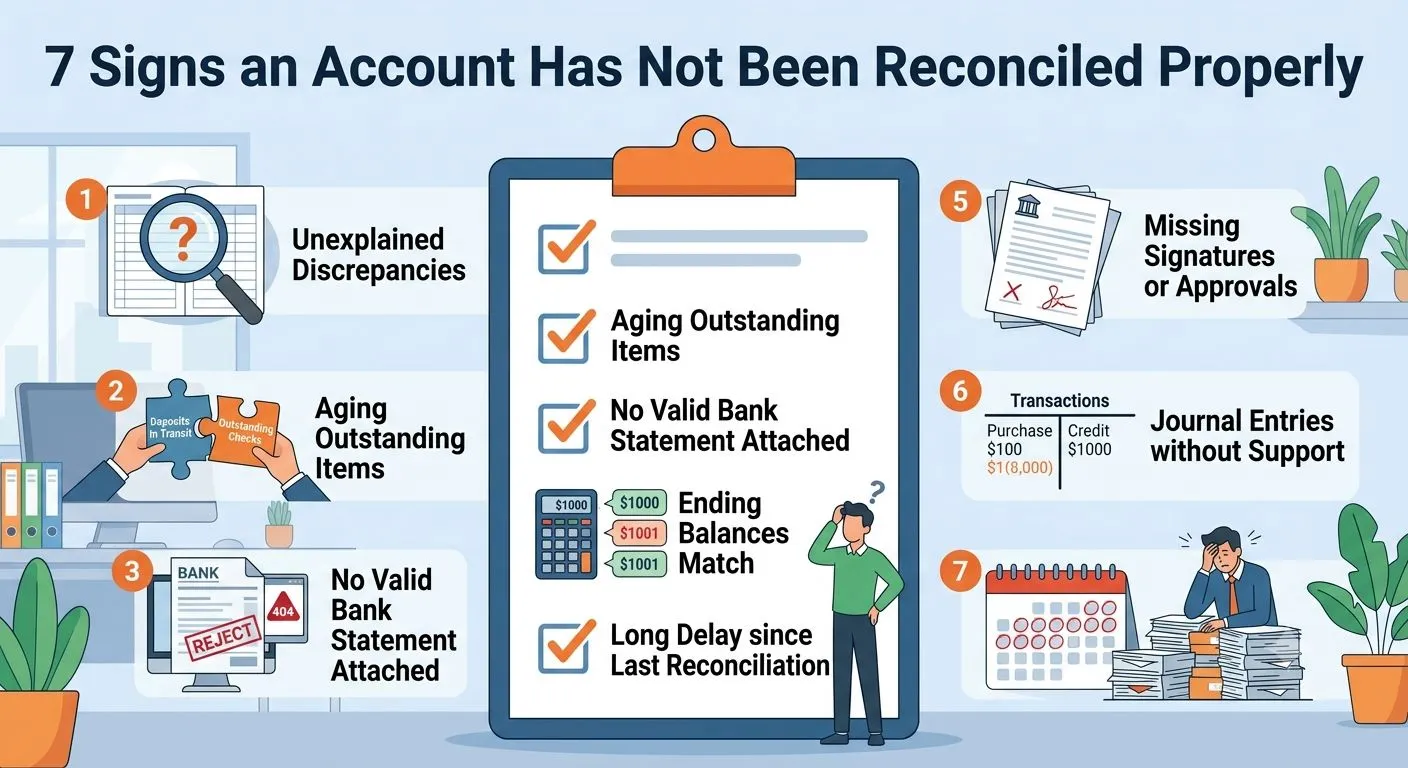
7 Signs an Account Has Not Been Reconciled Properly
These warning signs show that an account may need closer review.
1. Outstanding reconciliation items continue across multiple reporting periods
If the same open items keep appearing, the account has not been fully resolved. Aging items should have owners, explanations, and expected resolution dates.
2. Supporting documents are missing or incomplete
Missing invoices, statements, schedules, approvals, or contracts make it difficult to prove the balance is accurate.
3. Manual journal entries increase before month-end close
A sudden rise in manual entries may indicate rushed corrections, weak upstream controls, or unresolved differences being patched late.
4. The same discrepancies appear repeatedly
Recurring differences suggest a process problem, such as incorrect mapping, delayed feeds, poor coding, or inconsistent references.
5. Account balances cannot be traced back to source records
If reviewers cannot connect the account balance to source records, the reconciliation is incomplete.
6. Reconciliation approvals or reviewer sign-offs are missing
Missing approvals weaken accountability and make the reconciliation difficult to defend during audit.
7. Large unexplained balance fluctuations occur between reporting periods
Large movements should have clear explanations. Unexplained changes may indicate missing activity, incorrect posting, or unsupported adjustments.
Why Unresolved Reconciling Items Should Never Be Ignored
Unresolved items create risk even when they seem small at first.
Impact on financial statement accuracy
Open items can misstate assets, liabilities, revenue, expenses, or equity balances.
Increased audit questions and review comments
Auditors and reviewers often focus on aged, unexplained, or unsupported balances.
Delayed month-end and year-end close activities
Unresolved items slow account review, approval, and reporting.
Higher risk of compliance issues
Unsupported balances and unapproved adjustments can create compliance concerns.
Common Root Causes Behind Poor Reconciliation
Poor reconciliation usually comes from process gaps, weak ownership, or incomplete data.
Missing transactions and delayed postings
Transactions may not appear in the ledger because of late uploads, failed integrations, or approval delays.
Duplicate entries and incorrect account coding
Duplicate entries and wrong account coding can distort balances.
Timing differences left without explanation
Timing differences are common, but they should be documented and cleared in later periods.
Weak ownership and inconsistent reconciliation procedures
Accounts are more likely to remain unresolved when ownership is unclear or procedures vary by team.
How Poor Reconciliation Affects Month-End Close
Poor reconciliation directly affects close quality and timing.
More time spent investigating balances
Finance teams spend extra time tracing old differences, missing documents, and unclear adjustments.
Delayed approvals and financial reporting
Reviewers cannot approve accounts that lack evidence or explanations.
Increased correcting journal entries
Poor reconciliation often results in last-minute corrections before close.
Lower confidence in reported numbers
Unreconciled accounts reduce confidence in the final financial statements.
Accounts Most Likely to Show Reconciliation Problems
Some accounts create more reconciliation issues because of volume, risk, or timing.
Cash and bank accounts
Cash accounts often show differences from bank fees, outstanding checks, deposits in transit, and direct debits.
Accounts receivable and customer balances
AR accounts may include unapplied cash, missing receipts, incorrect allocations, or disputed invoices.
Accounts payable and supplier balances
AP accounts may include duplicate invoices, missing credits, payment timing gaps, or supplier-statement mismatches.
Payroll, tax, and accrual accounts
These accounts often depend on schedules, filings, estimates, and approval records.
Intercompany and clearing accounts
Intercompany and clearing balances can age quickly if ownership and settlement tracking are unclear.
How Finance Teams Should Investigate Warning Signs
A structured investigation helps teams resolve issues faster.
Compare balances with supporting schedules
Compare the ledger balance with schedules, statements, subledgers, and source records.
Review transaction history and source documents
Review dates, amounts, references, approvals, and supporting documents.
Validate approvals and adjustment records
Manual entries and corrections should have approval evidence.
Document findings and corrective actions
Each difference should show the cause, owner, action taken, and final status.
Documentation That Confirms a Reconciliation Is Complete
Documentation proves that the account was reviewed properly.
Supporting schedules linked to account balances
Schedules should connect directly to ledger balances.
Evidence explaining reconciling items
Every material reconciling item should have a clear explanation and support.
Approval records for adjustments
Adjustments should show who approved them and why they were needed.
Final reviewer sign-off and reconciliation date
Reviewer sign-off confirms that the reconciliation was checked and accepted.
How Multi-Entity Organizations Face Greater Reconciliation Risk
Multi-entity organizations face added risk because activity crosses systems, entities, and regions.
Shared ERP environments with decentralized ownership
Shared systems can create unclear responsibility for account balances.
Intercompany balances requiring coordinated review
Both entities must validate matching entries and settlement status.
Cross-border transactions and currency differences
Currency conversion and local settlement timing can create differences.
Different reconciliation practices across business units
Inconsistent processes can make group-level reporting harder.
Risks of Managing Reconciliation Through Spreadsheets
Spreadsheets can make reconciliation control harder as volume grows.
Version-control issues
Different file versions can create conflicting results.
Formula and manual-entry errors
Manual formulas and copied data can produce incorrect balances.
Limited visibility into outstanding exceptions
Open items may be scattered across files and emails.
Difficulty maintaining a complete audit trail
Spreadsheet-based records may not clearly show changes, approvals, and review history.
Controls That Help Detect Poor Reconciliation Earlier
Controls help finance teams identify reconciliation problems before close.
Standardized reconciliation templates
Templates create consistency across accounts and teams.
Segregation of preparer and reviewer responsibilities
The preparer and reviewer should be different people.
Periodic quality reviews of completed reconciliations
Quality reviews help identify weak documentation, stale items, and repeated issues.
Escalation procedures for unresolved differences
Aged or material differences should move to the right owner quickly.
Metrics That Reveal Reconciliation Quality
Metrics help teams identify weak reconciliation practices.
Number of unresolved reconciliation items
A rising count signals growing account risk.
Aging of open discrepancies
Older discrepancies need faster escalation.
Percentage of reconciliations completed on time
On-time completion shows close readiness.
Frequency of manual adjustment entries
Frequent manual entries may indicate upstream process issues.
Review rejection and rework rates
High rejection rates show weak preparation or missing support.
How Automation Helps Identify Poorly Reconciled Accounts
Automation improves visibility into account status and exception quality.
Continuous monitoring of reconciliation status
Teams can track account progress throughout the reporting period.
Automated detection of recurring discrepancies
Recurring differences can be flagged for root-cause review.
Centralized visibility into unresolved exceptions
Dashboards show open items, owners, aging, and review status.
Complete documentation supporting review and audit
An account reconciliation platform helps centralize supporting evidence, approvals, exception history, and audit trails.
What High-Performing Finance Teams Do Differently
Strong finance teams treat reconciliation as an ongoing control, not a last-minute close task.
Resolve reconciliation issues throughout the reporting period
They address differences before month-end pressure begins.
Assign ownership for every account
Each account has a clear preparer, reviewer, and issue owner.
Review recurring differences for root-cause correction
Recurring issues are fixed at the process level.
Standardize documentation and approval practices
Standard evidence and approval rules reduce review delays.
Future Direction of Reconciliation Quality Monitoring
Reconciliation quality monitoring is moving toward earlier detection and continuous review.
AI-assisted identification of incomplete reconciliations
AI can flag missing evidence, unexplained movements, and aged open items.
Predictive detection of accounts likely to fail review
Predictive analysis can identify accounts that may cause close delays.
Continuous reconciliation across connected finance systems
Continuous reconciliation reduces reliance on period-end review.
Real-time account health monitoring supported by intelligent matching logic
Many account reconciliation challenges can be reduced when finance teams monitor account health continuously, track exceptions in real time, and resolve issues before reporting deadlines.



























Sign in to leave a comment.