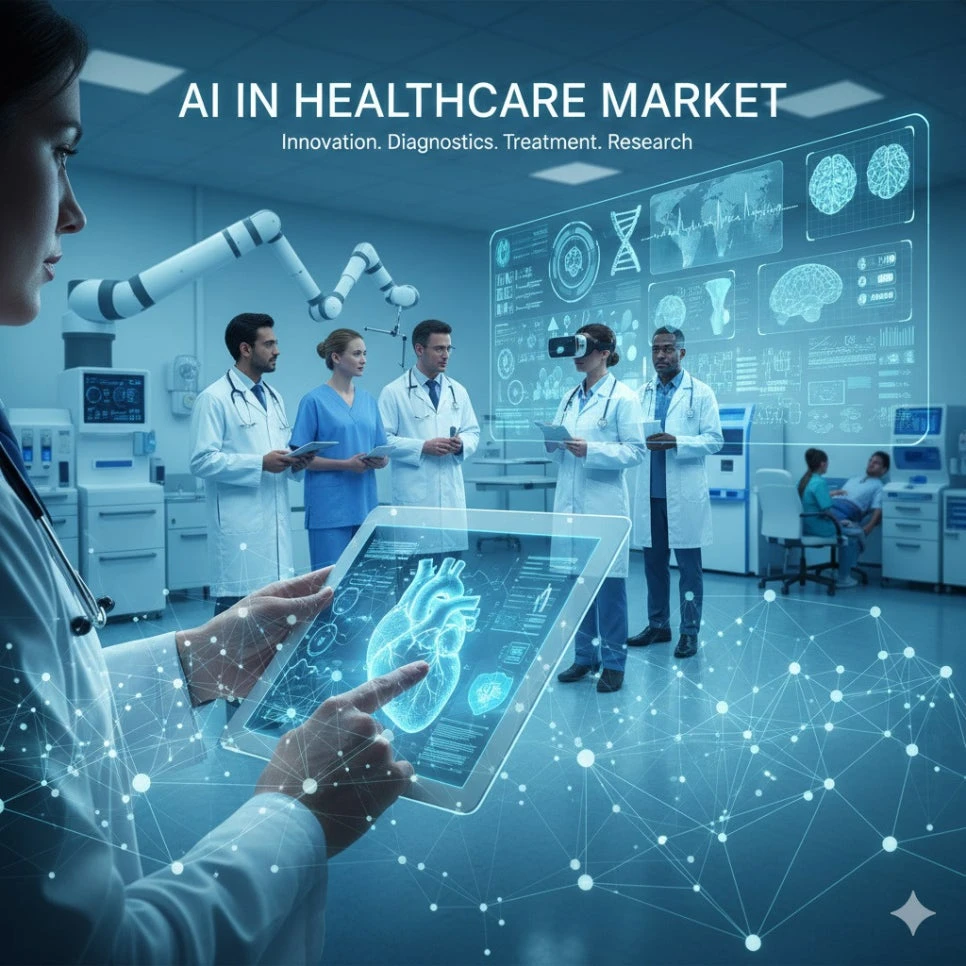
AI in healthcare in the U.S. isn’t just advancing—it’s accelerating. According to BIS Research, the market is forecasted to grow from billions today to hundreds of billions in just a decade. Here are 7 key trends and takeaways driving that transformation.
1. Massive Market Growth: From $5.25B in 2023 to ~$229.70B by 2034
- In 2023, the U.S. AI in healthcare market was valued at US$ 5,254.3 million (≈ US$ 5.25B).
- By 2034, it’s projected to hit US$ 229,699.4 million (≈ US$ 229.70B), implying a CAGR of ~ 40.41% over the 2024-2034 period.
- This kind of growth signals that AI is moving from early adoption to becoming a core pillar of healthcare strategy.
2. Offering Segmentation: Software & Services Dominate
- The market is divided by Offerings into two primary categories: Hardware and Software & Services.
- In 2023, Software & Services held roughly 72% market share among those offerings.
- So, while hardware is essential, the value and growth are clearly centered on software tools (analytics, workflows, diagnostics, etc.) and service components (integration, support, etc.).
3. End Users: “Other Healthcare Providers” Lead in Adoption
- The report categorizes End Users as Healthcare Providers, Healthcare Payers, Patients, and Other Healthcare Providers (which includes labs, diagnostic centers, ambulatory clinics, etc.).
- Surprisingly, “Other Healthcare Providers” held the largest share (~ 46%) in 2023.
- This suggests that smaller or more specialized care entities are rapidly adopting AI—likely due to diagnostic / lab automation, imaging support, and other focused applications.
4. Key Use Cases Driving Demand
BIS Research identifies several AI use cases in healthcare, which are especially important in shaping the future market:
- Diagnostics & Imaging
- Drug Discovery & Development
- Personalized Medicine & Treatment Plans
- Patient Management & Virtual Healthcare
- Remote Patient Monitoring (RPM)
- Hospital Operations & Administrative Automation
- AI in Surgery & Robotics
- Disease Prediction & Early Detection
These use cases span both clinical and operational needs, showing that AI’s impact will be broad—not just in clinical decision-making but in the systems that support it.
Request A Detailed Sample on the U.S. AI in Healthcare Market!
5. Recent Strategic Moves Signal Acceleration
To understand how fast things are moving, consider a few of the latest developments:
- In October 2023, Medtronic partnered with NVIDIA to build an AI platform for medical devices.
- In July 2022, Amazon acquired One Medical for US$ 3.9 Billion, expanding its AI-enabled primary care presence.
These large deals hint at how strategic players are positioning themselves for the future.
6. Drivers, Challenges & Opportunities
Drivers:
Growing demand for early detection & diagnosis, which AI can significantly help improve.
Technological advances: better algorithms, ML/AI platforms, data infrastructure are improving rapidly.
Increasing private & public investment and supportive regulation.
Challenges:
- Data privacy & security remain big concerns, especially as more patient-data sets are used for AI.
- Integration with legacy systems and ensuring clinical validity are non-trivial. While the report doesn’t enumerate all challenges in detail, these are implied in any rapid innovation environment.
Opportunities:
- Pain Management & Personalized Care as more precise, patient-centric treatments become feasible.
- Diagnostics, remote patient monitoring, and virtual healthcare to expand, especially in non-hospital settings.
7. What to Watch: Who Will Win in this AI Race
Some of the prominent companies profiled in the BIS report for their AI-in-healthcare offerings include:
- International Business Machines Corporation (IBM)
- Google LLC
- Microsoft Corporation
- Amazon.com, Inc.
- NVIDIA Corporation
- GE HealthCare
Click Here to Download The ToC
Final Thoughts
The BIS Research data makes it clear: the U.S. AI in healthcare market is at an inflection point. What was once a niche is rapidly becoming central to how healthcare is delivered, especially in diagnostics, virtual care, and administrative automation.
For healthcare organizations, tech providers, or investors, key actions might include:
- Investing in software & services rather than focusing only on hardware.
- Engaging with end users beyond hospitals (labs, diagnostic centers, outpatient services).
- Prioritizing early detection / prediction capabilities.
- Keeping privacy, security, regulatory, and ethical concerns front and center.




























Sign in to leave a comment.