A Detailed Guide for Embedding Security in Web Apps


Modern web applications rely on cloud infrastructure, APIs, third-party services, and distributed systems to deliver functionality. However, these integrations also introduce vulnerabilities that traditional perimeter-based defenses cannot address alone.
The OWASP Top 10:2025 identifies broken access control, security misconfiguration, and software supply chain failures as its three highest-ranked risk categories. The 2025 edition also adds Mishandling of Exceptional Conditions as a distinct category, covering insecure error handling, fail-open behavior, and improper handling of unexpected application states.
Addressing these risks requires embedding security controls into application design, development, and operations. This guide outlines eight practical approaches developers can use to secure web applications.
What Does Embedding Security in Web Applications Mean?
Embedding security in web applications means incorporating protective controls directly into application architecture, code, and deployment workflows instead of relying solely on external defenses or pre-release assessments.
The approach draws on three principles:
- Security by Design: Identify threats and security requirements during architectural planning.
- Secure by Default: Apply restrictive permissions and protective configurations from the outset.
- DevSecOps: Integrate security testing and verification into development and deployment workflows.
Together, these principles help developers establish security requirements that can be implemented, tested, and enforced as applications evolve.
How to Embed Security in Web Applications: 8 Essential Practices
The following practices cover the technical controls needed to secure application functionality, data, dependencies, and production environments.
1. Start with Secure Architecture and Threat Modeling
Identify critical assets, application entry points, data flows, and trust boundaries before development. Use threat modeling frameworks such as STRIDE to examine how attackers could manipulate requests, impersonate users, or access restricted resources.
For example, an eCommerce application connecting payment, inventory, and fulfillment services must prevent customers from modifying another customer's orders through manipulated API requests. This requires server-side authorization checks, restricted service permissions, and automated tests for unauthorized operations.
Record each identified threat alongside the affected component, required control, and verification test. The OWASP Application Security Verification Standard (ASVS) 5.0 provides requirements to assess these controls.
2. Implement Strong Authentication and Access Controls
Use OpenID Connect for identity verification, with phishing-resistant authentication methods such as passkeys and multifactor authentication (MFA) for privileged operations. For browser applications using OAuth 2.0, RFC 10017 recommends the Authorization Code flow with Proof Key for Code Exchange (PKCE) and describes the Backend for Frontend (BFF) pattern, which keeps OAuth tokens out of browser JavaScript.
Once users authenticate, the backend must independently verify their permissions before returning protected resources. For example, an invoice retrieval API should scope its database query to the authenticated customer:
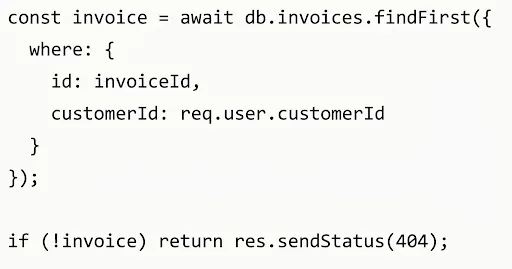
This assumes trusted authentication middleware and a validated invoice identifier. For more complex permissions, use role-based access control (RBAC) or attribute-based access control (ABAC). Enforce session expiration, Secure and HttpOnly cookies, appropriate cross-site request forgery (CSRF) defenses, and deny-by-default authorization.
3. Protect Sensitive Data and Validate User Inputs
Protecting application data requires separate controls for cryptographic security and unsafe input handling.
Secure data storage and transmission. Use HTTPS with modern Transport Layer Security (TLS) configurations and encrypt sensitive stored information according to its risk profile. Manage encryption keys and API credentials through dedicated secrets management services, while storing user passwords using password-specific hashing algorithms such as Argon2id.
Prevent injection vulnerabilities. User-supplied values must never be concatenated directly into executable SQL statements. Instead, use parameterized queries to separate input values from SQL commands:

For other input and output contexts, validate submitted data against defined constraints, apply context-aware output encoding to mitigate cross-site scripting (XSS), and sanitize user-generated HTML where necessary. Content Security Policy (CSP) offers additional protection by restricting script execution but does not replace secure output handling.
When integrating large language models (LLMs), treat retrieved content and model-generated responses as untrusted. Validate and authorize any tool actions influenced by model output to reduce prompt-injection risks.
4. Secure APIs and Third-Party Integrations
APIs require authorization at the resource, operation, and property levels, as highlighted in the OWASP API Security Top 10:2023. For example, before allowing an employee to close a support ticket, the backend must confirm their permission to modify that ticket and verify that its current status permits closure.
Extend these checks to request and response fields using explicit schemas and controlled serialization rather than exposing complete database objects. Validate authentication tokens against the expected issuer, audience, expiration, and permissions, and enforce rate limits and resource consumption restrictions to reduce abuse.
Validate third-party responses before processing. Where applications fetch user-supplied URLs, restrict permitted destinations and block internal networks and cloud metadata endpoints to mitigate server-side request forgery (SSRF), which falls under Broken Access Control in OWASP Top 10:2025. Maintain an API inventory to identify and disable outdated endpoints or unnecessary integrations.
5. Harden Application Configurations and Deployment Environments
Security misconfiguration, ranked second in OWASP Top 10:2025, can expose applications even when their code is secure. Establish hardened production defaults by disabling debug endpoints, removing unnecessary services, restricting administrative access, and applying least-privilege cloud Identity and Access Management (IAM) policies.
Configure HTTP Strict Transport Security (HSTS) to instruct browsers to use HTTPS for subsequent connections, set X-Content-Type-Options: nosniff to prevent MIME sniffing, and apply a suitable Content Security Policy (CSP) to restrict unauthorized resource loading. You can enforce these headers at the web server, reverse proxy, or application layer.
To prevent insecure settings from reaching production, manage configurations through Infrastructure as Code (IaC) and scan Terraform or Kubernetes definitions for exposed resources, excessive permissions, and unsafe network rules. Monitor configuration drift to identify deviations from approved security baselines.
6. Secure Dependencies and the Software Supply Chain
Third-party libraries and build tools can introduce vulnerable or malicious code into applications. Commit dependency lockfiles and use reproducible installation commands such as npm ci to avoid unintended version changes. Integrate software composition analysis (SCA) into CI pipelines to identify vulnerable direct and transitive dependencies, while maintaining a software bill of materials (SBOM) to trace affected components when new advisories emerge.
Because dependency scanning cannot establish whether an application was built securely, also protect the build environment. Enforce branch protection, mandatory code reviews, restricted CI/CD permissions, and short-lived deployment credentials to reduce unauthorized modifications.
Before deployment, generate signed build provenance recording the source repository and build workflow. Verify artifact integrity, trusted signing identities, and expected provenance during release. The SLSA framework provides guidance for implementing these build integrity controls.
7. Integrate Security Testing into CI/CD Pipelines
Configure CI/CD security checks to run when developers submit changes, rather than relying on assessments performed immediately before release. In GitHub Actions or GitLab CI, pull-request workflows can execute Static Application Security Testing (SAST), secrets scanning, and dependency checks. Scan Infrastructure-as-Code configurations when they change, then run Dynamic Application Security Testing (DAST) against a deployed test build.
Automated scanning cannot reliably detect application-specific authorization flaws, so supplement it with integration tests. For example, create two tenant accounts in a test environment and verify that one cannot retrieve the other's reports, while confirming that legitimate access still succeeds.
Connect these results to required status checks and deployment gates. Block merging when critical checks fail, and prevent releases with findings exceeding defined risk thresholds unless an approved exception exists. This approach aligns with NIST Secure Software Development Framework (SSDF) 1.1; NIST also published a draft of SSDF 1.2 in December 2025.
8. Enable Continuous Security Monitoring, Incident Response, and Failure Handling
Configure structured logging in authentication middleware, authorization handlers, and critical APIs. Forward events through OpenTelemetry-compatible collectors to centralized monitoring, recording timestamps, event types, and correlation identifiers without exposing credentials or sensitive user data.
Use these events to detect suspicious patterns. For example, repeated authorization failures across different customer accounts can trigger alerts in a Security Information and Event Management (SIEM) platform. Link confirmed incidents to procedures for investigating affected sessions, revoking credentials, and containing unauthorized activity.
Applications must also fail securely when critical dependencies become unavailable. Deny protected operations if authorization cannot be verified, and use database transactions to roll back incomplete updates. Simulate these failures during testing to confirm that access remains restricted and data consistency is preserved. These controls address Security Logging and Alerting Failures (A09) and Mishandling of Exceptional Conditions (A10) in OWASP Top 10:2025.
The Takeaway: Making Security a Continuous Engineering Practice
Embedding security in web applications requires more than implementing individual security controls. Their effectiveness depends on how consistently developers apply security requirements across application architecture, coding practices, deployment workflows, and ongoing maintenance. Even well-established security frameworks can leave critical gaps when implementation is inconsistent or security takes a back seat to delivery deadlines.
This makes choosing the right web application development partner a critical business decision. Beyond technical proficiency, businesses need a team that understands how security choices affect application reliability, compliance, scalability, and long-term maintenance. An experienced development partner can incorporate these considerations into engineering decisions from the outset, helping businesses avoid costly architectural rework, reduce security exposure, and maintain confidence in their applications as they grow.







Sign in to leave a comment.