
Ask a consumer AI for a second-date idea in New York, and it may return a familiar triangle: a bar, a restaurant, or an activity.
There is nothing wrong with any of those places. The problem is that the answer quietly changes the question from “What fits tonight?” to “What places are popular near me?”
A second date is not really a place request. It is a context request disguised as one.
The context includes things people rarely put into a search box: how much energy they have left, whether they want to talk without competing with loud music, how much they are comfortable spending, how far they are willing to travel, and what they will do if the first plan is unavailable.
That is where consumer AI becomes interesting. Not when it produces one impressive answer, but when it makes the hidden conditions visible.
A date has conditions, even when people call them a vibe
“Somewhere fun” sounds like a preference. It is not yet useful context.
A better request might sound like this:
Second date in New York, around 7:30 p.m. We want dinner and something small afterward. Keep it under $120 before tip, avoid loud bars, stay within 25 minutes of Union Square, and give us a backup if the first plan does not work.
The prompt is ordinary. Its structure is not.
It tells the system what kind of evening the couple wants, what could make the evening uncomfortable, and which limits should not be treated as minor details.
Noise matters because conversation is part of the date. Budget matters because an expensive recommendation can create a different kind of pressure. Distance matters because a beautiful plan can become tiring when it requires two trains and a long walk in bad weather.
None of these details is romantic by itself. Together, they describe the atmosphere a couple is trying to protect.
The useful answer is not one perfect place
A recommendation should not pretend that there is one objectively correct date. It should offer two to four possibilities, each with a reason.
One option might be a dinner spot close to a quiet street or waterfront walk. That fits a couple who wants the evening to remain flexible after the meal.
Another might be a small gallery, bookstore, or cultural event followed by dessert. That gives two people something to look at together when conversation still has pauses in it.
A third might be a low-commitment café or tea room in a neighborhood with nearby places to continue or leave easily. That works when one person is interested but tired, and neither wants a three-hour commitment.
The point is to show the relationship between a choice and the mood it creates.
A useful recommendation might say: this option is quieter but less spontaneous; this one is more atmospheric but farther away; this one is easier to abandon if the energy is wrong. That kind of explanation builds more trust than a confident phrase such as “This is the perfect date spot.”
There is no perfect date spot. There is only a place that fits the people, the evening, and the amount of uncertainty they are willing to carry.
Control begins with the second message
The first message to an AI assistant is often treated as the important one.
I suspect the second message matters more.
After receiving a few options, someone might reply:
Option two sounds right, but no tasting menu. Keep the walk under ten minutes. If the event is sold out, stay in the same neighborhood and give me something quieter.
That is not just refinement. It is control.
The assistant should make it easy to adjust the plan without starting over. A couple should be able to change the budget, shorten the distance, remove a noisy setting, or ask for a backup without losing the original context. This is why an iMessage-based city guide can feel more natural than a separate planning dashboard. The decision remains inside the conversation, where people already explain what they want in incomplete sentences.
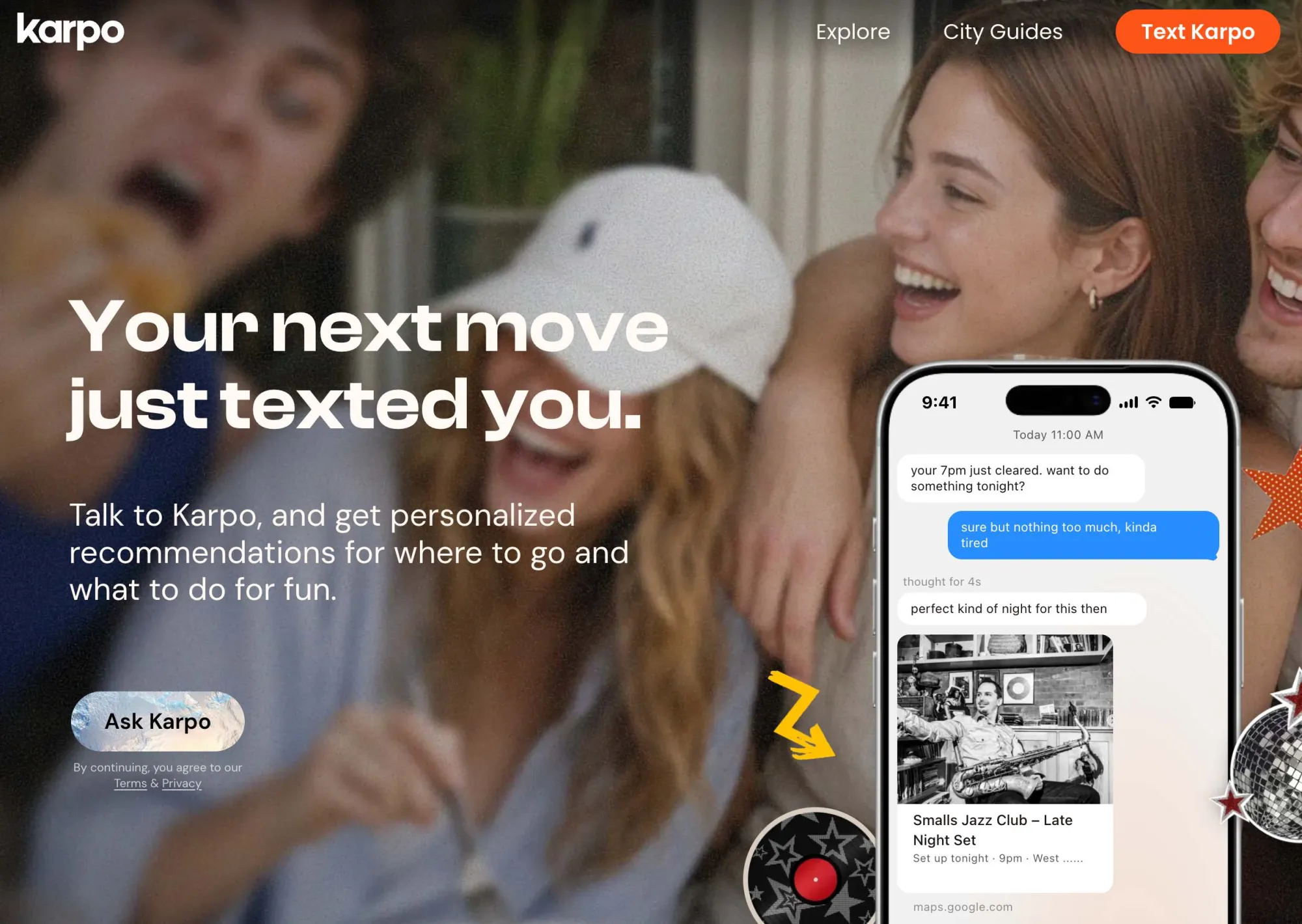
For couples who want to turn those details into a city conversation, the Karpo AI city guide is designed around asking for recommendations in iMessage and receiving personalized picks or an agenda when needed. The important part is the shape of the request:
context → a small set of options → a reason for each → one clear next action.
That sequence keeps the system from becoming an oracle. It remains a collaborator whose suggestions can be corrected.
The backup plan is part of the plan
A backup is usually treated as evidence that the original plan failed. For a second date, it can be a form of care.
Restaurants fill up. Events change. A room feels louder than expected. Someone realizes they are more tired than they thought. A good recommendation should account for these ordinary interruptions instead of presenting them as rare exceptions.
The backup does not need to be equally impressive. It needs to preserve the mood.
If the first choice is a quiet dinner, the backup could be another nearby place where conversation is still possible. If the first choice depends on tickets, the alternative might be an easy walk and a dessert stop that does not require a reservation. If the plan crosses neighborhoods, the backup should not quietly add another long journey.
This is where control becomes more important than confidence.
An AI can help expose the trade-offs, but it cannot guarantee chemistry, availability, or the way two people will feel after sitting across from each other for an hour. The reservation still needs to be checked. The opening hours still need to be confirmed. A recommendation is a starting point, not a promise.
A second date does not need to be perfectly designed.
It needs to leave enough room for both people to notice what is actually happening. The better plan is not the one that sounds most certain. It is the one that lets two people change their minds without losing the evening.



























Sign in to leave a comment.