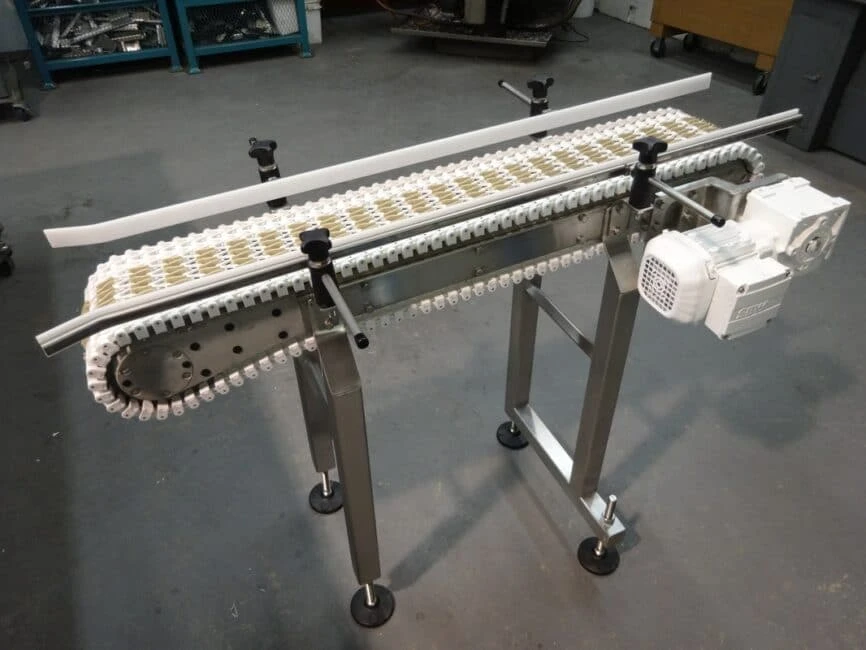

In modern manufacturing where products and industry needs are highly varied, material handling conveyor systems become a reflection of those varied needs. In the broader manufacturing and, production and supply chain world, every production manager must make choices about throughput, speed, process, and diversion needs. But for each production manager, the parameters guiding those choices will differ.
This is where conveyor zones, the accumulation conveyor and the retractable conveyor will come into play as part of the process. Since every need and production line is different, it’s likely more beneficial to talk about these solutions broadly in ways that show how they help production managers meet speed, QA, and throughput needs.
What are zoned conveyors?
Zoned conveyors are mostly seen in material handling conveyor systems where pallets or packaged products are moving through the process. When pallets hit a stop in a conventional conveyor with a single motor, they will begin to accumulate behind each other, which might cause product damage.
Zoned conveyors typically use individual motors that can turn off small sections of a conveyor independently when it senses a pallet or packaged product is stopped downstream. This zero-contact zoned conveyor process ensures there is always a gap between products to eliminate the backpressure that can cause product damage.
The Role of the Accumulation Conveyor in QA and Throughput
The accumulation conveyor collects products on the conveyor to move as a group rather than individually. Manufacturers use the accumulation conveyor in a conveyor system to:
- Buffer product prior to sortation
- Support product merging
- Enable end-of-line unloading, palletizing, or packing for shipping
Although this has a similar effect to a zoned conveyor, the goal here is to allow products to catch up to create a slug of products that can move together for packaging into a single bundle.
It’s also used when different parts of the production line run at different speeds. Manufacturers also use it as a safeguard against line shutdowns. The line can continue to accumulate products before the point of any down machine rather than triggering a line shutdown.
These material handling conveyor systems have specialized component designs to support their functions, such as SpanTech’s Tube Top Chain Conveyor design, which was specifically designed for accumulation. According to SpanTech, these tubes “roll under the accumulated product Tube Top chain” to decrease the “back pressure felt on the products.” The rolling tubes are also much gentler on the products with printed surfaces.
There are minimum pressure accumulation conveyors, which are belt-driven roller conveyors that use an adjustment so the drive of rollers can be increased or decreased. There are also Zero Pressure Accumulation Conveyors that use sensors for product segregation into different zones to provide an additional buffer for lightweight and fragile products to avoid damage. Manufacturers may also use the cost efficient Zero-Pressure conveyor, which they can use with a wide variety of sizes of box sizes and weights.
The Retractable Conveyor in Varied production Lines
While today’s modular conveyors play an important role in the accumulation conveyor designs to meet varied needs, the retractable conveyor plays an even bigger role. Getting products to the right place at the right time and in the right quantity without damage is always the name of the game. That requires a great deal of conveyor system flexibility, which is where the modular and retractable conveyor often comes into play.
The challenge is that even retractable conveyors must be highly versatile and flexible in design to meet a variety of needs. This can be for product merging to another conveyor, product routing to multiple lines, stacking and palletizing processes and QA needs. One solution that has been developed to be adaptable to all these needs is the Spantech retractable conveyor.
Meeting Varied needs with Adaptable Material Handling Conveyor Systems
Modern production lines must be highly flexible and versatile to meet the challenges of a post-pandemic workforce shortages, ecommerce growth, supply chain, needs and much more. This requires leading conveyor manufacturers like Conovey to strike the right balance between customization, standardization. Their goal is to bring together the leaders in conveyor design to further those ends.
Ensuring throughput, speed, and QA are never compromised means having access to modular and system components that can work together holistically while still providing options for specific needs. The accumulation conveyor, zoned conveyor and even the retractable conveyor play key roles in how they feed products into other stages in a handling pipeline that may include:
- Loading
- Sorting
- Palletizing
- Staging
Finding the right accumulation conveyor balance between custom and standardized conveyor system designs requires leading conveyor manufacturers like SpanTech that understand your production goals, environment, and market needs. To learn how Conovey partners with SpanTech to deliver conveyor designs that met diverse sorting and accumulation needs.


























Sign in to leave a comment.