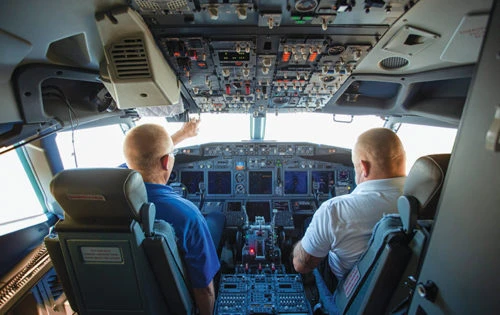

Products of complex engineering processes like passenger aircrafts have an integrated mesh of systems which provide the pilot and the cabin crew with different types of data inputs which help them in easy navigation and safe travel. On the other hand, these integrated systems built for military aircrafts have a different role to play. From conducting reconnaissance of an area to spotting and neutralizing the target, these integrated systems help the military aircraft pilot in completing the assigned missions. However, even if these systems play different roles for different types of aircrafts, their basic function of aiding the pilot is the same. The mechanism we’ve been referring as “integrated systems” for a while now is, in fact, aerospace avionics.
Request Exclusive Sample Report Here @ https://www.researchdive.com/download-sample/2838
Avionics is literally a blend of two words- aviation and electronics. Aerospace avionics is thus, an electronic system that is used in aircrafts, or even satellites and spacecrafts, that perform several functions like aiding in navigation, establishing communications, providing information about the weather, recording flight data, etc.
Different Components of a Typical Aerospace Avionics System
As said earlier, an Airbus A380, a F-16, and a GSLV MkIII will have different systems of aerospace avionics which will be assigned different functions. Thus, the aerospace avionics market can be segmented across various lines depending on the type of aircraft or spacecraft it is installed in. However, since certain roles played by these systems are the same irrespective of the vehicle, certain components of these systems, which perform these roles, are also the same. Some of these components are given here.
Connect With Our Expert Analyst to Get More Details@ https://www.researchdive.com/connect-to-analyst/2838
Communication Systems:
The most obvious and the most important part of the aerospace avionics system is the communication system as it helps in establishing a communication link between the aircraft and the ground base and/or between two aircrafts. The range of frequencies used for establishing and maintaining such a communication link is generally classified into long, medium, or even ultra-high frequency.
Display Systems:
Display systems provide the aircraft pilot with an interface with which he/she can engage with the Aerospace Avionics System. Advanced technologies have, over the years, led to three types of display systems- heads up display, heads down display, and helmet mounted display. The third type of display systems, i.e., helmet mounted display is typically used in a military aircraft.
Flight Control Systems:
The most basic part of avionics system, a flight control system, essentially helps in controlling the direction, altitude, and pace of the aircraft when in flight. The fly-by-wire avionics systems have brought about a massive technological upgrade in these flight control systems. Flight control systems of today take the help of electronics in two areas, for auto stabilization of the aircraft and for continuous stabilization of the aircraft by using motion sensors.
Navigation Systems:
Navigation systems provide critical information to the aircraft pilot such as aircraft’s position over the ground, ground speed, track angle, direction of the aircraft, etc. For this, several technologies are employed by the navigation system including Global Positioning System (GPS) and Wide Area Augmentation System (WAAS). In some avionics systems, technologies like inertial navigation system (INS) are also used which employ motion sensors and gyroscopes to calculate the position, orientation, and velocity of the aircraft.
Weather Systems:
Weather is a very important stakeholder in deciding the course of the aircraft’s flight. Weather systems, which are basically radars, help in assessing the meteorological conditions, thereby helping the aircraft pilot to decide on the path the aircraft should take to minimize the effect of bad weather on the aircraft.
The Bottom Line
Apart from the components mentioned above, aerospace avionics also use flight recorder systems which store flight information and other important data points like audio recording from the cockpit. Collision-avoidance systems and air management systems also form an important part of the aerospace avionics systems. Thus, aerospace avionics systems provide a holistic support to the aircraft pilot and his/her cabin crew so as to minimize the impact of the challenges that can hinder the smooth travel of the aircraft.
Request for this Report Customization & Get a 10% Discount on this Report@ https://www.researchdive.com/request-for-customization/2838
Related Reports:
Aircraft Seat Actuation System Market
About Us:
Research Dive is a market research firm based in Pune, India. Maintaining the integrity and authenticity of the services, the firm provides services that are solely based on its exclusive data model, compelled by the 360-degree research methodology, which guarantees comprehensive and accurate analysis. With unprecedented access to several paid data resources, a team of expert researchers, and a strict work ethic, the firm offers insights that are extremely precise and reliable. Scrutinizing relevant news releases, government publications, and decades of trade data, and technical white papers, Research dive delivers the required services to its clients well within the required timeframe. Its expertise is focused on examining niche markets, targeting their major driving factors, and spotting threatening hindrances. Complementarily, it also has a seamless collaboration with the major Market aficionado that further offers its research an edge.
Contact Us:
Mr. Abhishek Paliwal
Research Dive
30 Wall St. 8th Floor, New York
NY 10005 (P)
+ 91 (788) 802-9103 (India)
+1 (917) 444-1262 (US) Toll
Free: +1 -888-961-4454
Email: [email protected]
LinkedIn: https://www.linkedin.com/company/research-dive
Twitter: https://twitter.com/ResearchDive
Facebook: https://www.facebook.com/Research-Dive
0










Sign in to leave a comment.