
Financial institutions are moving beyond chatbots that answer questions. They are now deploying software that can investigate a fraud alert, update a customer record, and trigger a payment workflow, all with minimal human involvement. This is agentic AI in fintech, and it is changing both what technology can do for financial services and what attackers can do to it.
Traditional AI and generative AI mostly produce outputs: a summary, a recommendation, a draft reply. An AI agent takes actions. It connects to APIs, reads databases, calls tools, and makes multi-step decisions on its own. Every one of those connections is a new entry point, so the cybersecurity attack surface grows with each capability you grant.
That is why fintech cybersecurity needs a fresh look in 2026. Agents are moving from pilots into production in customer service, fraud detection, KYC/AML, and back-office operations. Security practices built for static applications and human users do not fully cover software that reasons and acts independently.
In this guide you will learn:
- What agentic AI is and how it works in financial services
- The eight biggest agentic AI security risks
- Real-world scenarios where things can go wrong
- The security controls and governance practices that reduce risk
- A practical checklist for adopting agentic AI safely
Key Takeaways
- Agentic AI in fintech goes beyond generating content. Agents plan, use tools and take actions, which expands the attack surface.
- Use cases are growing fast in customer service, fraud detection, KYC/AML, back-office work and security operations.
- The eight major risks are excessive permissions, prompt injection, data leakage, tool and API misuse, unauthorized transactions, memory poisoning, supply chain exposure and loss of human oversight.
- Security must shift from model security to agent security: machine identity, action authorization, connected-ecosystem protection and continuous runtime monitoring.
- Effective protection combines least privilege, Zero Trust, secure tool access, data and memory protection, human approval for high-risk actions and behavioral monitoring.
- Governance (inventory, ownership, auditability, testing and incident response) makes technical controls sustainable. OWASP's Agentic Top 10 and NIST's AI agent work are useful references.
- Agents can also strengthen defense through faster detection, triage and compliance monitoring.
- Start with a simple checklist: know your agents, limit their access, test them, watch them, and keep humans in control of high-risk decisions.
What Is Agentic AI in Fintech and How Does It Work?
Agentic AI in fintech refers to AI systems that pursue goals autonomously inside financial workflows. Given an objective, such as "review this flagged transaction," an agent plans the steps, chooses the tools it needs, executes them, and adjusts based on what it finds.
How it differs from what came before
| Approach | What it does | Example in fintech |
|---|---|---|
| Traditional automation | Follows fixed rules | Auto-approve payments under a set limit |
| Traditional AI/ML | Predicts or classifies | Credit scoring model |
| Generative AI | Creates content on request | Drafts a customer email |
| Agentic AI | Plans, decides and acts across tools | Investigates a fraud alert, gathers data, and freezes an account |
How an AI agent operates
Most agents follow a loop: they perceive (read a request, document or data feed), reason (interpret the goal), plan (break it into steps), and act (call APIs, query databases, send messages). They often keep memory so they can continue work across sessions.
In financial services, that action layer usually touches payment systems, core banking platforms, CRMs, financial databases and enterprise applications.
Why autonomy changes the security model
Classic security assumes a human makes the decision and the software executes it. With agents, the software makes decisions and takes actions at machine speed, using credentials that someone has to manage. Securing the model alone is no longer enough. You also need to secure what the agent can reach and do.
Why Are AI Agents Becoming Important in Financial Services?
Adoption of AI agents in financial services is driven by clear business value. Institutions are exploring agents across:
- Customer service and personalized assistance: answering account questions and guiding customers through processes
- Fraud detection and investigation: correlating signals across systems faster than manual review
- KYC/AML workflow automation: collecting documents, checking records and flagging anomalies
- Back-office processing: reconciliation, reporting and document handling
- Risk analysis and decision support: summarizing exposure and surfacing insights for analysts
- Payment and transaction workflows: initiating, validating and routing transactions
- Software development and security operations: triaging alerts and assisting engineers
Industry analysts have projected that task-specific AI agents will appear in roughly 40 percent of enterprise applications by the end of 2026, up from under 5 percent in 2025. Whatever the exact figure proves to be, the direction is clear: agents are becoming part of core financial infrastructure, and security has to keep pace.
8 Agentic AI Security Risks Fintech Businesses Need to Watch in 2026
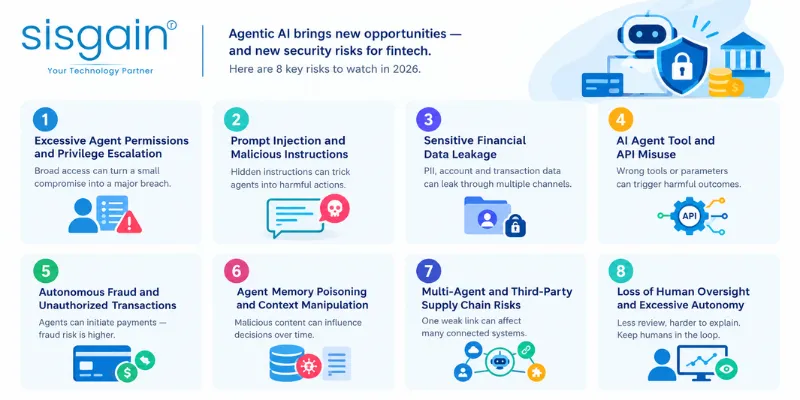
The OWASP GenAI Security Project published its Top 10 for Agentic Applications 2026 in December 2025. It is a peer-reviewed framework built with input from more than 100 experts, focused on the most critical risks facing autonomous AI systems. Its categories include goal manipulation, tool misuse, excessive privilege, supply chain weaknesses and memory management flaws. The eight risks below reflect those themes, applied to financial services.
1. Excessive Agent Permissions and Privilege Escalation
Agents are often given broad access "just in case." An agent that only needs to read invoices but can also edit payment details turns any compromise into a serious incident. If its credentials are stolen, an attacker inherits everything the agent can do.
The core problem is least privilege. Agents need their own identity and authorization controls rather than borrowing a human user's access. NIST has made this a focus: in February 2026 its Center for AI Standards and Innovation launched an AI Agent Standards Initiative covering agent security, identity and authorization.
2. Prompt Injection and Malicious Instructions
Prompt injection happens when an attacker hides instructions in content the agent reads. Direct injection comes from the user's own input. Indirect injection is subtler: instructions embedded in an email, PDF, web page or data field that the agent processes while doing legitimate work.
For a fintech agent, this could mean a document that quietly tells the agent to reveal account details or approve a transfer. NIST's own research is a sobering reference point: red-team testing found novel attack techniques hijacked agent tasks 81% of the time, compared with 11% for the strongest baseline attacks.
3. Sensitive Financial Data Leakage
Agents handle customer PII, banking details, transaction histories and credit records. Data can leak through prompts, stored memory, API responses or third-party tools. Even without a malicious attacker, an over-helpful agent can surface information to the wrong person if data boundaries are not enforced.
4. AI Agent Tool and API Misuse
Agents act through tools: payment APIs, banking platforms, CRM and ERP systems, internal databases. If an agent is manipulated, or simply makes a reasoning error, it can call the wrong tool, pass the wrong parameters, or chain legitimate actions into a harmful outcome. The tools may all be working exactly as designed, which makes this failure hard to spot.
5. Autonomous Fraud and Unauthorized Transactions
When agents can initiate payments, the stakes rise sharply. Risks include manipulated transaction instructions, account takeover through a compromised agent, and agent-initiated payments that no human reviewed. Banking-sector discussions around agentic commerce have raised concerns about misuse of financial data, insecure transaction pathways and fraud. Autonomous financial actions need stronger authorization than a typical user click.
6. Agent Memory Poisoning and Context Manipulation
Many agents store memory or rely on retrieval from knowledge bases. If an attacker plants malicious content there, it can influence decisions long after the initial attack. Long-running agents accumulate context, which can quietly carry poisoned instructions from one session to the next.
7. Multi-Agent and Third-Party Supply Chain Risks
Modern agent systems depend on third-party models, plugins, external APIs, cloud infrastructure and, increasingly, other agents. A vulnerability in any dependency can propagate through connected workflows. The IMF has also noted that AI can amplify financial-sector cyber risk through shared infrastructure and common service providers, so one weak link can affect many institutions.
8. Loss of Human Oversight and Excessive Autonomy
As agents handle longer chains of tasks, humans review less. That creates a traceability problem: when an agent takes a harmful action, it can be hard to explain why. Organizations need to distinguish human-in-the-loop (a person approves each step) from human-on-the-loop (a person supervises and can intervene) and decide which fits each risk level. Clear accountability must exist for every agent's actions.
How Agentic AI Changes the Fintech Cybersecurity Attack Surface
| Traditional Fintech AI | Agentic AI |
|---|---|
| Generates recommendations | Takes actions |
| Limited system access | Access to multiple tools and APIs |
| Mostly human-controlled | Partially or fully autonomous |
| Static workflows | Dynamic workflows |
| Single interaction | Multi-step execution |
| Lower operational impact | Higher operational impact |
This table reflects five deeper shifts in how security teams need to think:
- From model security to agent security: protecting the model is only one layer; the tools, memory and permissions around it matter as much.
- From user identity to machine identity: every agent needs its own authenticated, auditable identity.
- From output validation to action authorization: checking what an agent says is not enough; you must control what it is allowed to do.
- From isolated AI to a connected ecosystem: risk now travels across integrations and vendors.
- From periodic monitoring to continuous runtime monitoring: agents behave dynamically, so oversight must be continuous.
Real-World Fintech Scenarios Where Agentic AI Can Create Cybersecurity Risks
These scenarios are illustrative, based on how the risks above could realistically play out.
An AI Agent Handling Customer Banking Requests
A customer asks an agent to update contact details. During the process, the agent reads an external document containing hidden instructions. Following them, it retrieves account information the customer was never authorized to see. Lesson: treat all external content as untrusted and enforce data access rules outside the model.
An AI Agent Supporting Fraud Detection
An agent reviews suspicious transactions. An attacker seeds misleading context, such as crafted transaction notes, to steer the agent toward a wrong conclusion, so genuine fraud is cleared or a legitimate customer is blocked. Lesson: validate agent conclusions against independent signals for high-impact decisions.
An AI Agent Connected to Payment Systems
An agent receives a payment instruction, but the boundary between "prepare" and "execute" is unclear. A manipulated request results in an unauthorized payment. Lesson: separate preparation from execution and require policy checks or human approval before money moves.
An AI Agent Connected to Internal Financial Databases
An agent has broad read access for convenience. A manipulated prompt causes it to pull sensitive records and send them through a connected tool. Lesson: restrict data scope per task and monitor outbound actions.
How Fintech Companies Can Secure AI Agents
Good agentic AI security does not replace traditional cybersecurity. It extends it. NIST's recent work makes the same point: established practices still apply, but they must be adapted for AI models combined with software tools and autonomous actions.
Implement Strong Agent Identity and Access Management
Give every agent a unique identity. Apply least-privilege, role-based permissions, short-lived credentials and continuous authorization instead of long-lived, all-purpose keys. NIST's NCCoE has also proposed a demonstration project on agent identity and authorization, exploring approaches built on OAuth 2.0, SPIFFE/SPIRE and the Model Context Protocol.
Apply Zero Trust Principles to AI Agents
Never trust an agent automatically. Verify every request and action, restrict lateral movement between systems, and monitor continuously. In practice, this means an agent's access is granted per task, not per role forever.
Secure Agent-to-API and Tool Communication
Use strong API authentication and authorization, validate inputs and outputs, apply rate limiting, and maintain an allowlist of approved tools so an agent cannot call anything it discovers.
Protect Financial Data and Agent Memory
Encrypt data, classify it by sensitivity, filter sensitive fields before they reach the model, isolate memory between users and tasks, and control who and what can read or write it.
Add Human Approval for High-Risk Actions
Require review for payments, fund transfers, account changes, privilege changes and sensitive external communications. Autonomy can be generous for low-risk tasks and strict for irreversible ones.
Continuously Monitor Agent Behavior
Keep detailed audit logs, run runtime monitoring and anomaly detection, use behavioral analytics, and maintain an incident response plan that covers agent-specific scenarios such as a suspected compromised agent.
The Role of AI Governance in Securing Agentic AI in Fintech
Technical controls fail without governance to back them up. A workable governance program includes:
- An AI agent inventory so you know what is running
- Risk classification to match controls to impact
- Named ownership for every agent
- Permission management and periodic access reviews
- Human accountability for agent decisions
- Auditability of actions and reasoning
- Continuous testing, including prompt injection and red-team exercises
- Third-party risk management for models, plugins and APIs
- Incident response procedures
- Documented AI governance policies
The OWASP Top 10 for Agentic Applications 2026 and NIST's ongoing AI agent security work are practical reference points. Both are voluntary, but financial regulators and procurement teams increasingly expect organizations to show alignment with recognized frameworks.
Agentic AI Security vs Traditional Fintech Cybersecurity
| Security Area | Traditional Approach | Agentic AI Approach |
|---|---|---|
| Identity | Human/user identity | Human + agent identity |
| Access | Role-based access | Dynamic, least-privilege authorization |
| Monitoring | System monitoring | System + agent behavior monitoring |
| Threat detection | Rule/signature-based | Behavioral + AI-assisted detection |
| Transactions | Human approval | Human + policy-based agent authorization |
| Data security | Database/API controls | Data + model + memory + tool controls |
| Governance | Application governance | AI + agent lifecycle governance |
The takeaway: you are not starting from zero. Your existing security foundation matters, but each row needs an agent-aware upgrade.
How AI Agents Can Also Strengthen Fintech Cybersecurity
Agents are not only a risk. Used well, they are a powerful defensive tool. They can support:
- Automated threat detection and faster incident response
- Fraud pattern detection across large transaction volumes
- Vulnerability identification and prioritization
- Security alert investigation and triage
- Automated security workflows
- Continuous compliance monitoring
- Threat intelligence analysis
Both the IMF and the BIS have observed that AI can strengthen cyber defense while also increasing the scale and speed of cyber risk. The goal is not to avoid agents, but to deploy them with the right guardrails.
How Businesses Can Prepare for Secure Agentic AI Adoption in 2026

Use this checklist before scaling any agent:
- Identify every AI agent in your environment
- Map the data each agent can access
- Map every connected tool and API
- Define explicit agent permissions
- Apply least privilege everywhere
- Set human approval thresholds for high-risk actions
- Test regularly for prompt injection
- Monitor agent behavior continuously
- Audit third-party AI dependencies
- Establish an AI incident-response process
How SISGAIN Helps Businesses Build and Secure AI-Powered Fintech Solutions
Secure agentic AI needs both strong engineering and strong security. SISGAIN supports businesses across the full journey, from building agents to protecting them.
AI Agent Development for Financial Workflows
Businesses that want secure autonomous agents for customer service, financial operations, fraud detection and workflow automation should work with an experienced ai agent development company that designs permissions, guardrails and oversight in from the start, rather than adding them later.
Strengthening Fintech Security Infrastructure
Identity security, Zero Trust architecture, threat detection, data protection and continuous monitoring form the backbone of a resilient environment, and organizations in the region can strengthen these layers with dedicated cybersecurity solutions uae built for regulated financial workloads.
Building Secure Financial Applications
Secure architecture, well-protected APIs, reliable integrations and scalable design are essential for any financial product, which is why many teams turn to specialist fintech application development services when building or modernizing their platforms.
Automating Repetitive Financial Workflows
Document handling, intelligent processing and routine operational tasks are ideal candidates for automation with human checkpoints, and well-scoped ai automation services can improve efficiency without removing the oversight that financial processes require.
Developing Enterprise AI Solutions in Dubai
Custom AI development, agentic systems and enterprise integrations work best when planned around your existing infrastructure, and businesses in the UAE can explore tailored ai development services dubai to move from pilot to production responsibly.

Conclusion
Agentic AI offers real productivity and automation gains for fintech. But autonomy means agents can access data, use tools, make decisions and execute actions, so traditional AI security alone is not enough. The biggest concerns are identity, permissions, prompt injection, data leakage, tool misuse, memory manipulation, third-party dependencies and excessive autonomy.
The safest path combines AI governance, Zero Trust, strong identity, least privilege, continuous monitoring and human oversight. Businesses that build these foundations now will be able to scale agentic AI with confidence instead of scrambling to catch up after an incident.
Frequently Ask Questions ?
What is agentic AI in fintech?
It is AI that can plan, decide and take actions across financial systems with limited human input, such as investigating fraud alerts, processing KYC documents or preparing transactions.
What are the biggest agentic AI security risks?
Excessive permissions, prompt injection, sensitive data leakage, tool and API misuse, unauthorized transactions, memory poisoning, supply chain vulnerabilities and loss of human oversight.
How can AI agents create cybersecurity risks in financial services?
Agents have access to data and tools. If they are manipulated, over-permissioned or poorly monitored, they can expose data or perform harmful actions at machine speed.
Can AI agents access sensitive financial data?
Yes, if they are granted access. That is why data scoping, encryption, filtering and least-privilege permissions are essential.
How does prompt injection affect fintech AI agents?
Malicious instructions hidden in emails, documents or data can trick an agent into revealing information or taking unauthorized actions.
How can financial institutions secure AI agents?
Give each agent a unique identity, apply least privilege and Zero Trust, allowlist tools, protect data and memory, require approval for high-risk actions, and monitor behavior continuously.
What is the role of Zero Trust in agentic AI security?
Zero Trust means no agent or request is trusted by default. Every action is verified, access is limited to what is needed, and activity is monitored.
Can AI agents execute financial transactions autonomously?
Technically yes, but for higher-value or irreversible transactions, policy checks and human approval are strongly recommended.
How does agentic AI affect fintech cybersecurity?
It expands the attack surface by adding machine identities, tool connections, memory and autonomous actions, so security must cover agents as well as models.























Sign in to leave a comment.