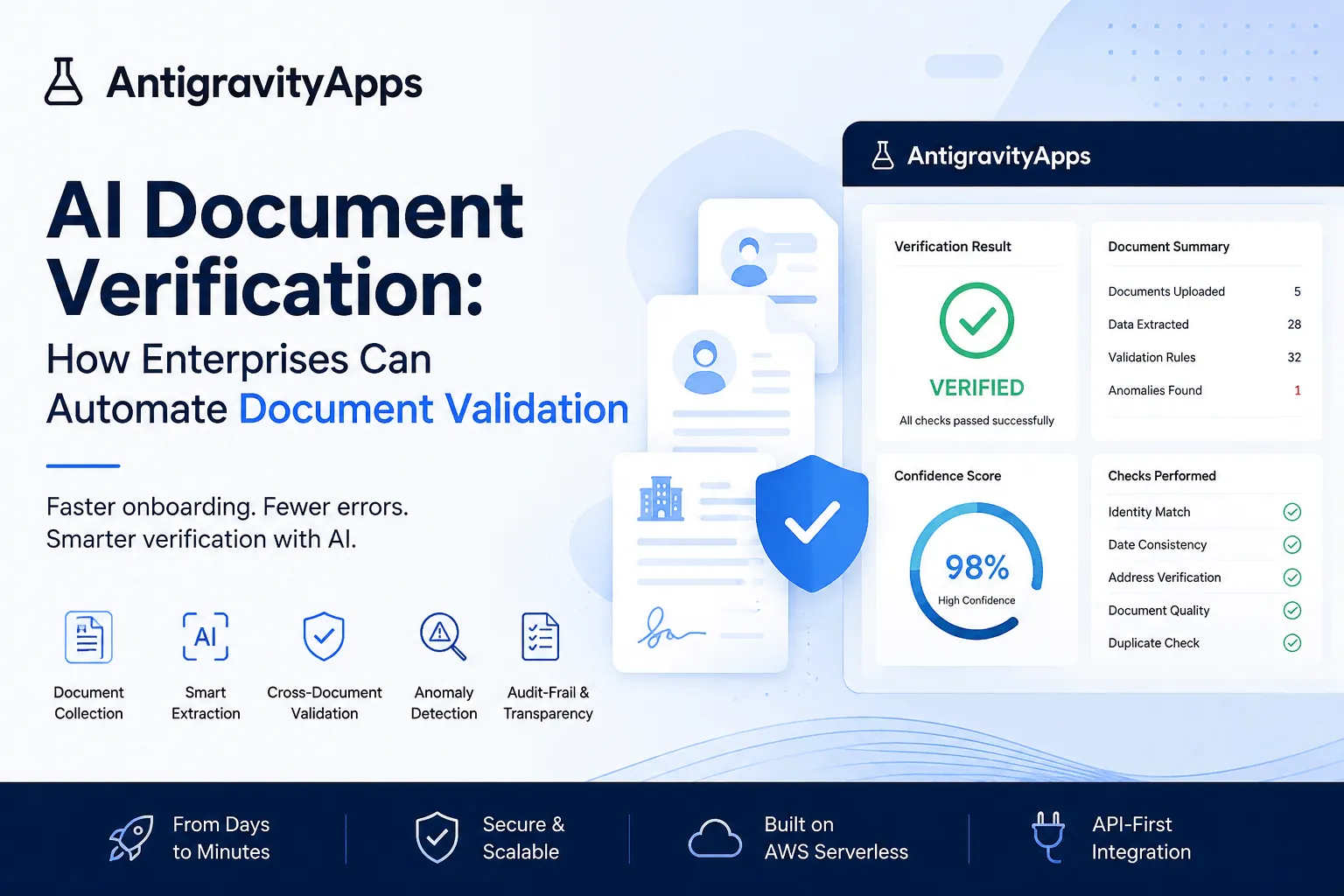

For many enterprises, document verification is still far more manual than it should be. Teams collect passports, IDs, certificates, invoices, bank statements, contracts, and other documents, then spend hours checking whether the information is complete, accurate, and consistent.
The problem becomes even bigger when an organization handles thousands of documents across different teams and workflows.
This is where AI document verification can make a meaningful difference. Instead of asking employees to review every field manually, AI can extract information, compare documents, identify inconsistencies, and highlight cases that actually need human attention.
What Is AI Document Verification?
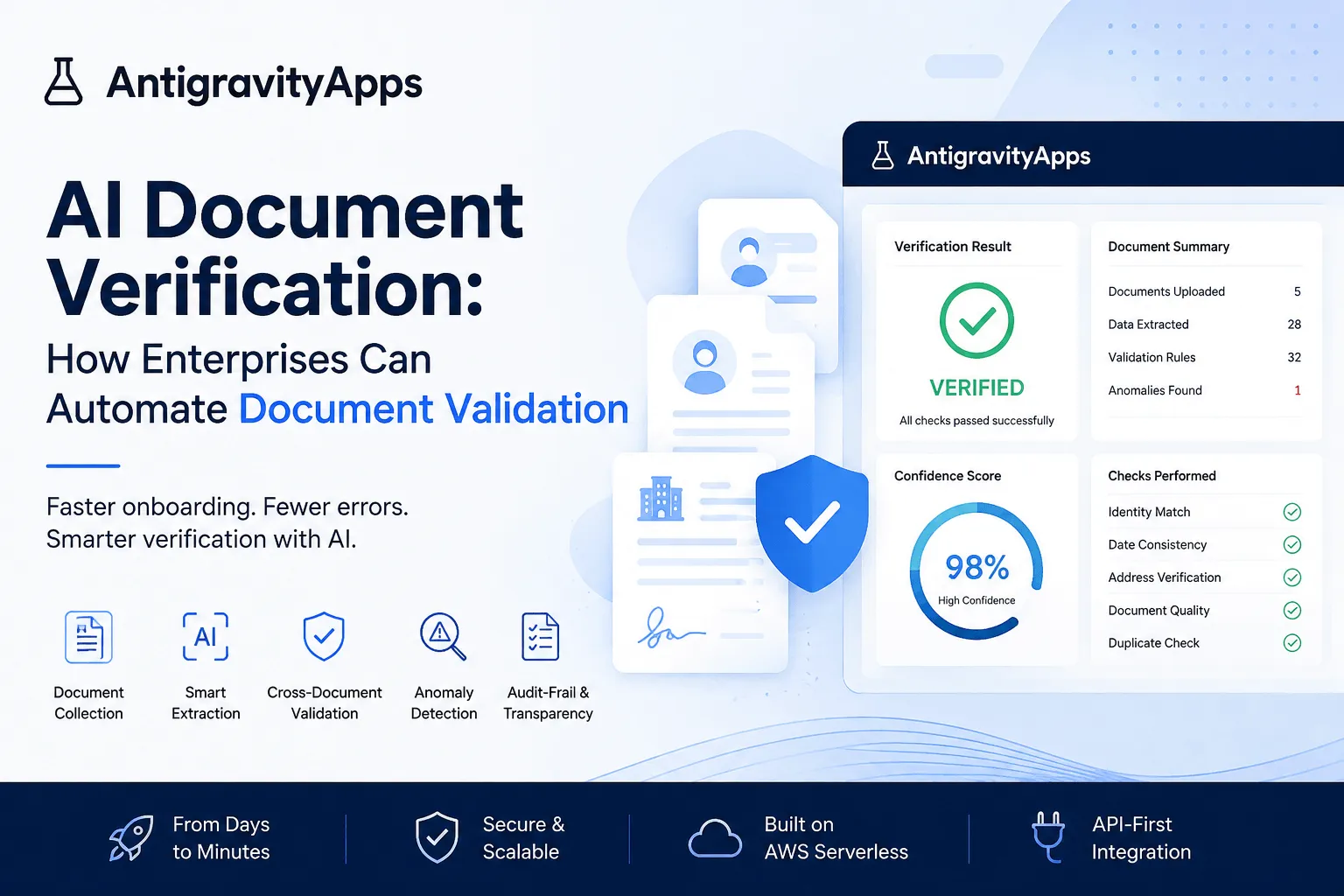
AI document verification is the use of artificial intelligence to collect, understand, extract, and validate information from documents.
A traditional verification process might require an employee to open multiple files, read individual fields, compare names and dates, check whether required documents are present, and record the results manually.
An AI-powered system can handle much of this process automatically.
For example, suppose an enterprise needs to verify an employee’s identity during onboarding. The system may need to check an ID document, address proof, employment documents, and other supporting files.
Instead of checking each document separately, an AI document verification system can extract the relevant information and compare it across the entire document set.
If the name matches everywhere, dates are consistent, and all required documents are available, the workflow can move forward. If something looks unusual, the system can flag it for human review.
Why Enterprises Need Automated Document Verification
Manual document review is not only time-consuming. It can also become difficult to manage as an organization grows.
A company processing a few hundred documents might manage with a manual team. But processing tens of thousands of documents every month creates a completely different challenge.
Automated document verification helps enterprises reduce repetitive work while maintaining a structured verification process.
Some of the biggest benefits include:
- Faster document processing
- Reduced manual data entry
- More consistent validation
- Easier identification of missing information
- Better detection of inconsistencies
- Improved auditability
- Easier integration with existing enterprise systems
The goal isn’t necessarily to remove people from the process. A better approach is to let technology handle routine checks while employees focus on exceptions and complicated cases.
How AI-Powered Document Validation Works
An effective AI document validation workflow generally involves several stages.
1. Document Collection
The process starts by collecting the required documents. Depending on the workflow, these could include identity documents, financial records, certificates, applications, or supporting evidence.
A structured system can identify whether all required documents have been submitted.
2. Information Extraction
The next step is extracting useful information from the documents.
AI-powered extraction can identify fields such as names, dates, addresses, document numbers, and other relevant information without requiring an employee to manually enter every value.
This turns unstructured documents into structured information that can be processed further.
3. Cross-Document Validation
One of the most useful capabilities of modern document verification systems is comparing information across multiple documents.
For example, the system may check whether:
- The applicant’s name is consistent across documents.
- Dates match where they should.
- Addresses correspond between related records.
- Required information is present.
- Duplicate documents have been submitted.
These checks can uncover issues that may be easy to overlook during repetitive manual reviews.
4. Anomaly Detection
Not every problem means that a document is fraudulent. Sometimes a document is simply incomplete, duplicated, unclear, or inconsistent with another document.
An automated system can identify these anomalies and send them to the appropriate team for further investigation.
This creates a more practical workflow where humans review exceptions instead of manually checking every field.
Introducing DocProof
DocProof is an AI-powered document verification solution designed for enterprise onboarding and document-heavy workflows.
It combines document collection, AI-powered extraction, rule-based validation, cross-document verification, and anomaly detection into a structured workflow.
With DocProof, organizations can define their verification rules, submit documents, and receive structured results showing what was checked and why.
The platform is designed around a simple principle: automate routine verification and let humans focus on anomalies.
DocProof also provides an audit trail for verification checks, including reasoning and confidence information. This can be particularly useful for enterprise teams that need visibility into how verification decisions were reached.
Why DocProof Uses a Deterministic Workflow
There is an important difference between using AI everywhere and using AI where it provides the most value.
DocProof uses a structured workflow rather than relying on an autonomous AI agent to make every decision. Targeted LLM calls are used where document understanding is required, while deterministic rules handle predictable validation tasks.
This approach can make the process more consistent, easier to debug, and more predictable from a cost perspective.
DocProof is also built using AWS serverless services, supporting a scalable architecture designed for enterprise workloads.
API-First Document Verification for Enterprise Systems
Enterprises rarely work with isolated software. Document verification often needs to connect with CRMs, ERPs, onboarding platforms, internal applications, or other business systems.
That’s why an API-first document verification software approach can be valuable.
DocProof can be integrated into existing workflows so organizations can incorporate document verification without completely changing their current technology stack.
Instead of moving documents manually between different systems, verification can become part of the existing onboarding or operational process.
The Future of Enterprise Document Verification
As enterprises process more digital documents, manual verification becomes increasingly difficult to scale.
The future is not simply about replacing human reviewers with AI. It is about creating a smarter workflow where machines handle repetitive extraction and validation, while experienced employees concentrate on unusual or high-risk cases.
That is the role AI document verification can play.
With capabilities such as automated extraction, cross-document validation, anomaly detection, rule-based checks, API integration, and audit trails, platforms like DocProof can help enterprises move from slow, repetitive document reviews toward faster and more structured verification workflow.
























Sign in to leave a comment.