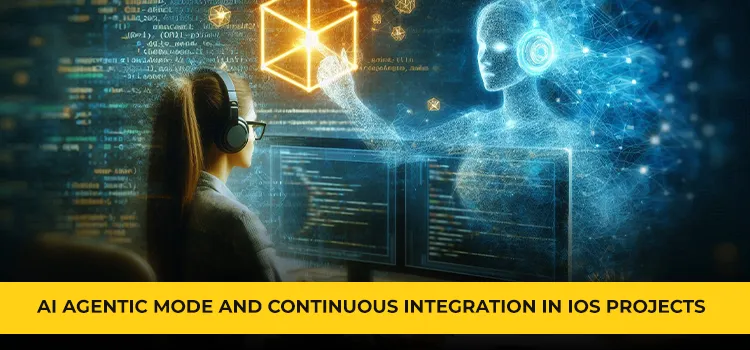

Introduction
Modern iOS app development involves many tasks, including coding. Development teams need to monitor application performance, code efficiency, testing, security, and updates. As iOS apps are becoming more advanced, manual process handling can slow down development. It also increases the risk of errors.
An AI agent-based development process can help teams increase their efficiency with precision. Developers used AI agents primarily for code suggestions. However, nowadays, it helps development teams with repetitive process automation for various tasks. AI helps teams make informed decisions. Moreover, it detects issues and strengthens continuous integration.
This blog explores how AI and continuous integration combine to transform the modern iOS development process. Let's start with the scope of AI agentic mode.
Overview of AI Agentic Mode in iOS Development
AI agentic mode works on systems that actively support development tasks. These AI systems analyze the context, identify problems, and provide the necessary recommendations. It offers the following benefits in iOS app development:
- Detecting code issues
- Generating test cases
- Reviewing pull requests
- Analyzing build failures
- Recommending improvements
- Supporting release planning
In simple words, AI plays a vital role in the iOS development process.
This becomes more powerful when applied to CI.
Why Continuous Integration Matters in iOS App Development
Continuous integration enables developers to merge code frequently. It validates changes automatically through builds, testing, and quality checks.
An iOS CI workflow includes
- Automated Xcode builds
- Unit and UI testing
- Static code analysis
- Security and dependency checks
- Deployment automation for staging or TestFlight
Strong continuous integration eliminates delays, releases, unstable builds, and many other production issues.
| Challenge | Without Strong CI | With Strong CI |
| Build Stability | Frequent issues | Reliable builds |
| Testing | Manual effort | Automated checks |
| Deployment | Slower releases | Faster releases |
| Code Quality | Higher defect risk | Early issue detection |
| Collaboration | More conflicts | Smoother development |
Continuous integration provides structure and consistency. AI transforms this entire process smartly.
This is where AI and CI begin to create measurable value together.
How AI Agentic Mode Improves Continuous Integration
AI agentic mode is useful for improving CI (Continuous Integration). Here are the top ways this mode can do it.
Faster Build Failure Analysis
Build failures often take time to investigate. Here, AI helps developers analyze compiler errors, dependency conflicts, and configuration issues.
Instead of spending significant time in manual troubleshooting, developers can identify root causes faster with the help of AI.
Automation Test Generation
It is difficult to maintain strong test coverage, especially in growing iOS applications. AI tools for AI developers are also useful for automatic unit testing. It suggests missing test cases and improvements. It identifies edge cases that developers sometimes miss.
Smarter Code Reviews
AI can support pull request reviews by identifying potential performance concerns, security risks, and code quality issues. Additionally, it detects architectural insufficiencies and possible memory management problems.
It adds an additional validation layer before the code moves forward.
CI Pipeline Optimization
AI can also improve the efficiency of the pipeline by recommending faster build sequences and better test optimization. Moreover, it can remove unnecessary steps.
It makes the CI pipeline more efficient and supports the entire iOS development lifecycle.
Where AI Fits Across the iOS Development Lifestyle
AI helps developers improve overall efficiency, strengthen quality, and reduce risk.
| Development Stage | Traditional Approach | AI-enhanced Approach |
| Coding | Standard CI checks | Intelligent CI monitoring |
| Testing | Developer-created tests | AI-assisted coding |
| Integration | Standard CI checks | Intelligent CI monitoring |
| Code Review | Manual Review | AI-supported review |
| Deployment | Basic automation | Smarter release validation |
| Monitoring | Reactive issue handling | Early risk detection |
This comparison shows the reasons many businesses invest in AI development services.
Why Businesses Use AI Development Services
Adding AI to development workflows requires more effort than adopting standalone tools.
Businesses use AI development services to help with:
- Implementing AI tools within development pipelines
- Improving CI/CD automation
- Integrating AI into engineering workflows
- Adding governance and security controls
- Scaling intelligent automation across teams
This is especially valuable for enterprises or businesses managing complex iOS applications.
The impact becomes clearer through practical scenarios.
Real-Life Scenarios
Saas Product Team
A SaaS business leverages AI to analyze failed builds and to improve testing automation. They use AI to prioritize critical test runs.
Hence, it results in faster release with better code quality and lower QA workload.
Healthcare App provider
A healthcare organization implements AI-assisted validation in CI to improve checks before final deployment. It gives better compliance support and reduces release risk.
Logistics Platform
A logistics company can use AI to optimize their CI workflows to detect performance issues earlier. It provides more stable applications and faster issue resolutions.
AI in development provides many benefits in various industries. Here, the right implementation approach is necessary.
Challenges to Consider
Governance and Control - AI systems must offer clear controls and handle approval processes.
Integration Complexity - Traditional development environments require upgradation. It should be compatible with advanced integration.
Trust and Accuracy - Developers should review AI recommendations.
As development tools are evolving drastically, this approach is becoming more and more popular.
Best Practices for Adopting AI in iOS Development
We can consider these AI adoption best practices in two stages.
Firstly, we should start with practical use cases. These include,
- Build failure analysis
- Test automation
- Pull request support
- CI optimization
- Release risk analysis
In the second stage, we can track results using metrics like-
- Build success rates
- Test coverage growth
- Deployment frequency
- Defect reduction
- Faster issue resolution
These practices assist development teams to scale AI adoption in a structured and measurable way.
The Future of AI Agentic Mode in iOS App Development
AI in iOS development is moving beyond simple coding assistance. Future AI agentic mode in development can introduce:
- Self-improving continuous integration pipelines
- Better optimized release automation
- Potential risk detection
- Continuous code efficiency monitoring
These capabilities may become a standard part of modern software development.
Conclusion
Modern iOS app development demands speed, quality, and reliable delivery to match user expectations. AI agentic mode in development strengthens this foundation with automation, intelligence, and better decision support.
AI is helping development teams build better applications more efficiently with smarter testing and improved pipelines. Strong engineering practices combined with AI development services can support long-term success for businesses looking to scale innovation.






















Sign in to leave a comment.