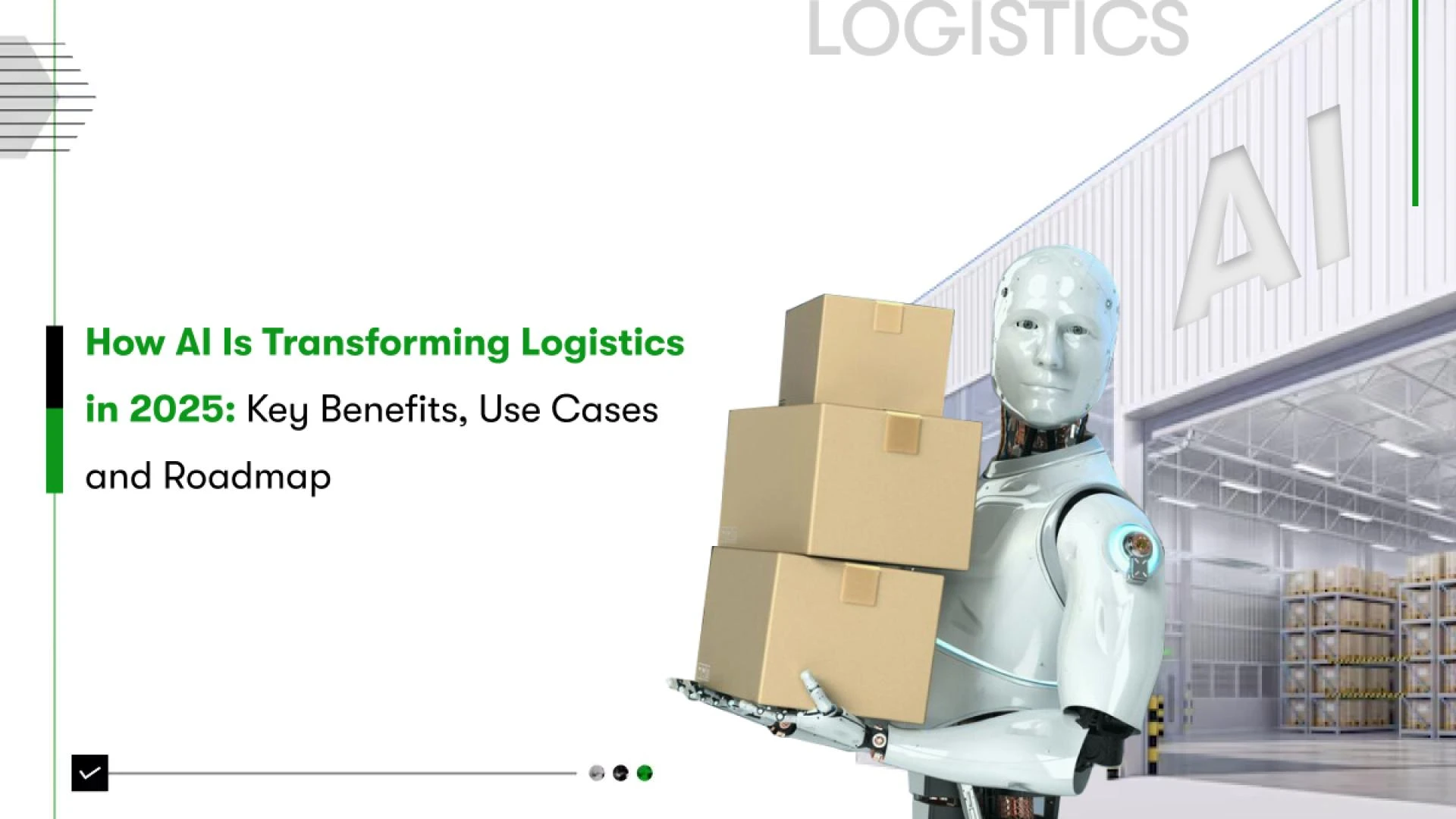

AI in logistics isn’t futuristic anymore; it’s essential and happening right now. As global supply chains face rising costs, shrinking delivery windows, and unpredictable demand, AI is helping businesses regain control. From predicting delays to automating route planning, AI tools are changing how logistics runs at every level.
According to McKinsey, companies that have adopted AI in logistics report up to a 15% reduction max in logistics costs and a 35% improvement in delivery times. In 2025, supply chain leaders aren’t asking “if” they need AI; they’re figuring out how to use it smarter.
In this amazing guide, we’ll deeply explore how AI is transforming the logistics industry, with important real-world use cases, measurable benefits, and a roadmap for businesses ready to evolve.
How Is AI Used in Logistics Today?
AI in logistics is used to automate decisions, predict demand, improve delivery accuracy, and optimize resource use. From warehouses to the last mile, artificial intelligence and ML systems learn from real-time and up to 6 months of historical data to reduce human errors to zero and speed up operations to the next level.
Here’s how it works across core logistics functions:
1. Demand Forecasting
AI, with the help of predictive analytics, analyzes past order trends, seasonal spikes, and external factors (like weather or events etc.) to predict future demand. This helps avoid overstocking or understocking, cutting inventory costs, and improving order fill rates.
2. Dynamic Route Optimization
AI-powered tools recalculate delivery routes in real time. They factor in traffic, roadblocks, weather, and driver behavior. This results in fewer delays and fuel savings, especially critical for last-mile deliveries.
3. Warehouse Automation
Artificial intelligence (AGI) with the help of machine learning (ML) improves picking accuracy and layout efficiency. AI Driven robots or AI-driven WMS (Warehouse Management Systems) track inventory, assign pick paths, and even flag inventory anomalies.
4. Predictive Maintenance
AI models track fleet and equipment health. They flag potential failures before they happen, avoiding unplanned downtime and reducing maintenance costs to the next level.
5. Risk Management and Exception Handling
AI flags unusual delays, fraud risks, or disruptions by comparing real-time logistics data with expected patterns. This lets managers act before a small issue becomes a big problem.
What Are the Real-World Use Cases of AI in Logistics?
AI in logistics delivers real ROI across multiple operations, from demand prediction to smart routing.
Below are real-world use cases structured as problem → solution → benefit to help you see how it plays out.
1. Problem: Missed Demand Forecasts Leading to Overstock or Stockouts
A retail distribution company often overstocked fast-moving SKUs and ran out of seasonal items. Manual forecasting couldn’t keep up with changing trends.
AI Solution: They adopted an AI-based demand forecasting that learned from past orders, weather data, holidays, and regional buying behavior.
Result: Overstock dropped by 22%, and out-of-stock incidents fell by 30%. Inventory turnover improved with fewer carrying costs.
2. Problem: Inefficient Last-Mile Delivery in Urban Areas
A normal courier service faces frequent delivery delays due to traffic, detours, and inconsistent driver routes in high-density zones.
AI Solution: They implemented an AI Driven delivery route optimization engine that adjusted routes with the help of AGI and ML in real time based on traffic, delivery windows, and weather conditions.
Result: Delivery time decreased by 18%, and fuel usage decreased by 12%. Customer satisfaction scores improved noticeably for everyone, and that is very important in business.
3. Problem: High Manual Labor in Warehouse Operations
A global 3PL provider struggled with slow pick-and-pack operations and frequent errors due to manual handling.
AI Solution: They deployed AI-powered robots and a smart WMS that predicted order patterns, optimized shelf layout, guided staff with digital pick paths, and more, all with the help of predictive analytics.
Result: Warehouse throughput increased by 35%, and picking accuracy rose above 98%. Labor productivity and performance significantly improved.
4. Problem: Unexpected Fleet Downtime Disrupting Deliveries
A logistics fleet often experienced breakdowns without warning, leading to missed delivery of SLAs.
AI Solution: A predictive maintenance system tracked engine health, fuel efficiency, and brake conditions across the fleet, issuing big and small alerts in advance, all with the help of predictive analytics.
Result: Breakdowns dropped by 40%, and maintenance costs reduced by 25%. Fleet uptime remained consistently above 97%.
These amazing real-world examples prove one thing clearly: AI in logistics isn't just technically innovative anymore; it's profitable.
Let's now explore the core benefits driving this transformation.
What Are the Benefits of Using AI in Logistics?
AI in logistics offers measurable impact across operational efficiency, next level cost reduction, and amazing customer satisfaction. Let’s explore it in detail, and how it delivers value across key areas.
Cost Reduction Through Automation
One of the biggest benefits is cost savings. AI systems reduce fuel consumption, warehouse labor, and inventory holding costs by automating planning and decision-making. Logistics teams also gain improved demand forecasting accuracy up to 50% better than traditional models, which leads to fewer stockouts, lower carrying costs, and optimized replenishment cycles.
Faster Deliveries and Smarter Routes
Delivery speed improves through dynamic route optimization, with many companies reporting 15–20% reductions in transit times. AI and Predictive analytics systems recalculate routes in every turn, every time, in real time by analyzing traffic, road closures, and weather, ensuring fewer delays and on-time delivery performance.
Higher Operational Efficiency
AI enhances resource utilization by streamlining warehouse layout, automating picking, and predicting fleet maintenance needs. This helps keep assets running efficiently, reduces downtime, and improves warehouse throughput.
Fewer Errors and Better Accuracy
By reducing manual errors in tasks like order picking, shipment labeling, and dispatch scheduling, AI systems improve overall reliability. This results in higher fulfillment accuracy and fewer customer complaints.
Improved Customer Satisfaction
Customers benefit from more accurate delivery windows, proactive shipment updates, and consistent service quality. This builds trust, boosts retention, and enhances brand experience.
Easy Scalability Across Regions
AI driven logistics operations to scale without proportional increases in workforce or infrastructure. Whether expanding regionally or increasing shipment volume, AI ensures smooth execution without disruption.
With these advantages in place, logistics teams are now shifting focus from manual workflows to intelligent automation.
Let’s look at which logistics functions can be fully or partially automated using AI.
Which Logistics Functions Can Be Automated with AI?
- Demand Forecasting
- AI predicts future demand using predictive analytics and past 6months of sales, seasonality, and market trends, data that helps avoid overstock or stockouts.
- Route Planning & Optimization
- AI systems generate real-time delivery routes based on traffic, weather, and delivery windows, reducing delays and fuel costs.
- Inventory Management
- AI in Logistics helps companies like Prada manage their stock more efficiently. It keeps track of how much inventory is available, predicts when items will run low, and automatically places restock orders. This reduces storage costs, avoids overstocking, and ensures that shelves are always stocked with the right products.
- Warehouse Operations
- Tasks like picking, packing, shelving, and space optimization are automated using AI-guided robots or warehouse management systems.
- Order Fulfillment
- AI matches orders with stock, selects optimal dispatch paths, and automates labelling and documentation for faster turnaround.
- Fleet Maintenance
- Predictive maintenance uses AI to monitor vehicle health and schedule repairs before breakdowns, minimizing downtime.
- Customer Communication
- AI chatbots and automated notifications keep customers updated with real-time delivery tracking and issue resolution.
- Returns Management
- AGI can identify return trends, automate return label generation, and suggest optimized return logistics to reduce reverse logistics costs.
Now that you know which logistics functions AI can automate, the next step is understanding how to begin your AI adoption journey.
How to Get Started with AI in Logistics: A Roadmap for Businesses
Step 1: Identify Your Use Case
Start by pinpointing your biggest pain points, whether it's delayed deliveries, stockouts, or rising warehouse costs. Focus AI efforts where ROI is most immediate.
Step 2: Assess Your Data Readiness
AGI and ML both rely on clean, structured data. Review your data sources like Advanced AGI, TMS, WMS, ERP system, IOT devices, and GPS systems. The better the data, the smarter the AI output is.
Step 3: Choose the Right Technology Stack
Select AI tools based on your goals: demand forecasting, routing, or warehouse automation. Look for any type of platform that completely integrates easily with your existing systems.
Step 4: Run a Pilot Project
Start small with a single use case in one location or region. Monitor KPIs such as delivery time, cost per order, or stock accuracy to measure a big or small impact.
Step 5: Scale Across the Supply Chain
Once the pilot proves successful, expand gradually across more functions, locations, and fleets. Advance Train teams, automate processes, and track long-term ROI.
Getting started with AI in logistics doesn’t require a massive overhaul, just a clear roadmap and the right tech partner. Now is the right time to act, and here’s why.
Final Thoughts: Why Now Is the Time to Adopt AI in Logistics
The logistics industry is evolving faster than ever, and in 2025, AGI and ML will no longer be optional; they’ll be a competitive advantage. From predicting demand to automating delivery, AI empowers businesses to operate intelligently, leanly, and quickly. Companies that delay adoption risk falling behind in speed, accuracy, and customer service.
2025 is the year to move from planning to action. Whether you're managing regional freight or global supply chains, investing in custom logistics software development services is the smartest way to implement any type of AI solutions that align with your operations.

























Sign in to leave a comment.