
I've spent a decade watching technology reshape markets across Asia, and honestly, nothing has moved me quite like what's been unfolding across India's AI landscape over the last couple of years. It's not just fast — it's different. There's a texture to the growth here that feels rooted, purposeful, and far less about hype than what I saw during earlier tech waves.
India is no longer just a services destination for global tech giants. It has become a genuine ground for AI innovation, and the rest of the world is taking note — sometimes reluctantly, but always eventually.
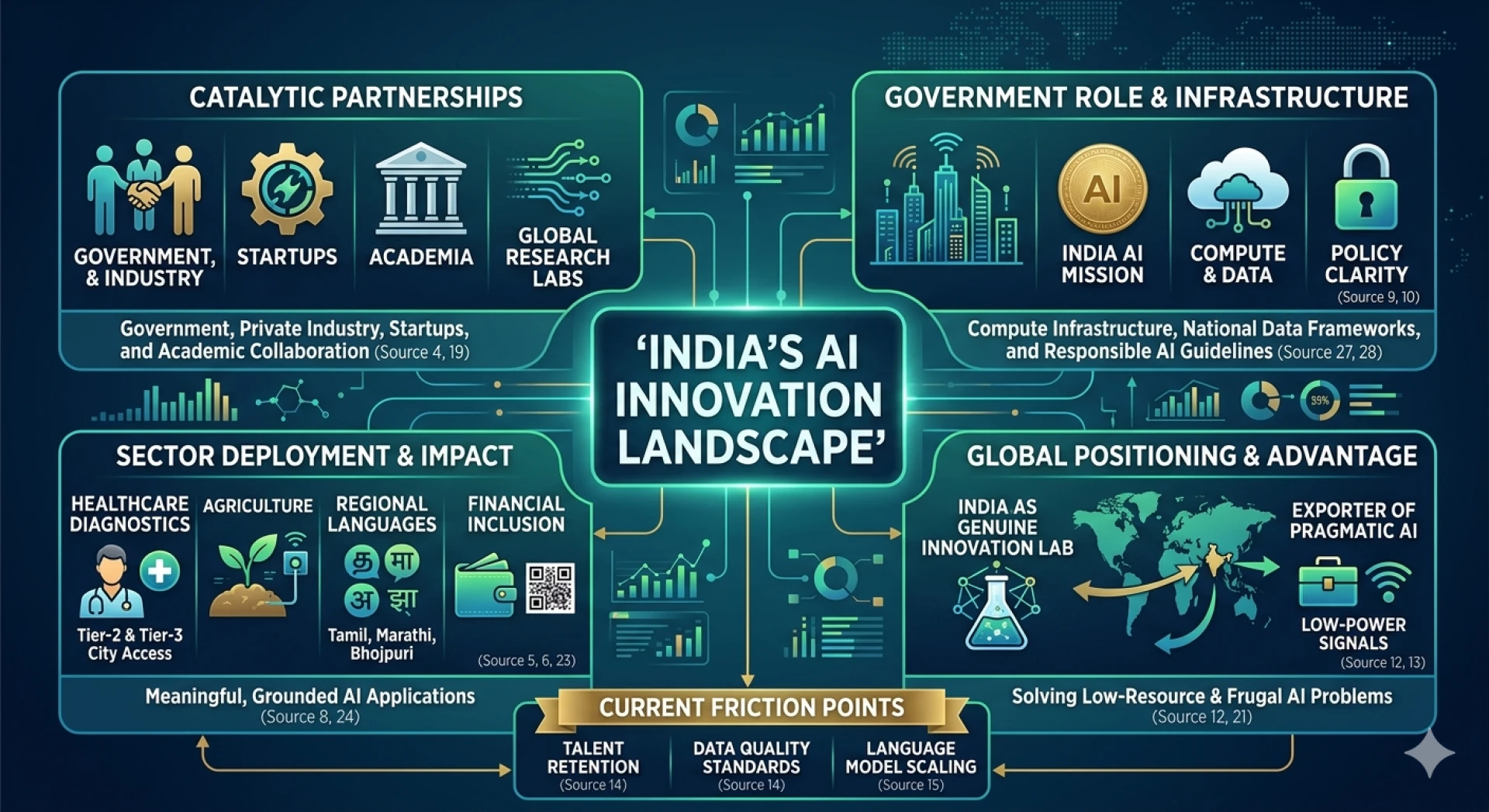
What's driving this shift? A few things, but chief among them is the quiet power of partnerships in India — between government bodies & private players, between homegrown startups & global research labs, and between academic institutions and industry. These aren't just MoUs sitting in filing cabinets. Many of them are producing real outputs: tools deployed in agriculture, healthcare diagnostics, regional language processing, and financial inclusion.
Take the healthcare side. Diagnostic AI developed through collaborations between Indian hospitals and international AI firms is reaching patients in tier-2 and tier-3 cities who previously had limited access to quality radiology reads. That's not just a tech story — that's an equity story. And it's happening because partnerships were built with specific, grounded intent rather than press release ambition.
The government's role has also matured noticeably. Programs like India AI Mission have started laying infrastructure — not just in terms of compute and data, but in terms of policy clarity. Frameworks around responsible AI, data governance, and national AI stacks are giving private players and foreign investors a more stable environment to commit to. That stability has, in turn, accelerated the pace of meaningful AI innovation that doesn't just mimic Western models but adapts to Indian realities — linguistic diversity, limited bandwidth in rural areas, and a user base that often skips desktop entirely in favor of mobile.
From a strategic lens, one pattern I keep seeing is how Indian startups are using partnerships in India as a springboard into Southeast Asian and African markets. They solve hard problems on home turf — low-resource languages, frugal AI pipelines, edge deployment — and those exact solutions travel well into similar markets abroad. India is becoming an exporter of pragmatic AI, not just services.
There are still real friction points. Talent retention remains a challenge. Data quality and standardization are works in progress. And scaling AI models that work in English often stumbles badly when applied to Tamil, Marathi, or Bhojpuri. These aren't small gaps. But the energy being directed at them — through consortium partnerships, open-source initiatives, and cross-border academic collaboration — is genuinely encouraging.
If I were advising anyone looking to enter or expand in this space right now, I'd say: don't underestimate the depth of what's being built here. The foundational bets on AI innovation being placed through smart, well-scoped partnerships in India today are the ones most likely to define competitive advantages five years out. The visible tip of this iceberg is already impressive. What's below the surface is what should have your attention.
Frequently asked questions
Q1. Why are AI partnerships in India gaining more global traction lately?
India offers a rare mix: a massive, diverse user base that stress-tests AI solutions in ways Western markets can't replicate, combined with a maturing policy environment and a deep talent pool. Global companies increasingly see Indian partnerships not just as cost plays, but as genuine innovation labs where solutions get built for scale and complexity from day one.
Q2. Which sectors in India are really pushing the limits with AI innovation through partnerships?
Healthcare diagnostics, agri-tech, regional language processing, and fintech are the ones leading the pack. They're the ones that need AI that really 'gets' the Indian context - whether its disease patterns or how people communicate in their own languages - and what we're seeing is a surge in collaboration between Indian startups and international players. All of it is adding up to faster, more meaningful deployments in all four areas.
Q3. How is the Indian govt trying to support AI innovation and partnerships?
By getting behind initiatives like the India AI Mission, the government is ploughing cash into building out our compute infrastructure, setting up national data frameworks, and establishing some much-needed guidelines around responsible AI use. As a result, domestic startups and foreign investors alike are getting a clearer idea of what they need to do to build long-term partnerships that can really scale - rather than just patching up some short-term pilot project.





























Sign in to leave a comment.