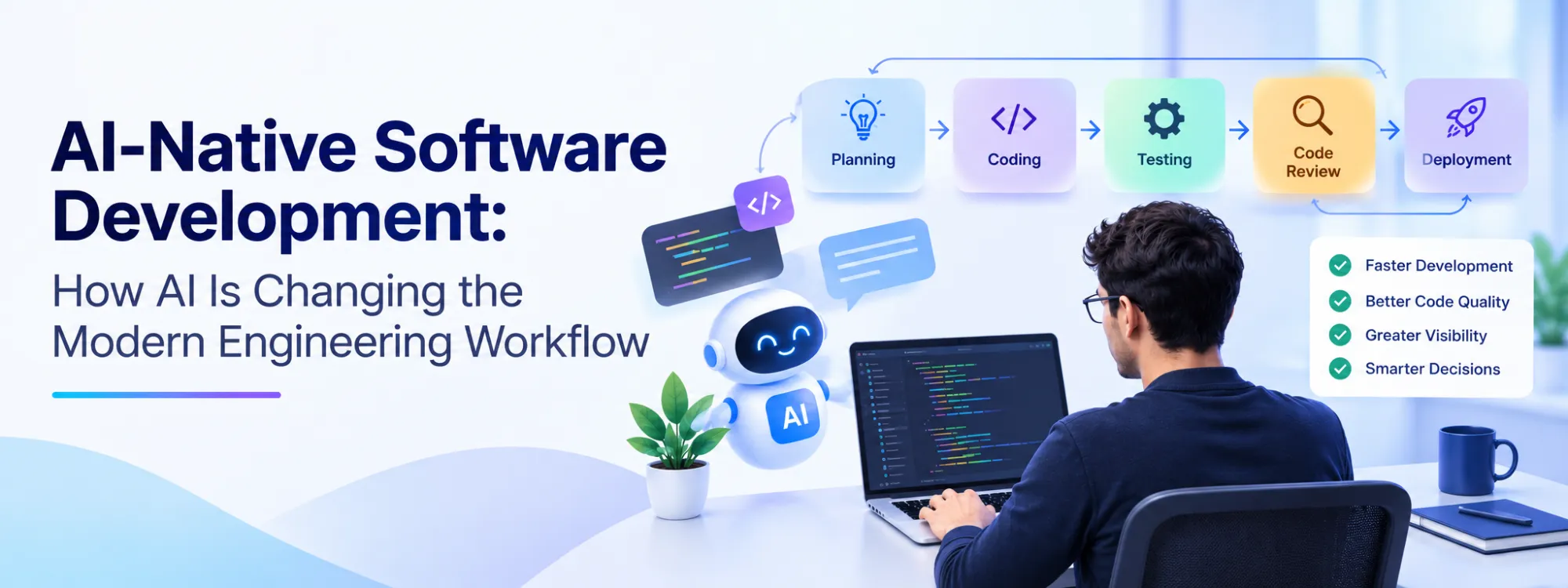

Software engineering is entering a new phase. AI is no longer limited to autocomplete, code suggestions, or occasional assistance with debugging. Modern engineering teams are beginning to integrate AI across planning, coding, testing, documentation, code review, and delivery.
This shift is creating a new approach to building software: AI-native software development. Instead of treating AI as an additional tool within an existing engineering process, teams are redesigning workflows around AI capabilities while maintaining human oversight, technical standards, and measurable outcomes.
The result is a development environment where engineers can move faster while creating more structured and repeatable processes.
What Is AI-Native Software Development?
AI-native software development refers to an approach where AI is integrated into multiple stages of the software development process rather than being used only for isolated coding tasks.
Traditional development workflows generally follow a predictable sequence: requirements are defined, developers write code, tests are created, issues are resolved, and the application is deployed. AI can now participate in many of these activities.

For example, an engineering team may use AI to:
- Convert requirements into technical implementation plans
- Generate or modify code
- Analyze existing repositories
- Create test cases
- Identify potential bugs
- Explain unfamiliar code
- Assist with documentation
- Review implementation decisions
- Support debugging and optimization
However, becoming AI-native does not simply mean adding more AI tools. Teams need structured workflows that define where AI is useful, where human judgment is required, and how development outcomes should be evaluated.
How AI Is Changing the Engineering Workflow
AI is changing engineering workflows by reducing repetitive work and helping developers interact with codebases more efficiently.

1. Planning Becomes More Interactive
Software planning traditionally requires engineers to manually break requirements into technical tasks. AI can assist by analyzing requirements, identifying dependencies, suggesting implementation approaches, and creating structured development plans.
Instead of starting immediately with code, developers can use AI to explore different approaches and identify potential challenges before implementation begins.
This makes planning more iterative. Engineers can ask questions, refine requirements, evaluate trade-offs, and create a clearer path toward implementation.
2. Coding Becomes More Collaborative
AI coding assistants can generate functions, suggest implementations, refactor existing code, and explain unfamiliar components.
The developer remains responsible for deciding what should be built and whether the generated implementation is appropriate. AI becomes a collaborator rather than an autonomous replacement for engineering expertise.
This creates a different interaction model. Developers increasingly describe intent, review generated solutions, modify implementations, and validate the resulting code.
3. Testing Moves Closer to Development
Testing is another area where AI can have a significant impact.
AI can help developers generate test cases, identify edge cases, analyze failures, and suggest potential improvements. When integrated into the development workflow, testing can become a continuous activity rather than something performed only after implementation is complete.
This approach encourages developers to validate AI-generated code immediately and creates stronger feedback loops between implementation and quality assurance.
4. Code Review Can Become More Evidence-Based
As AI generates more code, reviewing that code becomes increasingly important.
Engineering teams need to understand not only whether the final code works, but also how it was created, modified, tested, and validated. AI-assisted development therefore increases the importance of development evidence.
Teams can establish review processes that examine AI-generated changes, testing results, architectural decisions, and developer validation.
Tools such as Savyre can support structured AI-assisted development workflows by helping teams create greater visibility into how software is planned, implemented, and evaluated.
The Rise of the Agentic Product Development Lifecycle
As AI capabilities expand, development is moving beyond simple coding assistance toward more autonomous workflows.
The Agentic Product Development Lifecycle describes an emerging model where AI agents can participate in multiple stages of product development, from understanding requirements to planning, implementation, testing, and validation.
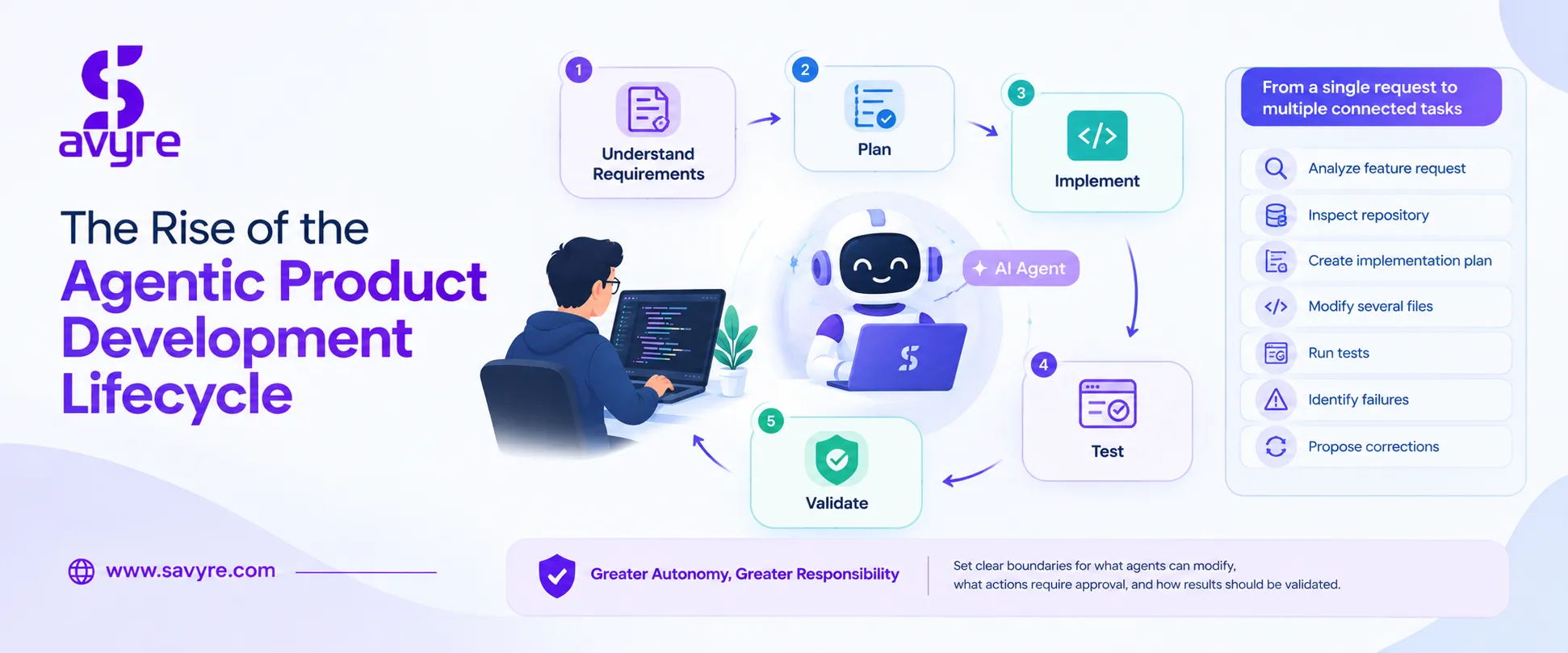
Rather than asking an AI assistant to generate a single function, engineers can increasingly provide a larger objective and allow AI systems to perform multiple connected tasks.
For example, an AI agent might analyze a feature request, inspect the repository, create an implementation plan, modify several files, run tests, identify failures, and propose corrections.
However, greater autonomy also creates greater responsibility. Engineering teams need clear boundaries around what agents can modify, what actions require approval, and how results should be validated.
From AI Coding Assistants to Agentic SDLC
The evolution of AI in software engineering can also be understood through the development of the Agentic SDLC.

An Agentic SDLC extends traditional software development lifecycle practices by allowing AI agents to perform connected activities across multiple stages of development.
Instead of using separate AI tools for coding, testing, documentation, and debugging, an agentic workflow can connect these activities.
A developer might begin with a requirement and ask an AI agent to:
- Analyze the requirement
- Inspect the existing codebase
- Develop an implementation plan
- Generate or modify code
- Run tests
- Analyze failures
- Refine the implementation
- Produce a development report
This can reduce repetitive work and allow engineers to focus more heavily on architecture, decision-making, validation, and product outcomes.
However, autonomous workflows should not eliminate human accountability. Developers and engineering leaders still need visibility into changes and evidence that the resulting software meets technical and business requirements.
Why Structured AI Workflows Matter
The biggest challenge with AI-assisted development is not simply generating code. It is maintaining consistency, quality, and accountability as AI becomes more deeply integrated into engineering.
Unstructured AI usage can lead to several problems:
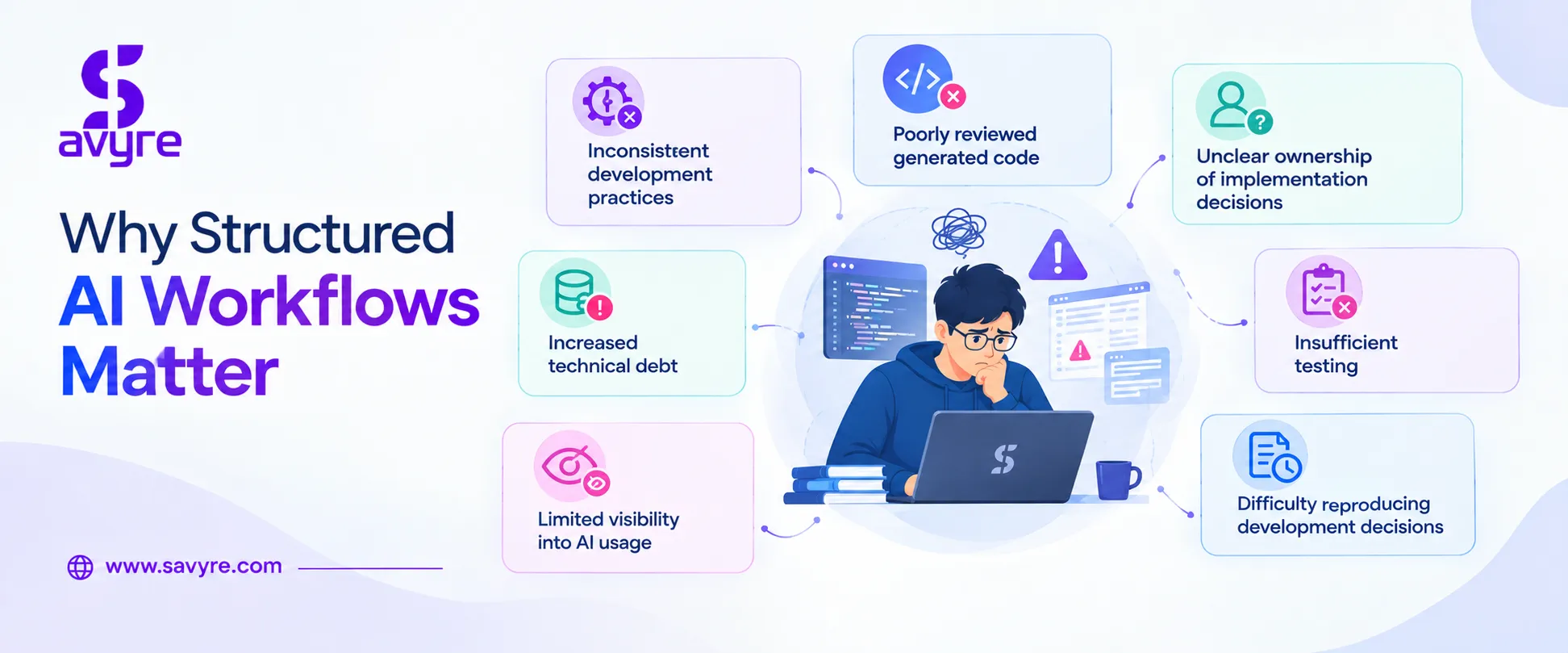
- Inconsistent development practices
- Poorly reviewed generated code
- Unclear ownership of implementation decisions
- Insufficient testing
- Difficulty reproducing development decisions
- Increased technical debt
- Limited visibility into AI usage
Structured workflows address these problems by defining stages, checkpoints, validation steps, and expected outputs.
For example, an engineering workflow might require developers to create a plan before implementation, validate AI-generated code with automated tests, review changes manually, and document important technical decisions.
Savyre approaches AI-assisted development with structured workflows that help engineering teams introduce AI into development processes while maintaining evidence and control.
The Role of Developers in an AI-Native Environment
AI-native engineering does not mean removing developers from the software development process.
Instead, the developer's role evolves.
Developers increasingly spend less time writing every line manually and more time:
- Defining requirements
- Designing architecture
- Evaluating AI-generated solutions
- Reviewing implementation quality
- Testing and validating results
- Managing technical risk
- Making engineering decisions
This makes critical thinking even more important.
An AI system can generate a technically valid solution that is still inappropriate for the product. It may introduce unnecessary complexity, overlook security concerns, misunderstand business requirements, or create long-term maintenance problems.
Human expertise remains essential for determining whether a solution is actually the right solution.
Building a Modern Engineering Workflow With AI
Organizations looking to adopt AI across software development should start with a structured approach rather than introducing numerous AI tools simultaneously.
A practical adoption strategy can include four steps.

Start With Defined Use Cases
Identify repetitive or time-consuming engineering activities where AI can provide measurable value.
Examples include code generation, documentation, test creation, debugging assistance, repository analysis, and code review.
Establish Human Review
Define which AI-generated actions require developer approval. High-impact changes should generally remain subject to human review and validation.
Measure Development Outcomes
Teams should evaluate whether AI is improving meaningful engineering outcomes rather than measuring AI usage alone.
Useful metrics can include development cycle time, defect rates, test coverage, review quality, and deployment reliability.
Create Repeatable Workflows
Once successful practices are identified, teams can convert them into standardized workflows that developers can follow consistently.
This helps organizations scale AI adoption without allowing every developer to create completely different development processes.
The Future of AI-Driven Engineering
The future of software engineering will likely involve a combination of human expertise, AI assistants, and increasingly capable AI agents.
The Agentic SDLC may eventually enable AI systems to perform substantial portions of routine software development while engineers focus on architecture, product decisions, quality, security, and governance.
The important transition is therefore not simply from manual coding to AI-generated code. It is a transition toward development environments where AI participates throughout the engineering process.
Organizations that establish structured workflows early can be better positioned to take advantage of increasing AI capabilities without sacrificing software quality or engineering accountability.
Conclusion
AI is fundamentally changing how software teams plan, build, test, and maintain applications. The most effective organizations will not simply adopt AI coding assistants; they will rethink how engineering work is organized around AI.
AI-native software development represents this broader transformation by integrating AI into the development workflow while preserving human judgment and technical oversight.
As agentic systems become more capable, concepts such as the Agentic Product Development Lifecycle and Agentic SDLC provide useful frameworks for understanding how AI can participate across increasingly large portions of software development.
The key to successful adoption is balance: automate repetitive work, create structured workflows, validate AI-generated results, and keep engineers accountable for technical decisions.
With the right approach, AI can become more than a coding assistant. It can become an integrated part of a modern engineering workflow that helps teams build software faster while maintaining quality, visibility, and con

























Sign in to leave a comment.