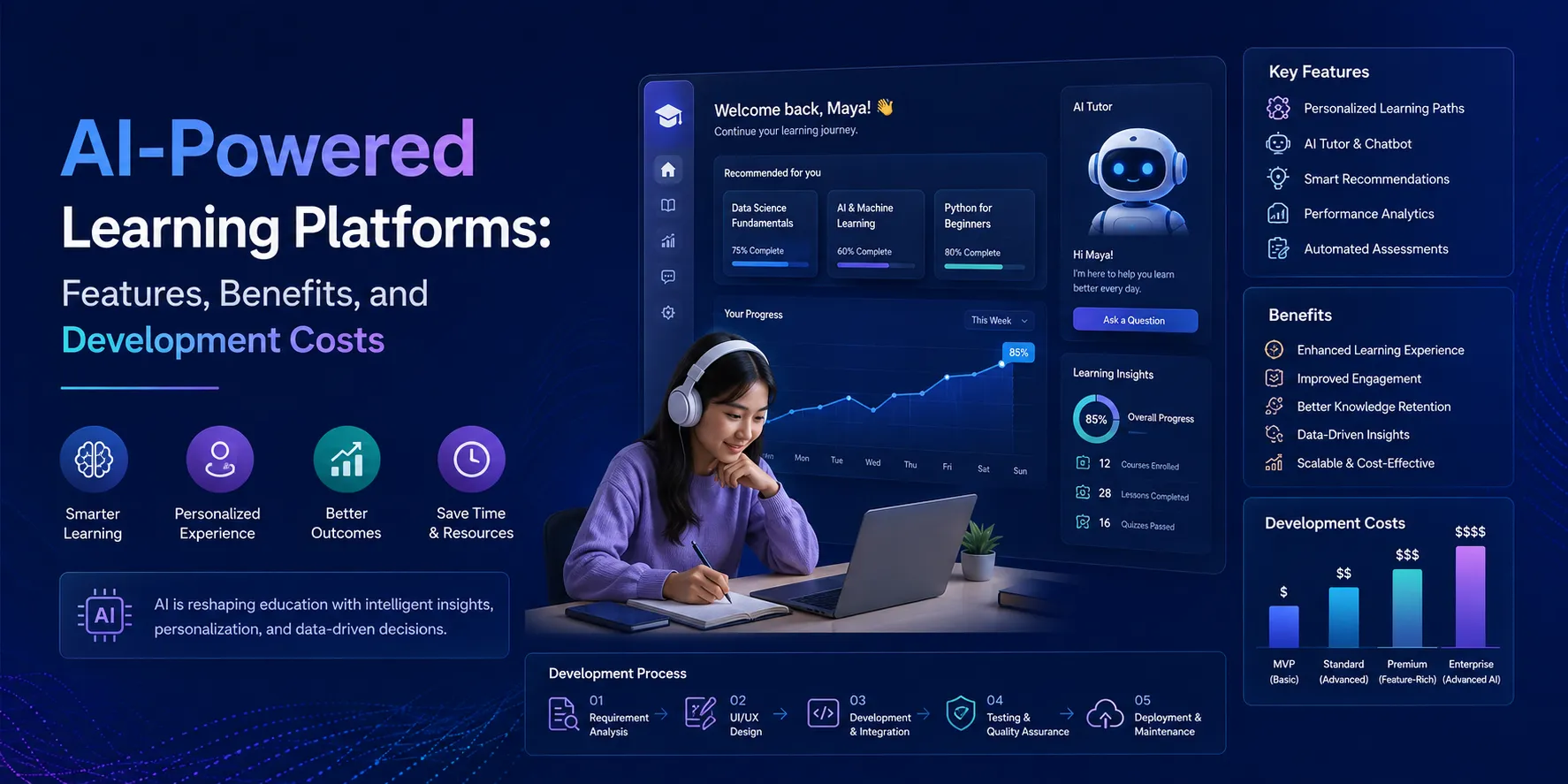

Online learning has changed the way students, professionals, and organizations access education. However, simply moving courses online is no longer enough. Learners expect platforms to understand their needs, provide quick support, and make learning more engaging.
This is where artificial intelligence is making a difference. AI Development for E-Learning Platform solutions can turn a traditional learning management system into an intelligent platform that personalizes content, tracks progress, automates routine tasks, and provides real-time assistance.
What Is an AI-Powered Learning Platform?
An AI-powered learning platform uses technologies such as machine learning, natural language processing, generative AI, recommendation engines, and learning analytics to improve the learning experience.
Instead of giving every learner the same course path, an AI-enabled platform can analyze performance and behavior to recommend appropriate lessons, exercises, and resources.
For example, if a learner repeatedly struggles with a particular topic, the platform can recommend additional explanations and practice before moving to a more advanced lesson.
Key Features of AI-Powered E-Learning Platforms
1. Personalized Learning
Personalization is one of the biggest advantages of AI in education. AI can analyze a learner's performance, interests, learning speed, and previous activities to create a more suitable learning path.
The system can recommend courses, lessons, quizzes, and study materials based on individual requirements.
2. AI Virtual Tutors
AI tutors provide learners with on-demand assistance. Students can ask questions in natural language and receive explanations without waiting for an instructor.
Generative AI can make these interactions more conversational, while human educators can remain involved in complex or sensitive learning situations.
3. Intelligent Assessments
AI can make online assessments more dynamic. Instead of using the same questions for everyone, an intelligent assessment system can adjust question difficulty according to a learner's performance.
This helps identify knowledge gaps and gives learners more relevant practice.
4. Automated Grading and Feedback
AI can automate grading for many objective assessments and assist with evaluating certain types of written work.
It can also provide immediate feedback, helping learners understand mistakes while the material is still fresh in their minds.
5. AI Chatbots
Educational chatbots can answer common questions about courses, assignments, schedules, and learning resources. They can provide support around the clock and reduce repetitive work for teachers and support teams.
6. Learning Analytics
AI-powered learning analytics can turn student data into useful insights. Educators can see engagement levels, course completion rates, assessment performance, and areas where learners may need additional support.
Benefits of AI Development for E-Learning Platform
Investing in AI can provide benefits for both learners and education businesses.
Better learner engagement: Personalized content and interactive AI tools can make online learning more relevant.
Improved learning outcomes: Adaptive learning systems can focus on areas where students need additional practice.
Reduced administrative workload: Automation can handle repetitive tasks such as basic grading, recommendations, and frequently asked questions.
24/7 learner support: AI assistants can provide help outside normal teaching hours.
Scalable education: AI-powered platforms can support large numbers of learners without requiring the same increase in manual resources.
Data-driven decisions: Learning analytics can help educators understand what is working and where improvements are needed.
How Much Does It Cost to Develop an AI E-Learning Platform?
The AI e-learning platform development cost depends heavily on the platform's features, complexity, technology stack, integrations, and AI requirements.
A basic platform with AI recommendations and chatbot functionality may require a relatively modest development investment. A more advanced solution with personalized learning, generative AI tutoring, predictive analytics, automated assessments, multilingual capabilities, and custom AI models will require significantly more development work.
As a broad industry estimate:
- Basic AI learning platform: $25,000 to $50,000
- Medium-complexity platform: $50,000 to $120,000
- Advanced enterprise platform: $120,000 to $250,000+
These figures are estimates rather than fixed prices. API usage, cloud infrastructure, AI model costs, security requirements, third-party integrations, maintenance, and ongoing model optimization can also affect the total cost.
Factors That Affect Development Cost
Several factors influence the final budget:
- Number and complexity of AI features
- Custom AI model development
- Generative AI and LLM integration
- Mobile and web applications
- UI/UX design requirements
- LMS and third-party integrations
- Data security and privacy
- Number of users
- Cloud infrastructure
- Testing and quality assurance
- Post-launch maintenance
Starting with a focused MVP can be a practical approach. Businesses can launch essential features, collect user feedback, and gradually introduce more advanced AI capabilities.
The Future of AI-Powered Learning
AI-powered education is moving toward more intelligent and personalized learning experiences. AI agents, conversational tutors, predictive learning analytics, and adaptive content can make digital education increasingly responsive to individual learners.
However, technology should support education rather than replace the human side of teaching. Good AI development combines automation with educator expertise, reliable content, privacy protection, and meaningful learner interaction.
Conclusion
AI is transforming e-learning platforms from simple course delivery systems into intelligent learning environments. With personalized learning, AI tutors, intelligent assessments, automated feedback, chatbots, and learning analytics, organizations can create more engaging and effective digital education experiences.
For businesses planning AI Development for E-Learning Platform, the right strategy is to start with clear learning objectives, select the most valuable AI features, and build a scalable foundation for future growth.




























Sign in to leave a comment.