

Artificial intelligence has moved beyond experimental chatbots. In 2026, businesses are building AI-powered software for customer support, document processing, predictive analytics, enterprise search, workflow automation, recommendation engines, copilots, AI agents, and industry-specific applications. As demand for these solutions grows, AI software development companies in USA are helping businesses turn AI capabilities into production-ready software and integrated business solutions.
The challenge is no longer simply finding an AI development company. The harder question is finding a partner that can take an AI idea from business requirements and data preparation to architecture, development, evaluation, deployment, security, and ongoing optimization.
The U.S. market includes large technology consultancies, AI-focused software engineering firms, nearshore development companies, data science specialists, and companies specializing in generative AI and agentic systems. Recent 2026 industry comparisons similarly show a market ranging from enterprise engineering firms to specialized AI development providers.
This guide examines 12 AI software development companies serving the USA, their core services, technologies, pricing considerations, and the factors businesses should evaluate before selecting an AI development partner.
The right AI development partner is not simply the company that can build a model. It is the team that can turn an AI capability into reliable software that works inside your real business environment.
Quick Answer: Best AI Software Development Companies in USA
Companies worth evaluating for AI software development projects include:
| Company | Primary AI Focus | Suitable For |
|---|---|---|
| WeblineIndia | Custom AI, GenAI, LLMs, AI agents, ML | Startups, SMBs and enterprises |
| LeewayHertz | AI product engineering and enterprise AI | Enterprise AI products |
| Simform | Generative AI, agentic AI, ML | Enterprise software modernization |
| Azumo | AI agents, RAG, GenAI, LLM fine-tuning | Production AI applications |
| InData Labs | AI, ML, data science, GenAI | Data-intensive AI projects |
| Markovate | Generative AI, agentic AI, computer vision | Enterprise AI products |
| Master of Code Global | Conversational AI and GenAI | Customer-facing AI |
| 10Pearls | AI and digital product development | Enterprise digital products |
| SoluLab | AI/ML, GenAI and automation | Custom AI applications |
| Vention | AI/ML and software engineering | Dedicated engineering teams |
| DataArt | AI, data and software engineering | Enterprise technology |
| EPAM | AI and digital engineering | Large-scale transformation |
This is a market comparison rather than a universal ranking. The appropriate company depends on your project scope, budget, data maturity, industry, security requirements, preferred technology stack, and delivery model.
What Is AI Software Development?
AI software development is the process of designing and building applications that use artificial intelligence to perform tasks such as prediction, classification, generation, reasoning, recommendation, perception, automation, or decision support.
An AI software product can combine several technologies rather than relying on a single model.
For example, an enterprise AI assistant might use:
Frontend → Backend → Authentication → API layer → LLM → RAG → Vector database → Business systems → Monitoring
A production AI application may therefore require expertise across:
- Artificial intelligence
- Machine learning
- Generative AI
- Large language models
- Natural language processing
- Computer vision
- Data engineering
- Cloud infrastructure
- API development
- MLOps
- Cybersecurity
- User experience
This is why choosing an AI software development company purely on its ability to integrate an LLM API can be risky.
What Services Do AI Software Development Companies Provide?
The scope varies between providers, but modern AI development services commonly include the following.
Generative AI Development
Generative AI applications can create or transform:
- Text
- Images
- Audio
- Video
- Code
- Structured data
Companies may build custom GenAI applications using proprietary APIs, open-weight models, or a combination of models.
LLM Development
LLM development can include:
- Custom LLM applications
- LLM integration
- Prompt engineering
- RAG
- Fine-tuning
- Model evaluation
- LLM APIs
- AI copilots
- Enterprise knowledge assistants
AI Agent Development
AI agents combine models with tools, business rules, APIs, memory and workflows to execute multi-step tasks.
Typical applications include:
- Customer service agents
- Sales agents
- Research agents
- IT support agents
- Finance workflow agents
- Document-processing agents
- Scheduling agents
Machine Learning Development
Traditional machine learning remains important for:
- Predictive analytics
- Fraud detection
- Recommendation engines
- Demand forecasting
- Customer segmentation
- Risk scoring
- Anomaly detection
Computer Vision
Computer vision solutions can process:
- Images
- Video
- Documents
- Manufacturing inspections
- Medical imagery
- Retail imagery
- Security footage
NLP Development
Natural language processing can support:
- Text classification
- Sentiment analysis
- Entity extraction
- Document analysis
- Search
- Summarization
- Voice and conversational applications
RAG Development
Retrieval-Augmented Generation connects an LLM with external knowledge sources.
This can include:
- Company documents
- Databases
- Knowledge bases
- Websites
- CRM data
- Product catalogs
- Internal policies
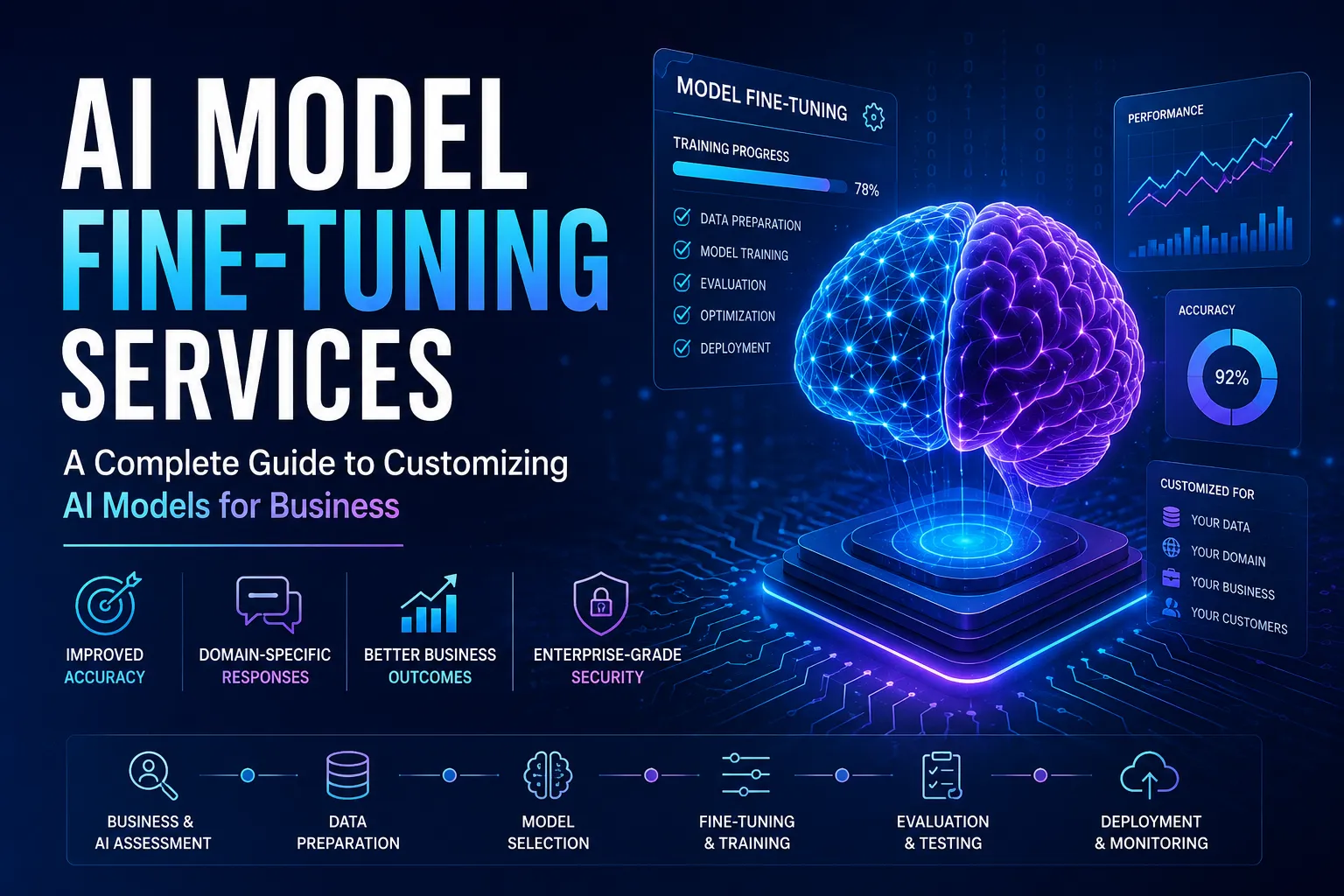
AI Model Fine-Tuning
Fine-tuning can adapt an existing model to specific behaviors, tasks, terminology, or response formats.
AI Integration
AI can be embedded into existing:
- SaaS products
- CRM systems
- ERP platforms
- Healthcare systems
- E-commerce platforms
- Mobile applications
- Enterprise software
12 AI Software Development Companies in the USA
1. WeblineIndia
WeblineIndia provides custom AI software development services covering AI, machine learning, generative AI, LLMs, AI agents, model fine-tuning and enterprise AI.
Its current AI service portfolio includes AI development, generative AI development, AI model fine-tuning, LLM development, enterprise AI development, AI agent development and AI consulting.
Its U.S.-focused AI development offering covers machine learning, NLP, deep learning, computer vision, AI-powered analytics, chatbots and speech recognition. The company also describes a process covering requirements, strategy, technology identification, QA/compliance testing, deployment and support.
Key AI services
- Generative AI development
- LLM development
- AI agent development
- AI model fine-tuning
- Machine learning
- NLP
- Computer vision
- AI consulting
- Enterprise AI
- AI automation
Technology ecosystem
Its published technology stack includes technologies such as:
- Python
- OpenAI
- TensorFlow
- PyTorch
- Machine learning frameworks
- NLP technologies
- Cloud platforms
- AI APIs
Suitable for
WeblineIndia can be considered when the requirement involves custom AI software development rather than only access to an AI API.
Typical projects can include AI SaaS platforms, enterprise AI applications, AI agents, RAG applications, intelligent automation and AI-enabled business software.
2. LeewayHertz
LeewayHertz is an AI and software development company focused on AI product engineering and enterprise applications.
Its AI development positioning covers generative AI, machine learning, computer vision and NLP, making it relevant for organizations developing custom AI products.
Typical services
- Generative AI
- AI application development
- Machine learning
- NLP
- Computer vision
- LLM applications
- AI consulting
- Enterprise AI
Suitable for
Businesses looking for an AI product engineering partner with experience across multiple AI technologies.
3. Simform
Simform provides software engineering and generative AI development services.
Its current GenAI offering includes agentic AI development, fine-tuning smaller language models, RAG, LLM integration, data engineering, governance and model monitoring.
Key strengths
- Generative AI
- Agentic AI
- RAG
- LLM integration
- Data engineering
- MLOps
- AI governance
- Enterprise software engineering
Simform's published approach emphasizes moving beyond proofs of concept toward production-ready AI systems and includes a GenAI framework covering data operations, governance, security, LLM integration, RAG and monitoring.
4. Azumo
Azumo focuses heavily on production AI engineering.
Its current AI development portfolio includes:
- AI agents
- RAG
- NLP
- Computer vision
- Generative AI
- LLM fine-tuning
- LLM evaluation
- MLOps
One notable aspect of its published methodology is the distinction between retrieval and fine-tuning: retrieval can provide current information while fine-tuning can teach model behavior.
Azumo also publishes engagement ranges from discovery and proof-of-concept work through production AI systems and larger enterprise platforms. Its stated engagement range starts around $10,000 and can exceed $500,000 depending on scope, data readiness and integration depth.
Suitable for
- AI agents
- RAG systems
- Enterprise AI
- GenAI applications
- LLM customization
- Production AI engineering
5. InData Labs
InData Labs combines AI development, machine learning and data science.
Its published AI technology stack includes:
- Python-based AI development
- TensorFlow
- PyTorch
- Keras
- Scikit-learn
- MLflow
- TensorRT
- ONNX
- Computer vision technologies
- Machine learning
Its services cover AI consulting, custom AI software development, generative AI, machine learning and LLM fine-tuning.
Suitable for
Organizations where data engineering, machine learning and AI development are closely connected.
Common applications include:
- Predictive analytics
- Computer vision
- NLP
- GenAI
- Recommendation systems
- Data-driven automation
6. Markovate
Markovate focuses on AI and generative AI development, including agentic AI, computer vision and machine learning.
Its published capabilities include production AI systems across industries such as manufacturing, construction, healthcare, insurance and real estate. The company also states that it maintains ISO 27001:2022 and ISO 9001:2015 certifications.
Services
- Generative AI
- Agentic AI
- Computer vision
- Machine learning
- AI automation
- Document intelligence
Suitable for
Businesses developing industry-specific AI products and enterprise automation systems.
7. Master of Code Global
Master of Code Global focuses heavily on conversational AI and generative AI applications.
Its published AI development portfolio includes conversational experiences, GenAI applications and customer-facing AI systems. One published example is a generative AI assistant for automotive e-commerce.
Suitable for
- Conversational AI
- Customer service
- AI assistants
- E-commerce
- Marketing automation
- Generative AI applications
The company also promotes a 30-day AI pilot approach for scoping, building and deploying an AI solution.
8. 10Pearls
10Pearls operates in digital product development and enterprise software engineering, with AI included within its broader technology capabilities.
It can be relevant when AI development is part of a larger product modernization initiative involving:
- Mobile applications
- Web applications
- Cloud
- Data
- AI
- Enterprise integrations
Suitable for
Organizations that want AI capabilities integrated into a broader digital product rather than developing an isolated AI prototype.
9. SoluLab
SoluLab provides AI and machine learning development alongside broader software development capabilities.
Typical AI services can include:
- Generative AI
- Machine learning
- NLP
- Computer vision
- AI applications
- Predictive analytics
- AI automation
Suitable for
Startups and businesses seeking custom AI application development combined with conventional software engineering.
10. Vention
Vention provides software development and engineering teams for technology businesses and enterprises.
For AI projects, the delivery model can be relevant when a company needs additional:
- AI engineers
- ML engineers
- Software developers
- Data engineers
- Product specialists
Suitable for
Organizations that already have product leadership but need additional engineering capacity to build and scale AI-enabled applications.
11. DataArt
DataArt operates as a software engineering and technology consulting company with capabilities spanning data, cloud, AI and application development.
Its model can be relevant for organizations where AI needs to connect with existing enterprise infrastructure.
Suitable for
- Enterprise software
- Data modernization
- AI integration
- Cloud transformation
- Large-scale software engineering
12. EPAM Systems
EPAM operates at large enterprise scale across digital engineering, software development and technology consulting.
For AI initiatives, an organization of this scale can be relevant when artificial intelligence is one part of a broader transformation involving:
- Cloud
- Data platforms
- Software modernization
- Enterprise architecture
- AI implementation
- Digital engineering
Suitable for
Large organizations with complex technology estates and multi-year transformation programs.
AI Software Development Company Comparison
| Company | Generative AI | LLM | AI Agents | ML | RAG | Enterprise Software |
|---|---|---|---|---|---|---|
| WeblineIndia | ✓ | ✓ | ✓ | ✓ | ✓ | ✓ |
| LeewayHertz | ✓ | ✓ | ✓ | ✓ | ✓ | ✓ |
| Simform | ✓ | ✓ | ✓ | ✓ | ✓ | ✓ |
| Azumo | ✓ | ✓ | ✓ | ✓ | ✓ | ✓ |
| InData Labs | ✓ | ✓ | ✓ | ✓ | ✓ | ✓ |
| Markovate | ✓ | ✓ | ✓ | ✓ | ✓ | ✓ |
| Master of Code Global | ✓ | ✓ | ✓ | — | ✓ | ✓ |
| 10Pearls | ✓ | ✓ | ✓ | ✓ | ✓ | ✓ |
| SoluLab | ✓ | ✓ | ✓ | ✓ | ✓ | ✓ |
| Vention | ✓ | ✓ | ✓ | ✓ | ✓ | ✓ |
| DataArt | ✓ | ✓ | ✓ | ✓ | ✓ | ✓ |
| EPAM | ✓ | ✓ | ✓ | ✓ | ✓ | ✓ |
The table is a high-level market comparison. Exact technologies, model availability and project capabilities depend on the engagement and should be confirmed with the provider.
AI Software Development Tech Stack
The technology stack should be selected according to the problem rather than because a framework is currently popular.
Programming Languages
Python remains particularly important for:
- AI
- Machine learning
- Data science
- NLP
- LLM applications
Other technologies can include:
- JavaScript
- TypeScript
- Java
- C#
- C++
- Go
AI and ML Frameworks
Common technologies include:
- PyTorch
- TensorFlow
- Scikit-learn
- Keras
- Hugging Face
- XGBoost
LLM Technologies
Modern LLM applications can use:
- OpenAI models
- Anthropic models
- Google Gemini
- Meta Llama
- Mistral
- Qwen
- Hugging Face models
LLM Application Frameworks
Depending on the architecture:
- LangChain
- LangGraph
- LlamaIndex
- Semantic Kernel
- Haystack
Vector Databases
RAG systems can use:
- Pinecone
- Weaviate
- Milvus
- Qdrant
- pgvector
- Elasticsearch
Cloud
Enterprise AI projects may use:
- AWS
- Microsoft Azure
- Google Cloud
DevOps and MLOps
Production AI systems may require:
- Docker
- Kubernetes
- MLflow
- CI/CD
- Model monitoring
- Logging
- Observability
- Automated evaluation
How Much Does AI Software Development Cost in the USA?
There is no single AI development price.
The cost depends on what you're actually building.
Recent 2026 market estimates put simple AI features at roughly $10,000–$40,000, mid-complexity systems around $40,000–$120,000, and complex custom AI systems at $120,000–$400,000+. Enterprise-grade platforms with multi-agent architectures, compliance and extensive integrations can reach $400,000–$1 million or more. These are market estimates rather than fixed industry prices.
Another 2026 market analysis places proof-of-concept projects around $15,000–$40,000, MVPs around $50,000–$200,000 and enterprise platforms from approximately $500,000 upward.
Typical Planning Ranges
| AI Project | Approximate Budget |
|---|---|
| AI API integration | $10K–$40K |
| AI proof of concept | $15K–$50K |
| AI chatbot | $20K–$80K |
| RAG application | $30K–$120K |
| AI copilot | $50K–$200K |
| AI SaaS product | $75K–$300K+ |
| AI agent system | $80K–$400K+ |
| Enterprise AI platform | $300K–$1M+ |
These ranges are planning benchmarks, not quotations.
What Drives AI Development Cost?
1. Data Complexity
Clean structured data reduces development effort.
Messy, distributed or poorly labeled data increases it.
2. Model Requirements
Using an existing model API is different from:
- Fine-tuning an LLM
- Training an ML model
- Running an open-weight model
- Building a custom model
3. Integrations
Connecting AI to:
- Salesforce
- SAP
- Microsoft Dynamics
- ERP
- CRM
- Databases
- Internal APIs
can significantly increase project complexity.
4. Security
Enterprise applications may require:
- SSO
- RBAC
- Encryption
- Audit logs
- Private networking
- Data isolation
- Compliance controls
5. AI Evaluation
Production AI needs testing beyond traditional software QA.
Teams may need to evaluate:
- Accuracy
- Hallucinations
- Retrieval quality
- Prompt injection
- Toxicity
- Bias
- Latency
- Cost
6. Deployment Scale
A prototype serving 100 users has very different infrastructure requirements from an AI platform serving millions of requests.
AI Development Pricing Models
Fixed Price
Best suited for clearly defined projects such as:
- Proof of concept
- AI chatbot
- Specific AI feature
- Defined integration
Time and Materials
Useful when requirements will evolve during development.
Dedicated Development Team
A dedicated team can include:
- AI engineer
- ML engineer
- Backend developer
- Frontend developer
- Data engineer
- QA engineer
- DevOps engineer
- Project manager
This model can work well for long-term AI products.
Staff Augmentation
You add AI specialists to your existing engineering team.
This is useful when internal product management and architecture already exist.
How to Choose an AI Software Development Company
Don't select a provider only because its website says "AI development."
Evaluate these areas.
1. Technical Depth
Ask:
Can the team build production AI or only integrate APIs?
Look for evidence involving:
- RAG
- LLMs
- Fine-tuning
- AI agents
- MLOps
- Evaluation
- Cloud deployment
2. Relevant Case Studies
Ask for projects similar to yours.
A healthcare AI project, for example, may require very different expertise from an e-commerce recommendation engine.
3. Data Expertise
AI quality depends heavily on data.
Ask how the company handles:
- Data preparation
- Data pipelines
- Data security
- Labeling
- Vectorization
- Data quality
- Evaluation datasets
4. Production Experience
Ask:
"How many AI systems have you taken from prototype to production?"
A prototype and a production system are fundamentally different engineering challenges.
5. Security and Compliance
For sensitive applications, discuss:
- SOC 2
- HIPAA
- GDPR
- ISO 27001
- Encryption
- Access control
- Data residency
Requirements should be evaluated according to your specific industry and geography.
6. Model Ownership
Clarify:
- Who owns the application?
- Who owns custom code?
- Who owns fine-tuned model weights?
- Who owns datasets?
- Can you migrate the system later?
7. Post-Launch Support
AI applications require ongoing monitoring.
Your contract should clarify:
- Bug fixes
- Model updates
- Retraining
- Monitoring
- Infrastructure support
- Performance optimization
AI Development Company vs AI Consulting Company
These are not necessarily the same.
An AI consulting company typically focuses more on:
- Strategy
- AI readiness
- Use-case identification
- Architecture
- Roadmaps
- Business cases
An AI development company focuses more heavily on:
- Software development
- Model integration
- AI application development
- APIs
- Data pipelines
- Deployment
- Testing
Some providers offer both.
For a company that already knows what it wants to build, a development-focused partner may be more appropriate.
For an organization still identifying AI opportunities, consulting may need to come first.
When Should You Hire an AI Software Development Company?
Consider external AI development when:
- Your internal team lacks AI expertise
- You need to launch faster
- You need specialized LLM expertise
- Your project requires RAG or fine-tuning
- You need AI agents
- You need to integrate AI into an existing application
- You require a dedicated AI engineering team
- You need help taking an AI prototype into production
When Should You Build AI In-House?
Internal development can make sense when you already have:
- Experienced ML engineers
- Data scientists
- AI infrastructure
- Product leadership
- DevOps/MLOps capabilities
- Long-term AI requirements
The decision should be based on the strategic importance of the technology, available talent and expected development timeline.
15 Questions to Ask Before Hiring an AI Development Company
- What AI technologies do you specialize in?
- Have you built production AI applications?
- Do you have experience with our industry?
- Which LLMs do you recommend?
- Can you build RAG systems?
- Can you fine-tune models?
- Do you build AI agents?
- How do you evaluate LLM responses?
- How do you reduce hallucinations?
- How will you protect our data?
- What cloud infrastructure do you recommend?
- Who owns the source code?
- Who owns custom model assets?
- What happens after deployment?
- How will the project scale?
Frequently Asked Questions
1. What is an AI software development company?
An AI software development company designs and builds software applications that use artificial intelligence, machine learning, generative AI, LLMs, computer vision, NLP or AI agents.
2. What are the best AI software development companies in the USA?
Companies to evaluate include WeblineIndia, LeewayHertz, Simform, Azumo, InData Labs, Markovate, Master of Code Global, 10Pearls, SoluLab, Vention, DataArt and EPAM.
The right choice depends on project requirements rather than company name alone.
3. How much does AI software development cost in the USA?
AI software development can range from approximately $10,000 for a focused AI feature to $1 million or more for complex enterprise AI platforms. Scope, data, integrations, infrastructure and compliance requirements are major cost factors.
4. How long does AI software development take?
A proof of concept may take several weeks, while a production AI platform can require several months or longer.
5. What is custom AI software development?
Custom AI development involves building an AI solution specifically around an organization's data, workflows, users, integrations and business requirements.
6. What technologies do AI development companies use?
Common technologies include Python, PyTorch, TensorFlow, Hugging Face, OpenAI, Anthropic, Gemini, LangChain, vector databases, AWS, Azure, Google Cloud and MLOps tools.
7. Can an AI development company build an AI chatbot?
Yes. AI development companies can build chatbots using LLMs, RAG, APIs, business integrations, authentication and custom workflows.
8. What is RAG in AI development?
RAG stands for Retrieval-Augmented Generation. It retrieves relevant information from external sources and provides it to an LLM to generate a grounded response.
9. Can AI companies develop AI agents?
Yes. AI agent development can combine LLMs, tools, APIs, memory, workflows, business rules and evaluation systems.
10. What is LLM development?
LLM development involves building applications around large language models, including RAG, fine-tuning, prompt engineering, evaluation and model integration.
11. Should I choose an AI development company or hire AI developers?
A development company can provide an entire team and delivery process. Hiring individual developers can provide more direct control over team composition.
12. Can AI software development companies fine-tune LLMs?
Yes. Many AI providers offer fine-tuning using techniques such as supervised fine-tuning, LoRA and other parameter-efficient approaches.
13. What is the difference between AI and machine learning development?
Machine learning is a subset of AI focused on algorithms that learn patterns from data. AI software development can include ML as well as generative AI, LLMs, agents, computer vision and other technologies.
14. Can AI development companies integrate AI into existing software?
Yes. AI can be integrated into SaaS platforms, CRMs, ERPs, mobile applications, websites and enterprise software through APIs, SDKs and custom services.
15. How do I reduce AI development costs?
Start with a focused use case, validate it through a proof of concept, use existing models where appropriate and avoid unnecessary custom model training.
16. Is RAG cheaper than fine-tuning?
It depends on the project. RAG and fine-tuning solve different problems, and the total cost depends on data, infrastructure, model, retrieval requirements and application complexity.
17. What industries use custom AI software?
Common industries include healthcare, finance, insurance, retail, manufacturing, logistics, education, real estate, legal services and SaaS.
18. What should an AI development proposal include?
A good proposal should define scope, architecture, technologies, deliverables, milestones, team composition, security, testing, deployment, pricing and post-launch support.
19. How do AI companies reduce hallucinations?
Common approaches include RAG, better retrieval, fine-tuning, structured outputs, evaluation datasets, guardrails, confidence thresholds and human review for high-risk workflows.
20. Can AI development companies build enterprise AI platforms?
Yes. Enterprise AI platforms can combine LLMs, RAG, AI agents, APIs, data pipelines, authentication, monitoring, governance and enterprise integrations.
21. What is AI model fine-tuning?
Fine-tuning adapts a pretrained model using task-specific or domain-specific training data.
22. What is an AI copilot?
An AI copilot is an AI-powered assistant embedded into an application or workflow to help users perform tasks, analyze information or generate content.
23. How do I evaluate an AI development company?
Review technical expertise, relevant case studies, production experience, security practices, development methodology, team composition, pricing and post-launch support.
24. Can startups hire AI development companies?
Yes. Startups commonly use external AI development teams to build MVPs, AI SaaS products, copilots, chatbots and AI-powered workflows without creating a large internal AI team.
25. What is the first step in an AI software development project?
The first step should usually be defining the business problem, users, available data, desired outcome and measurable success criteria before selecting the model or technology.
Final Takeaway
Choosing an AI software development company in the USA should start with the problem you need to solve, not the AI technology you want to use.
A simple AI API integration may require a very different team from an enterprise RAG platform, AI agent ecosystem, computer vision system or custom machine-learning product.
For a successful engagement, look for a provider that can connect the entire lifecycle:
Business Problem → AI Strategy → Data → Architecture → Model → Development → Evaluation → Security → Deployment → Monitoring
WeblineIndia, LeewayHertz, Simform, Azumo, InData Labs, Markovate, Master of Code Global, 10Pearls, SoluLab, Vention, DataArt and EPAM represent different approaches within the broader AI software development market.
For businesses evaluating vendors, the most important questions are therefore not simply "Who is the best AI development company?" but:
Can they solve my specific AI use case?
Can they integrate AI with my existing technology?
Can they take the product into production?
Can they measure AI performance?
Can they protect my data?
Can they support and scale the system after launch?
Those questions provide a much more practical basis for selecting an AI software development partner.






















Sign in to leave a comment.