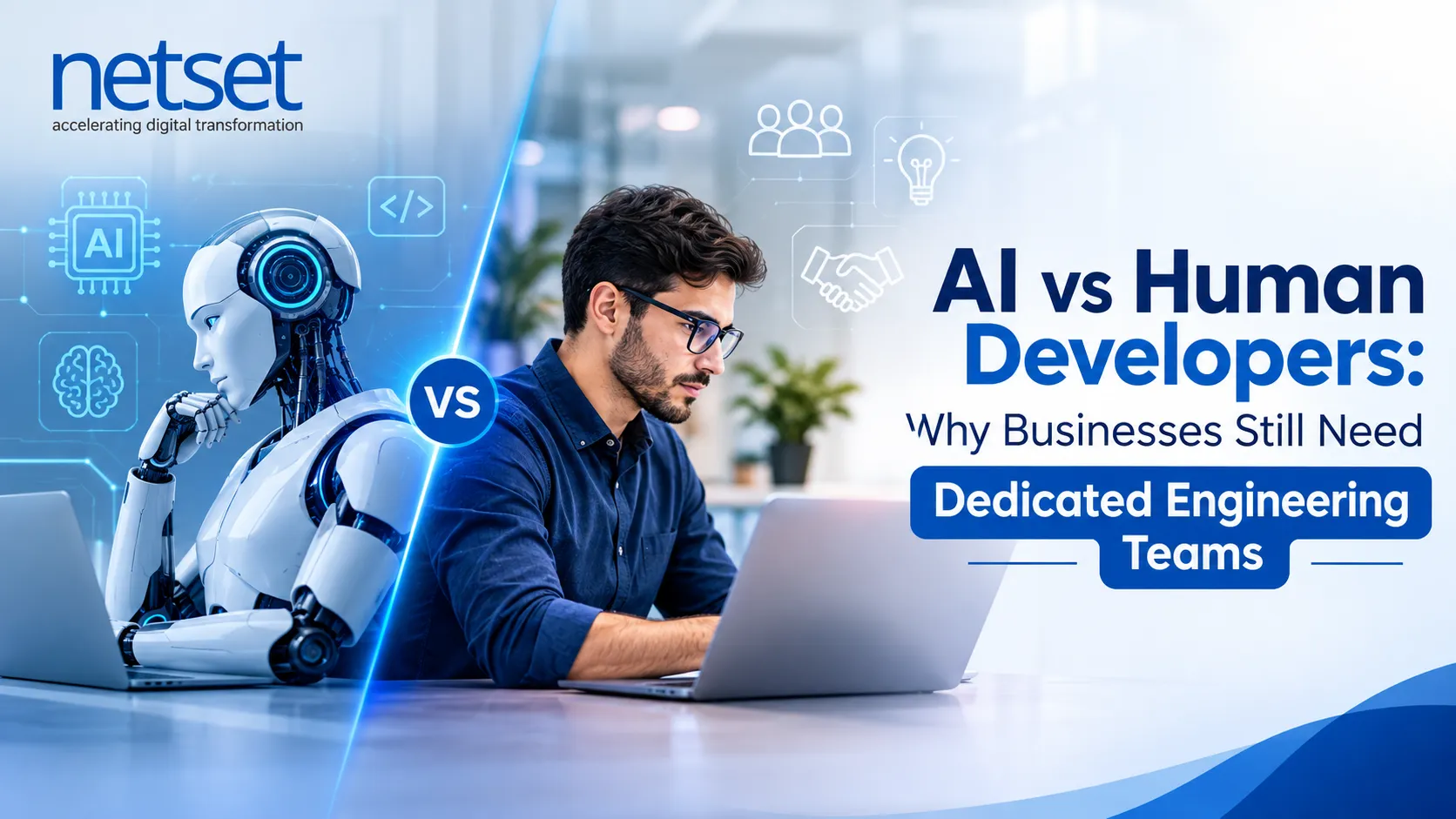

Artificial intelligence is changing how software gets built. From generating code and writing test cases to identifying bugs and explaining complex systems, AI tools are helping development teams complete many tasks faster than before. What once required hours of manual work can sometimes be accomplished in minutes.
However, faster coding does not automatically mean better software. Businesses still need people who understand customer requirements, make architectural decisions, manage risks, and take responsibility for the final product. This is where dedicated engineering teams continue to deliver significant value.
The discussion is no longer simply about AI versus human developers. It is about finding the right balance between automation and human expertise. While AI can improve productivity, experienced developers provide the judgment and technical direction needed to turn an idea into a reliable, scalable solution.
For businesses planning new digital products or modernizing existing systems, understanding this balance can help them make smarter technology investments.
1. What AI Can Do Better in Software Development
AI has become a valuable assistant throughout the software development firm. Modern tools can generate code snippets, suggest improvements, explain unfamiliar functions, and help developers identify potential errors.
For example, a developer building an e-commerce application can use AI to generate basic API structures, create initial test cases, or document repetitive functions. These capabilities reduce time spent on routine tasks and allow engineers to concentrate on more challenging problems.
AI can also help teams:
- Automate repetitive coding and documentation tasks.
- Generate initial prototypes for validating product ideas.
- Identify potential bugs and suggest possible fixes.
- Create test scenarios and improve code coverage.
- Explore alternative approaches to common technical problems.
These advantages are particularly useful when deadlines are tight or development requirements change frequently.
Nevertheless, AI-generated code still requires review, testing, and validation. Its suggestions may contain security weaknesses, outdated practices, or assumptions that do not match the actual business requirements. Productivity gains depend on how effectively developers use and evaluate these tools.
2. Where Human Developers Still Have the Advantage
Software development involves much more than writing code. Every successful product must solve a specific problem, work within its technical environment, and meet the expectations of its users.
Human developers bring contextual understanding, practical experience, and accountability to these decisions.
Understanding business requirements
Clients do not always arrive with complete technical specifications. They may describe a business challenge without knowing which features, integrations, or architectural choices would address it.
Experienced engineers ask questions, identify missing information, and translate business goals into workable technical requirements. AI can assist with organizing this information, but human judgment remains essential when requirements conflict or priorities are unclear.
Making architectural decisions
A system that works well for 100 users may struggle when it reaches 100,000. Developers must consider scalability, maintainability, performance, infrastructure costs, and future integrations before selecting an architecture.
An AI tool can suggest several approaches, but choosing the right one requires understanding the product's expected growth, existing technology, budget, and operational constraints.
Taking responsibility for quality
When a production system fails, businesses need a team that can investigate the cause, assess the impact, implement a fix, and prevent similar problems.
AI can help analyze logs or suggest debugging strategies. However, engineers must validate the findings and make sure the solution does not introduce additional problems.
This combination of technical knowledge and accountability is one reason businesses continue to invest in experienced development professionals.
3. Why Dedicated Engineering Teams Matter More Than Ever
A dedicated engineering team provides continuity across the software development lifecycle. Instead of treating development as a series of disconnected coding tasks, the team develops an understanding of the product, its users, and its long-term objectives.
Businesses working with software development firms can benefit from coordinated expertise across frontend development, backend engineering, quality assurance, cloud infrastructure, and product management.
A dedicated team can support activities such as:
- Planning product architecture and technical roadmaps.
- Building and maintaining application features.
- Integrating third-party services and legacy systems.
- Managing testing, deployment, and production issues.
- Improving security, performance, and reliability over time.
This continuity becomes particularly important for complex products that evolve after launch. Developers who understand the existing codebase can make informed decisions, recognize technical risks, and avoid unnecessary rework.
Dedicated teams also make it easier to establish consistent coding standards, document important decisions, and maintain shared ownership of product quality.
AI can accelerate individual tasks, but a coordinated team ensures that those tasks contribute to a clear, long-term engineering strategy.
4. The Role of a Generative AI Development Company
The growing adoption of AI has created new opportunities for businesses to automate workflows, improve customer experiences, and build more intelligent applications.
A Generative AI development company can help organizations identify practical use cases and integrate AI capabilities into existing or new software products. These projects may include intelligent customer support, document processing, internal knowledge assistants, automated reporting, and content generation workflows.
However, implementing generative AI requires more than connecting an application to a language model.
Engineering teams must consider data quality, privacy, model selection, response accuracy, integration requirements, latency, and ongoing operating costs. They also need to establish evaluation methods to determine whether the AI feature is actually delivering value.
For example, an AI-powered customer support assistant may produce fluent answers but still provide incorrect information. Human engineers must design appropriate safeguards, test realistic scenarios, and determine when a conversation should be transferred to a human representative.
Businesses should therefore look for technical partners who understand both AI capabilities and the engineering principles required to deploy them responsibly.
The most effective approach combines AI expertise with experienced developers who can evaluate trade-offs, manage integrations, and maintain the complete application.
5. Hire Remote Software Developers or Rely Entirely on AI?
For businesses facing talent shortages, increasing project costs, or tight delivery schedules, hiring additional engineering resources can be a practical alternative to expanding an in-house team.
When companies hire remote software developers, they can access specialized skills without limiting recruitment to their immediate geographical area. This approach can also provide flexibility when project requirements change or a business needs expertise for a defined period.
Remote developers can contribute to product development, application modernization, cloud migration, AI integration, and ongoing maintenance. With clear communication, suitable project management practices, and well-defined responsibilities, distributed teams can work effectively alongside internal employees.
AI tools complement this model by helping developers complete repetitive tasks, explore solutions, and improve development workflows.
Before selecting a remote team, businesses should evaluate technical experience, communication practices, security procedures, time-zone compatibility, and the team's ability to understand business objectives.
It is equally important to establish clear expectations around deliverables, code ownership, documentation, testing, and post-launch support.
The goal should not be to choose between hiring people and using AI. It should be to build a development model in which skilled professionals use AI to deliver better outcomes.
6. How an IT Software Development Company Can Combine AI and Human Expertise
An experienced IT software development company can help businesses establish a development process that uses automation where it adds value while retaining human oversight where it matters most.
A balanced approach typically includes several stages.
Step 1: Define the business problem. Before choosing technologies, the team identifies the user needs, operational challenges, expected outcomes, and project constraints.
Step 2: Select suitable AI tools. Developers determine which activities can benefit from AI assistance, such as code generation, test creation, documentation, or debugging.
Step 3: Establish engineering standards. The team defines coding conventions, security requirements, review procedures, and testing expectations to maintain consistency.
Step 4: Validate the implementation. Human engineers review generated code, test integrations, assess edge cases, and verify that the application meets its requirements.
Step 5: Monitor and improve. After deployment, the team evaluates performance, gathers user feedback, resolves issues, and identifies opportunities for further optimization.
This process makes AI part of a broader engineering strategy rather than treating it as a replacement for technical expertise.
It also helps businesses measure success through meaningful outcomes, including delivery time, defect rates, system reliability, maintainability, and customer satisfaction.
7. Choosing the Right Development Partner
Selecting a technology partner requires more than comparing hourly rates or counting developers. Businesses should assess whether a potential partner can understand their goals and support the product beyond its initial release.
Look for evidence of relevant project experience, a transparent development process, reliable communication, and clear quality assurance practices.
Ask how the team handles security reviews, changing requirements, production incidents, documentation, and knowledge transfer. If AI is part of the project, discuss how generated outputs are reviewed, how sensitive information is protected, and how AI features are evaluated before release.
Businesses should also consider whether the engagement model fits their needs. A dedicated team may be suitable for long-term product development, while a smaller project-based engagement may work better for a clearly defined deliverable.
For organizations exploring software development firms, the strongest partner is one that combines technical capability with an understanding of business priorities. AI expertise is valuable, but it should be supported by sound engineering practices and a commitment to delivering dependable software.
8. How NetSet Software Supports Modern Engineering Needs
At NetSet Software, we recognize that successful digital products require both modern technology and experienced engineering professionals. AI can accelerate development, but building dependable applications still requires thoughtful planning, technical expertise, testing, and ongoing improvement.
Our teams work across custom software development, AI solutions, blockchain development, and product engineering to help businesses turn ideas into practical digital products.
Whether an organization needs additional development capacity, wants to introduce AI-driven functionality, or plans to build a new application, the right engineering approach starts with understanding its objectives and technical requirements.
By combining appropriate AI tools with human-led development practices, businesses can improve productivity without overlooking security, scalability, or maintainability.
Rather than promoting automation as a complete substitute for developers, we believe technology should help engineering teams focus on higher-value work. This means making informed decisions, solving complex problems, and building solutions that continue to serve businesses as their needs evolve.
Conclusion
AI is changing the way software is developed, but its growing capabilities do not eliminate the need for experienced engineers. Instead, they are changing how developers spend their time and where their expertise creates the most value.
AI can generate code, automate repetitive activities, and assist with testing. Human developers bring business understanding, architectural judgment, creative problem-solving, and responsibility for the final outcome.
For businesses, the practical decision is not whether to choose AI or people. It is how to combine both effectively.
Dedicated engineering teams provide the continuity, collaboration, and technical ownership required to build and maintain reliable software. When supported by AI tools and a well-defined development process, they can help organizations innovate faster while keeping quality and long-term business objectives in focus.
The companies that gain the most from AI will be those that use it strategically, invest in engineering expertise, and recognize that good software is measured not simply by how quickly it is written, but by how well it works in the real world.
















Sign in to leave a comment.