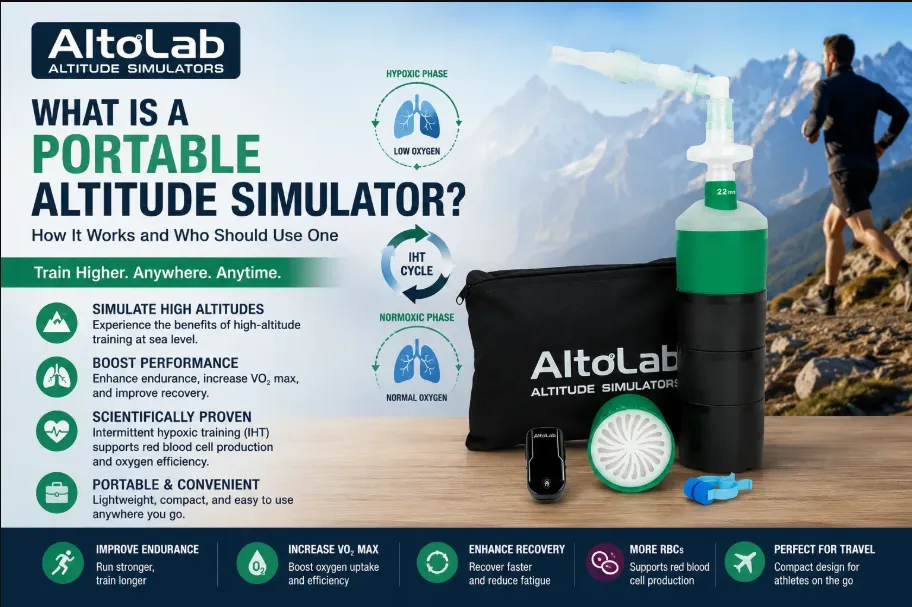

If you've ever wondered why elite runners, cyclists, and mountaineers train at high elevation before a big event, the answer comes down to one thing: oxygen. Less of it, on purpose.
Altitude training used to mean packing your bags and living in the mountains for weeks. Today, thanks to modern Altitude Simulator technology, you can get the same physiological benefits from your bedroom, gym, or clinic — no plane ticket required. That's exactly the space AltoLab was built for.
This guide breaks down what altitude training actually does to your body, how an Altitude Simulator recreates it, why Hypoxic Breathing is the method most people use to access it, and how tracking your Blood Oxygen levels tells you whether it's working.
What Is Altitude Training, Really?
Altitude training works on a simple principle: when you breathe air with less oxygen in it, your body responds by adapting. Over repeated sessions, this can lead to:
- More red blood cells, which carry more oxygen per breath
- Improved cardiovascular efficiency
- Better recovery and endurance capacity
- Enhanced metabolic function
Traditionally, athletes achieved this by training at 8,000–12,000+ feet in the mountains for two to three weeks at a time, since that's roughly how long it takes for the body to adapt. Most people don't have that kind of time or access — which is where an Altitude Simulator comes in.
How an Altitude Simulator Recreates the Mountains
An Altitude Simulator doesn't change the air pressure around you (that would require an expensive, specialized chamber). Instead, it uses normobaric hypoxia — pulling in ordinary air, filtering out a portion of the oxygen molecules, and delivering that oxygen-reduced air to you through a mask or mouthpiece.
The number of oxygen molecules reaching your lungs per breath ends up nearly identical to what you'd get at true elevation. That's what makes an Altitude Simulator like the systems AltoLab builds a practical stand-in for the real mountains — you get the training stimulus without leaving sea level.
Hypoxic Breathing: The Method Behind the Machine
The actual training protocol used with an Altitude Simulator is called Hypoxic Breathing, sometimes referred to as Intermittent Hypoxic Training (IHT) or Intermittent Hypoxic Breathing (IHB).
A typical Hypoxic Breathing session looks like this:
- Breathe simulated altitude air (often equivalent to 15,000–21,000 feet) for 5–6 minutes
- Remove the mask and breathe normal air for 4–5 minutes to recover
- Repeat this on/off cycle 5–6 times to complete one session
This cycling is intentional. Short, repeated bursts of low oxygen trigger the adaptation response without the risks of staying in a low-oxygen state too long. AltoLab's programs are structured around this exact interval approach, so you're not guessing at timing — the protocol is built into the system.
Hypoxic Breathing is also used well beyond endurance sports. It shows up in pre-acclimatization plans for climbers heading to peaks like Aconcagua or Denali, and increasingly in rehabilitation settings, where controlled, low-dose hypoxia has been studied for its cardiovascular benefits.
Why Blood Oxygen Is the Number That Tells You It's Working
None of this matters if you can't measure it. Blood Oxygen (your SpO2 level) is the single most useful number during Hypoxic Breathing sessions, because it tells you exactly how hard your body is working and whether you're in a safe, effective training zone.
At sea level, normal Blood Oxygen sits around 95–100%. During a well-run Altitude Simulator session, it's normal to see that number drop into the 80s as your body experiences simulated altitude — and then watching it climb back toward normal during your recovery interval is a good sign your body is adapting the way it should.
Tracking Blood Oxygen over weeks of Hypoxic Breathing also shows you something training logs can't: whether your body is genuinely adapting. Athletes who stick with a consistent Altitude Training plan often see their Blood Oxygen recover faster after each hypoxic interval as the weeks go on — a real, measurable sign of progress.
Bringing It All Together
Here's the simple version:
- Altitude training is the goal (more red blood cells, better endurance, faster recovery)
- An Altitude Simulator is the tool that gets you there without a plane ticket
- Hypoxic Breathing is the specific method — timed intervals of low-oxygen air
- Blood Oxygen is the number you track to know it's actually working
That's the whole system AltoLab is designed around: real Altitude Simulator hardware, structured Hypoxic Breathing programs, and Blood Oxygen tracking built in, so you're not just training blind — you can see the adaptation happening session by session.
Whether you're prepping for a high-altitude expedition, chasing a personal best in endurance sports, or just curious about what oxygen-restricted training can do for your fitness, starting with a proper Altitude Simulator and a plan for Hypoxic Breathing — backed by real Blood Oxygen data — is how you make sure the time you put in actually pays off.


























Sign in to leave a comment.