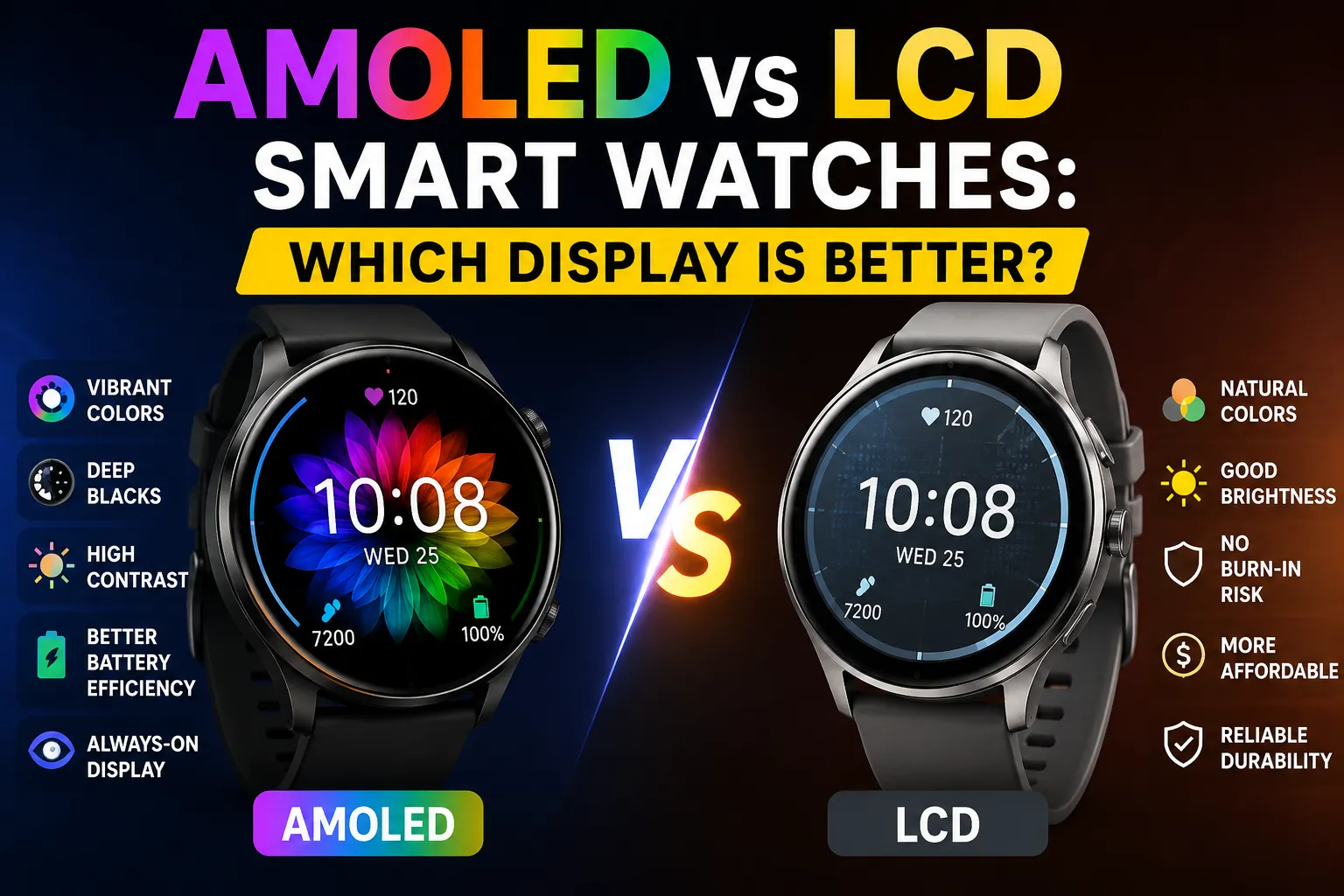

Smartwatches have evolved far beyond simple notification devices. Today’s smartwatches are used for fitness tracking, calling, entertainment, health monitoring, navigation, and even productivity. One of the most important features influencing the overall smartwatch experience is the display technology.
When buying smartwatches, you will often come across two main display types: AMOLED and LCD. While both displays serve the same purpose, they offer very different experiences in terms of colors, brightness, battery efficiency, viewing angles, and pricing.
So, which smartwatch display is actually better — AMOLED or LCD?
In this complete guide, we’ll break down everything you need to know about AMOLED vs LCD smart watches, including advantages, disadvantages, battery performance, outdoor visibility, durability, gaming experience, and which display suits your needs best.
What Is an AMOLED Display?
AMOLED stands for Active Matrix Organic Light Emitting Diode. It is considered one of the most advanced display technologies used in modern smartwatches and smartphones.
Unlike traditional displays, AMOLED screens use self-lighting pixels. This means each pixel produces its own light independently, without needing a separate backlight.
Because individual pixels can turn completely off, AMOLED displays deliver deep blacks, ultra-high contrast ratios, and highly vibrant colors.
Key Features of AMOLED Smart Watches
1. Deep Blacks & Rich Contrast
Since black pixels turn completely off, AMOLED displays provide true blacks instead of dark gray shades.
2. Vibrant Colors
AMOLED screens are known for punchy, saturated colors that make the UI look premium and modern.
3. Better Viewing Angles
Colors and brightness remain consistent even when viewed from different angles.
4. Always-On Display Support
AMOLED panels consume less power while showing minimal content, making Always-On Display features possible.
5. Premium Feel
Most flagship smartwatches use AMOLED displays because they look sharper, more luxurious, and visually immersive.
What Is an LCD Display?
LCD stands for Liquid Crystal Display. Unlike AMOLED, LCD panels use a backlight behind the screen to illuminate pixels.
This means the entire screen stays lit even when displaying black colors.
LCD displays are commonly found in affordable and mid-range smartwatches because they are cheaper to manufacture and highly reliable.
Key Features of LCD Smart Watches
1. Cost-Effective Technology
LCD displays are more affordable, helping brands offer budget-friendly smartwatches.
2. Natural Color Output
LCD screens usually provide more neutral and realistic color reproduction.
3. No Burn-In Risk
Unlike AMOLED, LCD panels are not prone to screen burn-in issues.
4. Reliable Brightness
Many LCD watches perform consistently under bright sunlight conditions.
5. Long-Term Durability
LCD displays are generally considered durable for long-term everyday usage.
BUY NOW - Streak X smart watch
AMOLED vs LCD Smart Watches — Complete Comparison
Now let’s compare AMOLED and LCD displays across the most important factors.
1. Display Quality
AMOLED displays clearly dominate when it comes to visual quality.
The colors appear more vibrant, blacks are truly black, and contrast levels are significantly higher. Animations and UI transitions also feel smoother and more premium.
LCD displays, while decent, cannot match AMOLED’s depth and richness because they rely on a backlight.
Winner:
AMOLED
2. Brightness & Outdoor Visibility
This category is more balanced than many people think.
Modern AMOLED displays now offer extremely high brightness levels, making them excellent outdoors. However, some budget AMOLED panels may struggle in direct sunlight.
LCD displays traditionally performed better under sunlight because of their strong backlight systems.
In 2026, premium AMOLED smartwatches generally outperform LCDs outdoors, but budget LCD watches still remain competitive.
Winner:
Tie (depends on quality and brightness rating)
3. Battery Consumption
Battery efficiency depends heavily on usage patterns.
AMOLED screens save power when using dark themes because black pixels turn off completely. This helps extend battery life significantly.
LCD screens keep the backlight active constantly, which means power usage remains relatively stable regardless of content.
If you use dark watch faces and Always-On Display, AMOLED becomes more power-efficient.
Winner:
AMOLED (especially with dark UI)
4. Always-On Display Capability
Always-On Display is one of the biggest advantages of AMOLED smartwatches.
Because only certain pixels remain active, AMOLED displays can continuously show time, notifications, or fitness data while consuming minimal battery.
LCD smartwatches struggle with this feature because the entire screen backlight remains active.
Winner:
AMOLED
5. Durability & Burn-In Risk
AMOLED displays have one weakness: burn-in.
If the same icons or watch face remain displayed for extremely long periods, faint image retention can occur over time.
LCD panels do not suffer from burn-in problems and are generally safer for extended static content.
However, burn-in is much less common in modern AMOLED smartwatches due to software optimization.
Winner:
LCD
6. Gaming & Multimedia Experience
If you watch videos, use animated watch faces, or enjoy rich UI experiences, AMOLED is significantly better.
The high contrast and saturated colors create a more cinematic experience.
LCD displays feel comparatively flatter and less immersive.
Winner:
AMOLED
7. Price Difference
AMOLED displays are more expensive to manufacture.
That’s why flagship smartwatches usually feature AMOLED screens, while budget-friendly watches mostly use LCD panels.
If your priority is affordability, LCD watches provide excellent value.
Winner:
LCD (for budget buyers)
Buy Now- Edge Pro smart watch
AMOLED vs LCD — Quick Summary
| Feature | AMOLED | LCD |
| Color Quality | Excellent | Good |
| Black Levels | True Black | Dark Gray |
| Battery Efficiency | Better with dark UI | Stable |
| Always-On Display | Excellent | Limited |
| Burn-In Risk | Possible | None |
| Premium Feel | High | Moderate |
| Cost | Expensive | Affordable |
| Multimedia Experience | Excellent | Average |
Which Display Is Better for Different Users?
Choose AMOLED Smart Watches If You:
- Want premium visuals
- Love vibrant colors
- Use Always-On Display frequently
- Watch videos or animations
- Want flagship-level smartwatch experience
- Prefer stylish modern watch faces
Choose LCD Smart Watches If You:
- Want affordable pricing
- Need basic fitness tracking
- Prefer long-term durability
- Want reliable everyday performance
- Don’t care much about premium visuals
AMOLED vs LCD for Fitness & Outdoor Users
Fitness enthusiasts often wonder which display performs better during workouts and outdoor activities.
AMOLED displays provide stunning visuals for fitness stats, heart rate animations, and GPS maps. Premium AMOLED panels are now extremely bright and work well outdoors.
LCD smartwatches, however, remain dependable for long-duration outdoor usage because they avoid burn-in risks and maintain stable visibility.
For athletes and heavy outdoor users, both can work well depending on budget and brightness levels.
Common Myths About AMOLED & LCD Displays
Myth 1: AMOLED Always Drains More Battery
False. AMOLED often saves battery when using dark themes and Always-On Display optimization.
Myth 2: LCD Displays Are Outdated
False. Many budget and fitness-oriented smartwatches still use excellent LCD panels.
Myth 3: AMOLED Is Always Brighter
Not always. High-quality LCD panels can sometimes outperform cheaper AMOLED screens outdoors.
Myth 4: LCD Is Only for Cheap Watches
False. Some rugged and sports-focused premium watches still use advanced LCD technology.
Smartwatch Display Trends in 2026
The smartwatch industry is evolving rapidly, and display technologies are improving every year.
Major Trends Include:
1. AMOLED Becoming More Affordable
Even budget smartwatches now feature AMOLED displays.
2. LTPO AMOLED Technology
Advanced AMOLED panels dynamically adjust refresh rates to improve battery efficiency.
3. Higher Refresh Rates
Smoother scrolling and animations are becoming common.
4. Better Outdoor Brightness
Modern displays now reach very high brightness levels for sunlight visibility.
5. Slimmer Bezels
Smartwatches are getting more immersive with edge-to-edge displays.
Buying Guide — What to Check Before Choosing a Smartwatch Display
Before buying any smartwatch, don’t focus only on AMOLED or LCD branding.
You should also check:
1. Brightness (Nits)
Higher brightness improves outdoor visibility.
2. Resolution
Sharper displays look more premium.
3. Refresh Rate
Higher refresh rates create smoother animations.
4. Touch Responsiveness
Important for navigation and gaming.
5. Battery Capacity
Display quality affects battery life.
6. Screen Protection
Look for Gorilla Glass or reinforced protection.
7. Watch Face Optimization
Good software optimization improves overall experience.
Buy Now - Verge pro smart watch
Final Verdict: AMOLED vs LCD Smart Watches
If you want the best visual experience, AMOLED smartwatches are the clear winner. They offer richer colors, deeper blacks, better contrast, improved multimedia performance, and superior Always-On Display support.
However, LCD smartwatches still remain an excellent option for budget-conscious buyers who prioritize affordability, reliability, and durability.
In Simple Terms:
AMOLED Is Best For:
- Premium experience
- Entertainment
- Stylish visuals
- Advanced smartwatch users
LCD Is Best For:
- Budget buyers
- Basic fitness usage
- Long-term reliability
- Simple daily tasks
Ultimately, the best display depends on your budget, lifestyle, and usage preferences.
FAQs
Is AMOLED better than LCD in smartwatches?
Yes, AMOLED generally provides better colors, contrast, and premium visual quality.
Does AMOLED drain more battery?
Not necessarily. AMOLED can actually save battery when using dark themes.
Which display lasts longer?
LCD displays generally have longer lifespan without burn-in risks.
Is LCD better for outdoor use?
Some LCD panels perform very well outdoors, but premium AMOLED displays now compete strongly.
Are AMOLED smartwatches worth the extra money?
Yes, if you value premium visuals and modern features.
Can AMOLED screens get burn-in?
Yes, but modern smartwatches use software optimization to reduce this issue.
Which display is better for gaming and videos?
AMOLED offers a more immersive multimedia experience.
Which display is best for budget smartwatches?
LCD remains the better option for affordable smartwatches.

























Sign in to leave a comment.