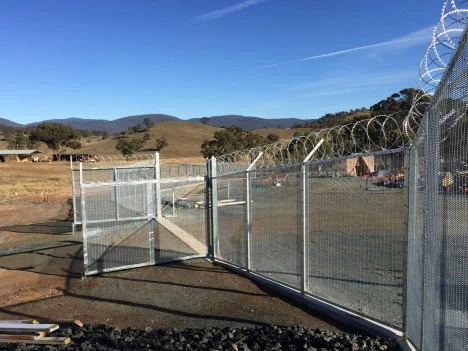

For anyone managing a correctional facility, detention centre, electrical power plant, or telecommunication facility, the need for the highest degree of security is paramount. Unauthorised persons entering into these high risk facilities could cause damage worth millions of dollars, whereas for detention centres, keeping inmates inside the borders is of utmost importance. To give your facility the right amount of protection, consider investing in razorwire fencing. Unsure of what razorwire fencing can do for you? Check out some Frequently Asked Questions and their answers to learn more:
What is razorwire?
A type of security fencing measure that makes it impossible to climb over, razorwire is made of high-tensile galvanised core wire. Manufactured in a continuous stainless steel strip with four razor-sharp barbs that are cold clenched around the core wire, it is extremely dangerous and can cut through both cloth and flesh. This is why it is best handled by trained experts.
Are there different types of razorwire?
Razorwire is available in two different configurations; Long Barb and Short Barb. Long barbed razorwire is the type typically used for correctional facilities, detention centers, jails, prisons, military zones, on the borders between two countries and areas where maximum security is required. It has a minimum width of 60mm, while the diameter of the wire may range from 630mm to 1500mm.
Short barb, on the other hand, is typically used for more commercial applications, such as a protective boundary around railway tracks, utility offices, bus depots, council offices and places where scaling deterrence is required. Short barb razor wire has a minimum width of 10mm, and may range in diameters of 470mm to 760mm, and is available in several different configurations, including concertina, flat loops and single-coil.
Can I install razorwire myself?
Razorwire is extremely dangerous, and can easily injure the inexperienced person. It is best to leave the transport, installation and maintenance of your razorwire fencing to trained professionals.
Is razorwire legal in Australia?
Razorwire may only be used in industrial and commercial applications in Australia, and only after obtaining a permit of approval from the local government. It is illegal to put up razorwire on the top of your house’s fence to deter people from entering it. Approval may be denied if the property that is to be fenced is next to a residential property, if the fencing is within 3 metres of the boundary of the property or if the razorwire being used is less than 2 metres or more than 2.4 metres above ground level.
Can razorwire be used to contain cattle?
Not unless you want to accidentally seriously injure your animals! Animals are not aware of how dangerous razorwire can be, and might accidentally graze against it, severely injuring themselves in the process. Razorwire should only be used to deter human intruders, not cattle.
How do I maintain my razorwire fencing?
Once it has been installed, there’s nothing else you need to do to maintain the fence. Because it is made from galvanised steel, it stands the test of time and harsh weather very well, but in time may lose its shape or the clips holding it to the fence may come undone. In such a case, get in touch with the manufacturers or a licensed and trained razorwire expert to come and repair or replace it for you.










Sign in to leave a comment.