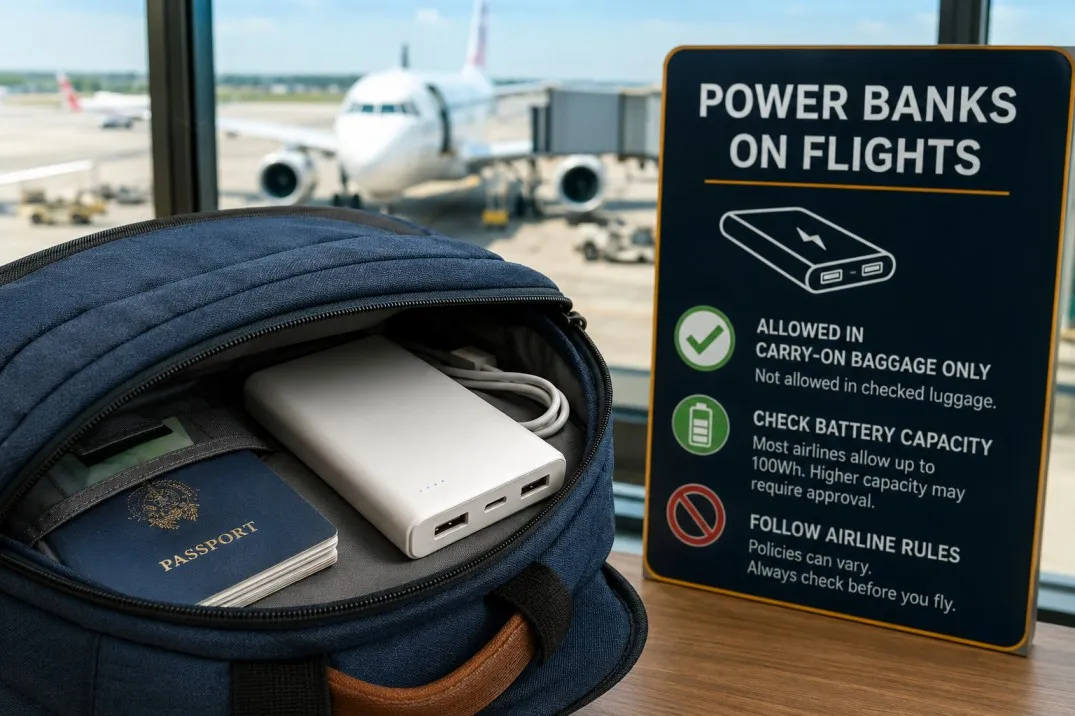

I never thought much about my power bank until the day an airport security officer asked me to take it out of my bag.
I was heading out on an international trip and had packed my usual 20,000 mAh portable charger along with my phone, headphones, and laptop. My first instinct was to put everything back into my backpack after the security check, but the officer reminded me that power banks are treated differently from ordinary electronic accessories because they contain lithium-ion batteries.
That small interaction changed how I pack for flights. Since then, I’ve paid much more attention to airline battery rules, carry-on requirements, and lithium battery safety before traveling.
Are Power Banks Are Allowed on Planes
The short answer is yes, passengers can generally bring power banks on flights, but there are important restrictions.
A power bank is essentially a portable battery. Because lithium-ion batteries can potentially overheat or catch fire if they are damaged or malfunction, aviation authorities generally require spare lithium batteries and portable chargers to be kept where the cabin crew can respond quickly if there is a problem.
That is why the most important rule I remember is:
Pack your power bank in your carry-on baggage, not your checked suitcase.
My Biggest Packing Mistake
Before that airport experience, I had occasionally put my portable charger into checked luggage without thinking about it.
I had always considered it just another gadget.
Now I understand the difference between an electronic device with a built-in battery and a spare battery or power bank.
If something goes wrong with a portable charger inside the passenger cabin, crew members can identify and manage the situation. A battery problem in the aircraft's cargo compartment is much more difficult to deal with.
So when I travel now, my portable charger stays in an easily accessible pocket of my hand luggage.
What Does 20,000 mAh Actually Mean?
This is where many travelers get confused.
Power banks are often advertised using mAh (milliamp-hours), while aviation rules commonly refer to watt-hours (Wh).
The basic relationship is:
Wh = mAh × Voltage ÷ 1,000
For example, a 20,000 mAh power bank rated around 3.7 volts would be approximately 74 Wh.
That is why simply looking at the mAh number isn't always enough when checking whether a battery meets an airline's requirements.
For ordinary travelers, the easiest approach is to look for the Wh rating printed on the power bank and check the airline's current battery policy before departure.
Are 10,000 mAh and 20,000 mAh Power Banks Usually Okay?
These are two of the most common sizes travelers carry for phones and tablets.
A 10,000 mAh power bank is relatively compact and is popular for short trips.
A 20,000 mAh battery pack provides more charging capacity and is useful during long-haul flights, airport connections, or trips where electrical outlets may not be readily available.
However, capacity alone doesn't guarantee that an item is permitted. Airline-specific rules and applicable aviation regulations always matter, particularly for larger batteries.
What About Very Large Battery Packs?
This is where you should stop assuming that a bigger battery is automatically acceptable.
Higher-capacity lithium batteries can be subject to additional approval requirements or restrictions, and some may not be permitted at all.
If you're carrying a large battery pack for professional equipment, photography gear, medical equipment, or another specialized purpose, check directly with your airline before arriving at the airport.
Don't wait until security screening to find out.
Can You Use a Power Bank During a Flight?
This was another surprise for me.
I used to assume that if I could bring a portable charger onboard, I could automatically use it whenever I wanted.
That's not necessarily true.
Airline policies regarding the use or charging of power banks onboard can differ. Some carriers may permit certain uses, while others restrict using or charging portable batteries during the flight.
The safest approach is simple: follow the cabin crew's instructions.
If you're unsure, ask a crew member rather than assuming.
What If Your Power Bank Is Damaged?
Never travel with a power bank that looks abnormal.
Before leaving home, check whether it has:
- Swelling or bulging
- Cracks or physical damage
- Leaking
- Burn marks
- Unusual heat
- Damaged cables or connectors
A damaged lithium battery can pose a safety risk.
I now give my power bank a quick inspection whenever I pack for a trip. It takes less than a minute and gives me some peace of mind.
Protect the Battery in Your Bag
There is another small habit I picked up after learning about battery safety.
I don't throw my power bank loosely into a bag filled with keys, coins, cables, and other metal objects.
Instead, I keep it in a small protective pouch.
The goal is simply to prevent the battery terminals or connectors from coming into contact with metal objects and to protect the unit from unnecessary physical damage.
What Happens If Security Questions Your Power Bank?
If an airport security officer asks about your portable charger, don't panic.
Have the battery's capacity information clearly visible if possible. If the label includes the voltage and watt-hour rating, that can make verification easier.
Security procedures vary by airport and country, so the final decision belongs to the relevant security authority.
The best preparation is knowing what you're carrying before you arrive.
My Simple Packing Checklist
Before an international flight, I now check these five things:
1. Battery condition Make sure the power bank isn't damaged or swollen.
2. Capacity Check the manufacturer's stated Wh rating.
3. Carry-on location Keep the portable charger in your cabin baggage.
4. Airline requirements Review the current rules for your specific carrier.
5. Accessibility Keep it somewhere you can easily remove if security asks to inspect it.
These five steps take almost no time but can prevent an unnecessary problem at the airport.
A Power Bank Can Be Extremely Useful While Traveling
After learning the rules, I actually appreciate my portable charger more.
On one long international journey, my phone battery dropped rapidly while I was using my boarding pass, checking a connection, messaging family, and navigating the airport.
Having a charged phone meant I could:
- Access my boarding information
- Contact my family
- Check flight updates
- Use maps
- Arrange transportation after landing
For international travelers especially, keeping your phone available can be extremely useful.
Final Thoughts
My airport security experience taught me that bringing a power bank on a flight isn't complicated, but it does require a little preparation.
The key points are straightforward:
- Power banks are generally permitted in carry-on baggage.
- They should not normally be placed in checked luggage.
- Check the Wh rating, not just the mAh number.
- Larger batteries may have additional restrictions.
- Don't carry a damaged or swollen battery.
- Follow your airline's current rules and cabin-crew instructions.
I used to treat my power bank as just another travel accessory.
Now I think of it as a small lithium battery that deserves the same attention as any other safety-sensitive item in my luggage. That change in mindset takes almost no effort—and makes packing for a flight much easier.


























Sign in to leave a comment.