
The transportation landscape in the Asia-Pacific region is undergoing a revolutionary shift, and at the center of this transformation is the rapid expansion of the Asia-Pacific Electric Vehicle Battery Market. Valued at USD 29.5 billion, the market’s dynamic growth is powered by increasing electric vehicle (EV) adoption, sustainability commitments, and a focus on mobility innovation.
As nations work toward decarbonization and clean energy adoption, EV batteries have emerged as the backbone of next-generation transportation systems.
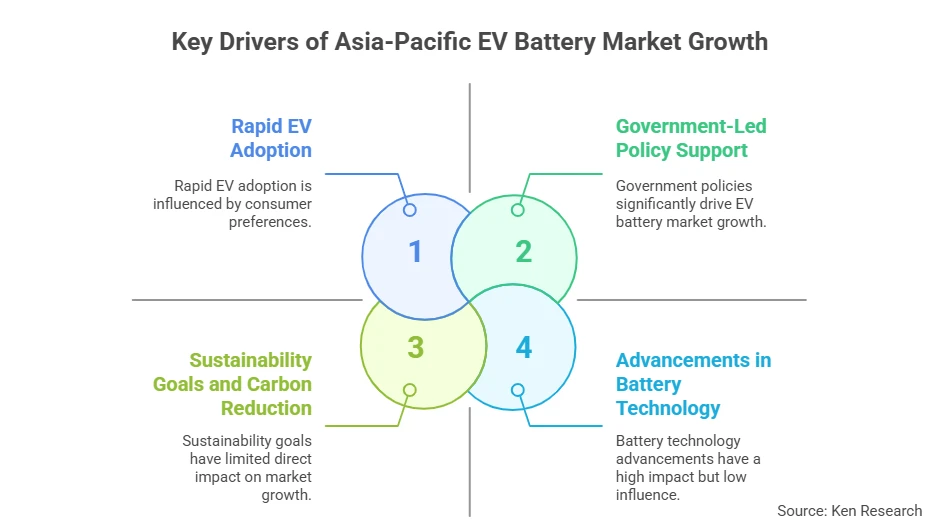
Key Drivers Accelerating Market Growth
- Rapid EV Adoption
- The surge in electric vehicle sales across Asia-Pacific is creating a parallel demand for advanced battery solutions. Consumers are increasingly prioritizing sustainability, low maintenance, and long-term cost savings, all of which are accelerating the transition from internal combustion engines to EVs.
- Government-Led Policy Support
- National governments are playing a pivotal role through subsidies, tax rebates, and mandates. China’s New Energy Vehicle (NEV) policy and India’s FAME II scheme are incentivizing local production and adoption, while also encouraging private sector investment in EV infrastructure.
- Advancements in Battery Technology
- Significant R&D is focused on increasing energy density, reducing charging time, and enhancing battery life. Solid-state and lithium-ion battery technologies are seeing improvements that offer better performance and safety, which are essential for mainstream EV adoption.
- EV Charging Infrastructure Boom
- The rise in battery-powered vehicles has prompted countries to develop fast-charging networks, enhancing convenience and user experience. Urban centers across the region are rapidly building EV-compatible infrastructure to cater to this demand.
- Sustainability Goals and Carbon Reduction
- Countries across Asia-Pacific are aggressively working to meet climate commitments under the Paris Agreement. EV battery technology plays a crucial role in replacing fossil-fuel-based transport systems, contributing to emission reduction targets.
Leading Countries Powering the Battery Revolution
- China
- As the world’s largest EV market, China leads the region in both demand and supply of electric vehicle batteries. Major players like CATL and BYD have solidified China’s dominance with extensive manufacturing capacities and cutting-edge R&D. Additionally, the Chinese government mandates the recycling of end-of-life EV batteries, aiming to recycle 70% of all batteries by 2030.
- Japan
- Japan continues to lead in innovation, particularly in solid-state battery development. With automakers such as Toyota and Panasonic investing heavily in next-gen battery technologies, Japan’s market dominance is rooted in a culture of high precision and long-term sustainability.
- South Korea
- South Korea’s strengths lie in its technology-driven battery manufacturers like LG Energy Solution and Samsung SDI. These companies are global leaders in EV battery innovation, supplying advanced batteries not just for automobiles but also for applications in public transportation and energy storage.
- India
- India is an emerging player, with rapid EV policy development and an expanding market for two-wheelers and three-wheelers. The government’s draft battery waste management rules mandate producers to recycle 70% of battery waste by 2025, highlighting the nation's push for a circular battery economy.
Regulatory Push for Recycling and Waste Management
- Battery Recycling Mandates
- Countries like China and India have taken major steps to enforce battery recycling. China’s Ministry of Ecology and Environment enforces the recycling of 80% of end-of-life batteries as part of its sustainability roadmap. India, too, has launched policies mandating producers to handle battery collection and processing.
- Safety and Environmental Standards
- To mitigate risks associated with battery disposal and leakage, stringent norms have been established. These include safe handling protocols, labeling, traceability, and proper recycling procedures that meet international benchmarks.
For deeper insight into regulatory trends, the Asia-Pacific Lithium-Ion Battery Recycling Market offers a valuable view into the parallel industry that is gaining traction due to environmental concerns.
Emerging Trends Shaping the Future
- Integration with Renewable Energy Systems
- EV batteries are now being repurposed as energy storage solutions in solar and wind power grids. This dual usage promotes battery second life applications, enhancing overall sustainability.
- Innovation in Battery Swapping
- To combat long charging times, battery swapping infrastructure is emerging in countries like India and China, providing consumers a quicker and more convenient option to stay mobile.
- Local Manufacturing and Supply Chain Decentralization
- The region is witnessing localization efforts to mitigate dependency on imports and strengthen domestic capabilities. This also improves supply chain resilience and cost-efficiency.
- Diversification Beyond Automobiles
- EV battery applications are extending to the rail and public transport sectors. The Global Train Battery Market is seeing similar adoption patterns, highlighting how EV battery tech is becoming central to multimodal transport.
- Growth of Premium Segments
- With an increase in demand for luxury and long-range EVs, battery technologies are adapting to deliver extended mileage and enhanced in-vehicle experience. Regions like Europe, led by Germany and France, are also exploring partnerships with APAC manufacturers, as detailed in the Europe EV Battery Pack Market.
Conclusion
The Asia-Pacific Electric Vehicle Battery Market is more than just a supply chain—it is the backbone of future mobility. Fueled by policy support, technological advancements, and a shift toward sustainable transportation, this sector is well-positioned to lead the global clean energy movement.
As EV adoption rises, battery innovation will remain the most critical pillar shaping the region’s green transition.
Explore forecasts, technology trends, and regional opportunities with the sample report on the Asia-Pacific Electric Vehicle Battery Market
Read More: Why the North America Robotic Lawn Mowers Market Is Growing Among Smart Consumers


























Sign in to leave a comment.