

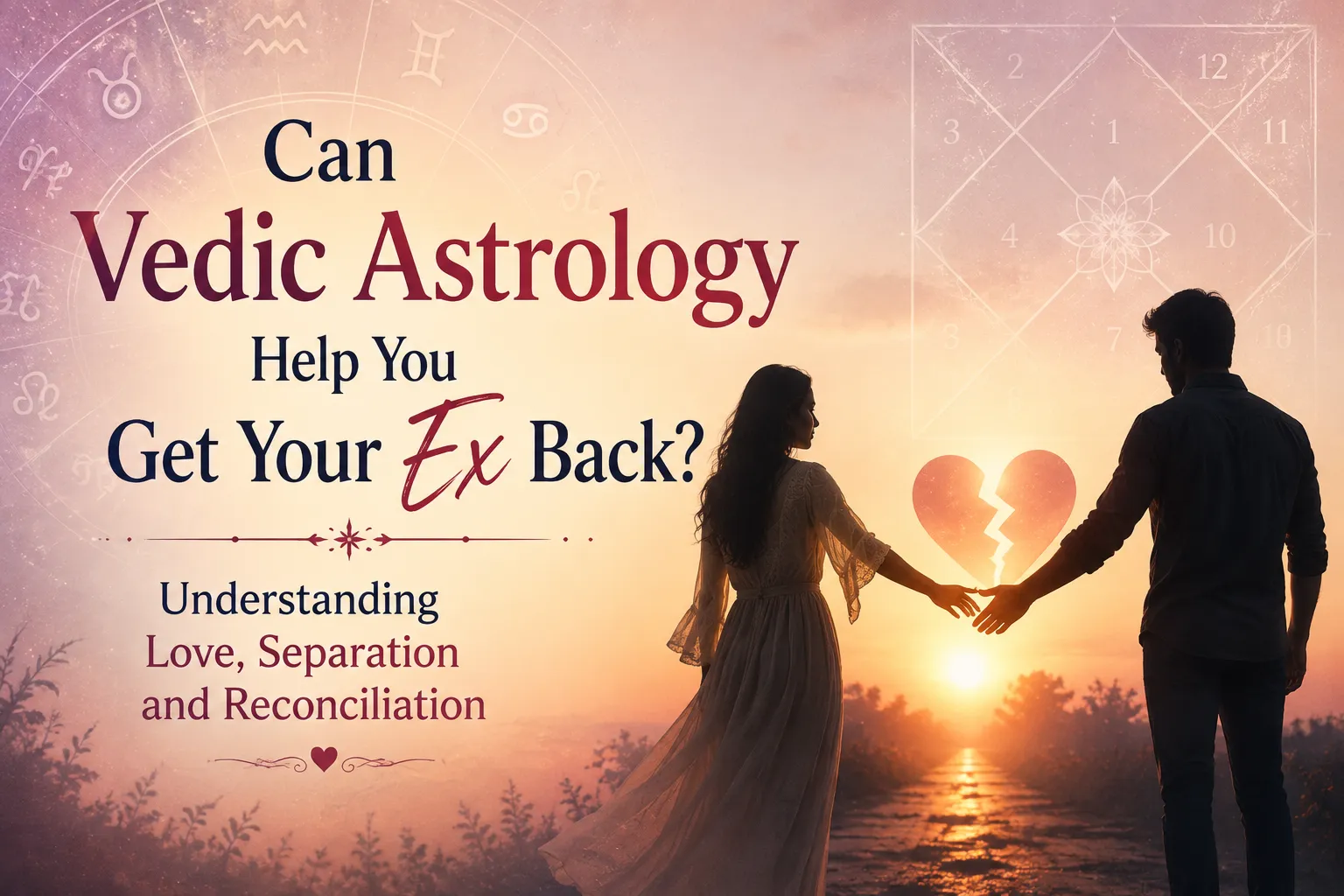
When people face important questions about relationships, marriage, career, family, or major life changes, they often look for different ways to understand their situation. For people interested in Indian traditions, Vedic astrology offers a traditional system for interpreting these questions through an individual's birth chart.
Today, people across the United States search for an astrologer in USA for personalized horoscope readings, Kundli analysis, marriage compatibility, career guidance, and spiritual perspectives.
Unlike a general horoscope that provides broad information based on a zodiac sign, Vedic astrology examines a person's complete birth information and interprets different elements of the resulting chart.
What Is Vedic Astrology?
Vedic astrology, traditionally known as Jyotish, is an Indian system of astrology centered around the interpretation of planetary positions at the time of birth.
A Vedic astrology consultation generally uses three key details:
- Date of birth
- Exact or approximate birth time
- Place of birth
These details are used to create a birth chart, commonly known as a Kundli or Janam Kundali.
The astrologer may then study the chart's planetary positions, houses, Nakshatras, Dashas, transits, and other traditional factors.
The interpretation depends on the practitioner's methodology and the specific question being discussed.
Why Is the Birth Chart Important?
The birth chart is the foundation of a personalized Vedic astrology reading.
A general horoscope may apply the same interpretation to a large number of people born under a particular zodiac sign.
A birth chart is different because it is calculated from an individual's specific birth information.
This allows an astrologer to discuss questions in relation to the individual's chart rather than relying only on generalized zodiac descriptions.
For example, two people may have the same Sun sign but very different birth charts.
Their planetary placements, houses, Moon sign, Nakshatra, and other factors may differ significantly.
This is why personalized chart interpretation is central to Vedic astrology.
Understanding the 12 Houses in Vedic Astrology
The twelve houses of a Vedic birth chart are traditionally associated with different areas of life.
Depending on the question being discussed, an astrologer may examine one or more houses.
First House
Traditionally associated with the self, personality, appearance, and general approach to life.
Second House
Associated with family, speech, values, and financial resources.
Third House
Connected with communication, courage, skills, and siblings.
Fourth House
Traditionally associated with home, family, property, and emotional foundations.
Fifth House
Associated with creativity, education, children, and personal expression.
Sixth House
Connected with work, responsibilities, competition, and everyday challenges.
Seventh House
Traditionally associated with partnerships, marriage, and significant one-to-one relationships.
Eighth House
Associated with transformation, shared resources, and deeper changes.
Ninth House
Connected with higher learning, philosophy, spirituality, and long-distance journeys.
Tenth House
Traditionally associated with career, profession, reputation, and public life.
Eleventh House
Associated with gains, networks, friendships, and aspirations.
Twelfth House
Connected with expenditure, retreat, foreign connections, and spiritual themes.
These interpretations are part of a larger astrological system and are normally considered together rather than individually.
Vedic Astrology for Relationship Questions
Relationships are one of the most common reasons people seek an astrology consultation.
A person may want to understand:
- Relationship compatibility
- Marriage prospects
- Communication difficulties
- Family expectations
- Long-term partnership
- Traditional marriage factors
- Compatibility between two birth charts
A Vedic astrologer may examine the relevant houses, planetary placements, Nakshatras, and other traditional factors.
For people considering marriage, Kundli matching can also be performed by comparing two birth charts.
Astrology cannot determine another person's feelings or guarantee how a relationship will develop. Relationships also depend on communication, trust, shared values, behavior, and individual choices.
Career and Professional Life
Career questions are another important area of astrology consultations.
Modern careers are rarely linear. People may change companies, move into new industries, start businesses, return to education, or relocate for professional opportunities.
A Vedic astrology consultation may examine traditional indicators associated with:
- Career direction
- Professional responsibilities
- Leadership
- Business
- Career transitions
- Professional growth
- Financial activity
For someone considering a major career decision, astrology can be used as an additional reflective perspective.
It should not replace research into the job market, financial planning, qualifications, or professional advice.
Horoscope Reading vs. Birth Chart Analysis
Many people use the terms horoscope and birth chart interchangeably, but there can be a difference in how they are used.
A general horoscope may provide broad interpretations based on a zodiac sign or other limited information.
A personalized birth chart reading uses specific birth information and can involve a much wider range of astrological factors.
This distinction is important for anyone searching for a Vedic astrologer in USA because the type and depth of consultation can vary considerably between practitioners.
What Are Dashas in Vedic Astrology?
One distinctive feature of Vedic astrology is the use of planetary periods known as Dashas.
Dashas are traditionally used to interpret different phases of life.
An astrologer may examine the planetary period currently operating in a person's chart when discussing a particular concern.
For example, someone experiencing a major career transition may ask about the traditional astrological timing associated with professional changes.
Dashas are one component of a larger birth-chart interpretation and are generally considered alongside planetary placements and other factors.
Understanding Nakshatras
The Nakshatra system is another important part of Vedic astrology.
The zodiac is traditionally divided into 27 Nakshatras, each associated with particular characteristics and symbolism.
An individual's Moon placement is commonly examined in relation to their Nakshatra.
Nakshatras may be discussed in consultations involving personality, relationships, compatibility, timing, and other areas.
For people familiar with Indian astrology, Nakshatra analysis can be an important part of understanding a birth chart.
What Are Planetary Transits?
Planetary transits refer to the movement of planets through the zodiac and























Sign in to leave a comment.