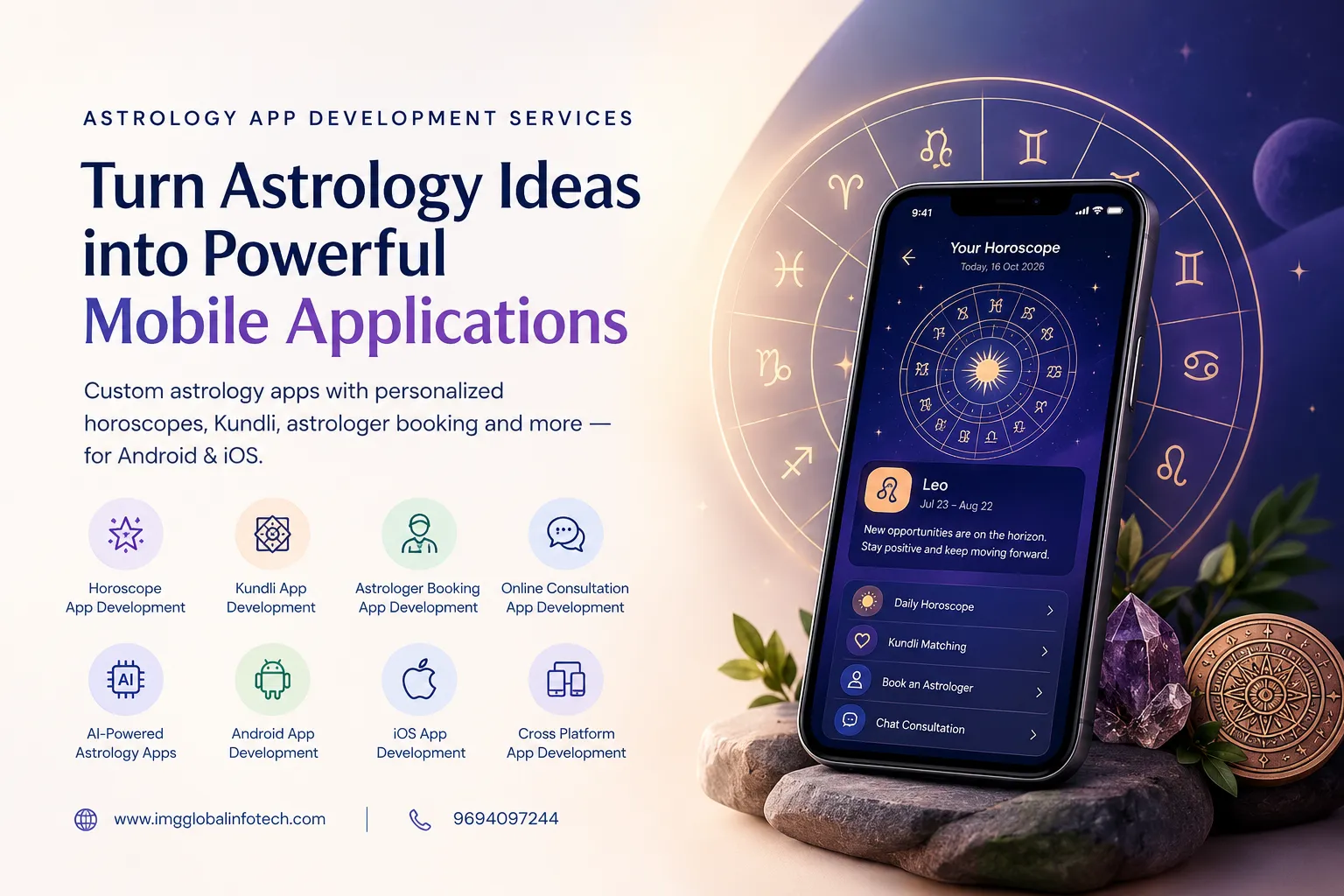

A great-looking interface is not enough for an astrology app to not fail. The birth chart may contain contradictory planetary positions. The astrologer appointment may not fit availability. The AI assistant may generate interpretations that contradict the chart data. These problems are not mere technical annoyances, they can erode user confidence in the entire product.
If businesses are planning to build an astrology platform, the choice of an astrology app development partner should be based on how the team will solve these problems, not just how fast they can deliver a mobile application.
The right partner should understand your business model, and translate astrological requirements into testables.
1. Define the Astrology Product You Actually Need
Before comparing development proposals, identify the primary job your application will perform. An astrology content platform, a consultation marketplace, and an AI-powered horoscope assistant have different technical requirements.
A content platform may need horoscope publishing, birth profiles, saved readings, and subscriptions. A consultation marketplace needs astrologer onboarding, availability management, bookings, payments, and session tracking. An AI-based application may additionally require structured chart data, a controlled interpretation system, and safeguards against unsupported responses.
Practical step: Write a one-page product brief describing your target users, core problem, revenue model, and three essential features. Ask each prospective partner to explain how its proposed architecture supports those priorities.
This exercise reveals whether the developer understands the product or is simply presenting a standard mobile app package.
2. Establish How Astrological Calculations Will Be Verified
Calculation accuracy deserves particular attention because it influences almost every downstream feature, from horoscope reports to compatibility matching.
Ask your prospective development team how it will handle birth locations, historical time zones, daylight-saving changes, calculation conventions, and missing birth times. Clarify which astrological tradition the application supports and whether users can choose between different systems.
For example, a Vedic astrology application may need configurable settings for sidereal calculations and house systems, while a Western astrology product may follow different conventions. These choices should be explicit rather than hidden in the software.
Create a validation plan before development begins:
- Prepare a set of reference birth charts with known input details.
- Agree on the calculation settings and expected outputs.
- Test dates and locations that expose time-zone edge cases.
- Compare results against an appropriate reference engine or qualified reviewer.
- Record discrepancies and require fixes before release.
A development partner should be able to demonstrate how calculation results will be tested, not simply promise that the application will be accurate.
3. Separate AI Interpretation from Calculation Logic
AI can make astrology apps easier to use by explaining chart elements, answering questions, and adapting content to a user's interests. However, a language model should not be treated as the authoritative source for planetary positions or other deterministic calculations.
A more controlled design uses separate components for calculations, astrological interpretation, and conversational presentation.
For instance, the calculation engine can supply structured chart information. A defined interpretation layer can identify relevant placements according to the selected tradition. An AI model can then explain those results in simpler language.
This structure makes it easier to investigate errors and reduce invented details.
When evaluating astrology app developers, ask how they will test conflicting answers, handle questions outside the application's knowledge, protect personal data sent to AI services, and monitor ongoing model costs.
AI should solve a clearly identified user problem. It should not be added merely because it makes the product sound more advanced.
4. Test the Most Difficult Workflow Before Building Everything
A common project risk is investing heavily in interface design before confirming that the application's hardest feature works.
A small proof of concept can test technical feasibility before the full development budget is committed.
Depending on the product, that proof of concept might demonstrate:
- Generating a birth chart from location and time inputs.
- Matching consultation bookings with astrologer availability.
- Processing payments and handling cancelled sessions.
- Producing an AI explanation based on structured chart data.
- Supporting video consultations across intended devices.
Consider a consultation marketplace. A simple demonstration should test more than a successful booking. It should also account for an astrologer becoming unavailable, a payment succeeding while a booking fails, or a call disconnecting unexpectedly.
Ask the development partner to document these failure scenarios and explain how the application will recover. This provides a more useful assessment of engineering quality than a polished homepage demonstration.
5. Compare Development Proposals by Total Operating Cost
The initial development quote is only part of the investment. Astrology applications may also incur hosting, third-party API, AI model, messaging, video, payment processing, maintenance, and customer support expenses.
Request separate estimates for initial development and ongoing operations. Ask which services charge by transaction, request, minute, or usage volume.
For example, an AI assistant that generates lengthy interpretations for every interaction may have a different operating cost from one that uses reusable content and calls an AI model only when needed.
Likewise, a live consultation platform must account for session infrastructure and transaction handling, not just the screens used to book a call.
A phased launch can reduce uncertainty. Start with the features required to validate demand, measure actual usage, and use that evidence to prioritize later investment.
6. Check Data Ownership, Privacy, and Portability
Astrology apps can collect birth details, locations, contact information, consultation histories, and payment-related records. Your development partner should explain where information is stored, who can access it, and how it is protected.
Discuss encryption, account permissions, backup and recovery, data deletion, and applicable privacy obligations in your target markets. If AI or other third-party services process user information, establish what is shared and what the providers retain.
Contract terms matter as much as technical controls. Confirm ownership of the source code, design files, and custom intellectual property. Ensure your business controls essential accounts, including hosting, domains, analytics, and paid integrations.
Ask for technical documentation and a practical handover process. These measures reduce dependence on a single vendor and make future maintenance or migration easier.
7. Choose a Partner That Can Improve the Product After Launch
The first release should create a foundation for learning, not lock the business into a fixed feature list.
Plan how you will measure chart-generation failures, booking completion, repeat consultations, subscription renewals, crashes, and user feedback. These signals can help distinguish features people genuinely use from features that merely look attractive in a presentation.
Businesses evaluating providers can explore IMG Global Infotech's astrology app development services and assess how the proposed scope, technical approach, and support arrangements match their product requirements.
During discussions with any provider, request a milestone-based delivery plan, clear acceptance criteria, a testing strategy, and defined responsibilities for post-launch issues. A useful partner should explain trade-offs and identify risks early rather than agreeing to every feature without examining its implications.
Conclusion
Choosing an astrology app development partner is about finding a team that can turn specialized requirements into reliable, maintainable software. Calculation validation, AI boundaries, failure handling, operating costs, privacy, and ownership deserve attention before development begins.
Start by defining your product model, then test the riskiest technical workflow and compare proposals against the same requirements. This approach gives your business a clearer view of the investment involved and helps establish a foundation for an astrology application that can grow responsibly.
Frequently Asked Questions
1. What is the most important factor when choosing an astrology app development partner?
The partner should demonstrate a clear understanding of your specific product requirements and explain how critical features will be implemented, tested, and maintained. Relevant mobile development expertise alone is not enough.
2. How can I verify birth-chart calculations before launch?
Define the astrological system and calculation settings, prepare reference cases, test time-zone edge cases, and compare outputs against an appropriate reference engine or qualified reviewer.
3. Is AI necessary for a new astrology app?
No. A useful first version can focus on reliable calculations, well-organized content, and a good user experience. AI can be introduced when it addresses a specific need, such as explaining chart elements or answering questions conversationally.
4. What costs should an astrology app development budget include?
Consider design, development, testing, hosting, third-party integrations, AI usage, payment processing, maintenance, and support. The exact costs depend on the application's scope and usage.
5. What should I confirm before signing a development contract?
Confirm deliverables, milestones, acceptance criteria, source-code ownership, third-party service accounts, data handling, documentation, maintenance terms, and the process for managing additional requirements.





















Sign in to leave a comment.