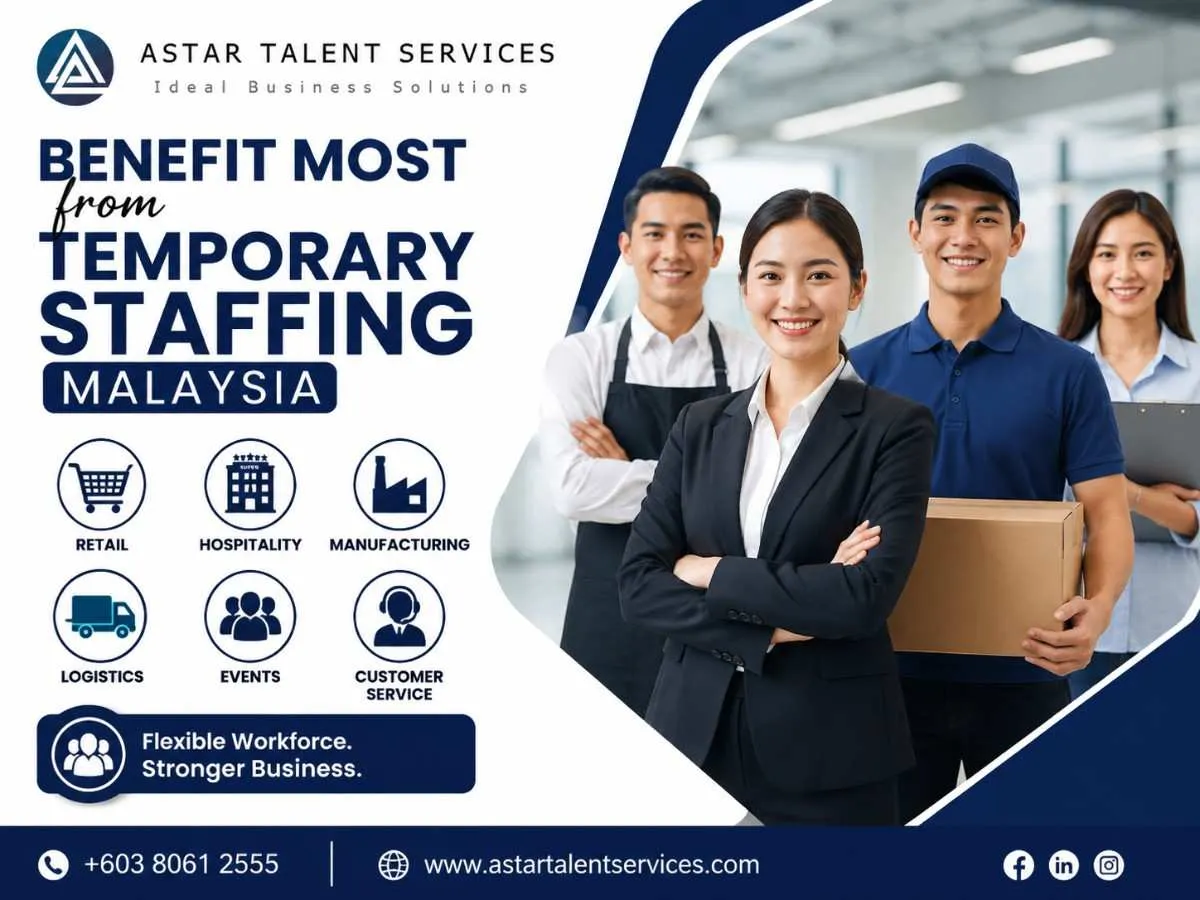

Some sectors in Malaysia rely greatly on temporary workers to help bridge the labor gaps, meet project needs, and to meet seasonal requirements. The most appreciative sectors are retail, warehousing, logistics, manufacturing, and event management. These sectors are characterized by fluctuating labor needs, making the idea of fixed-term contracts unlikely to be a suitable solution, and flexible staffing has become a necessity and not a last resort.
In certain industries, the use of temporary staffing Malaysia can be a key determinant in the efficiency and profitability of your business, so it's worth knowing how it works and when to hire it.
Why Temporary Staffing Is a Strategic Tool, Not a Last Resort
Temporary hiring is still considered by many business owners as a panic measure - when someone leaves of their own accord. That's the way you think is no longer relevant. In today's labor market in Malaysia, temp staffing is becoming a conscious response to the need to employ a workforce, particularly in industries with fluctuating demand or demand that cannot be predicted.
The Department of Statistics Malaysia reported that the combined share of the sectors of wholesale and retail trade, manufacturing, and transportation make up a large percentage of the country's total employed population. These are also the sectors where the requirement for manpower is maximum throughout the year.
Industries That Rely Most on Temporary Workers in Malaysia
1. Retail: Managing Festive Rush Without Overstaffing Year-Round
Malaysia's retail industry experiences significant surges in staffing during certain time of the year such as the period around the religious holiday of Hari Raya, Chinese New Year, end-of-year sales, and during large-scale promotions such as 11.11 and 12.12. Retailers simply don't have the luxury of not having enough staff on those dates, but having too many on a year-round basis can be very costly.
Temporary retail workers perform duties such as cashiering, restocking merchandise, in-store promotions and customer service. They can be set up rapidly, trained on basic SOPs within days and scaled back once the rush is over. This flexibility is crucial for shopping mall anchors, as well as standalone retail stores, in Klang Valley, Penang and Johor Bahru.
Key roles filled through temporary retail staffing:
- Cashiers and checkout assistants
- Product demonstrators and promoters
- Stock replenishment staff
- Customer service representatives
2. Warehousing: Handling Volume Spikes in Fulfilment Operations
The e-commerce explosion has led to an increased need for warehouse staffing in Malaysia.The surge in e-commerce has propelled the demand for warehouse staffing in Malaysia to a significant level. Major sale events are held in platforms such as Shopee and Lazada on a regular basis, and the fulfilment warehouse needs to handle 5x to 10x as many orders in a short period of time.
The permanent warehouse teams are not able to take that kind of surge. These are the times when temporary workers are required to pick, pack, sort, label and dispatch products. The use of temp staffing is a normal method in many warehouses in Selangor, Shah Alam, and the Free Trade Zone Klang.
Beyond peak sales, warehouses also bring in temporary manpower during:
- Stock-take and inventory audits
- New product line launches
- Facility relocations
- Sudden spikes due to supply chain shifts
3. Logistics: Keeping Supply Chains Moving Under Pressure
The manpower needs of the logistics industry in Malaysia are not always predictable. Gaps in ground operations can occur immediately due to one delayed shipment, an unexpected surge in incoming freight or a new client onboarding. Temporary staffing is also vital for third-party logistics (3PL) and freight forwarders, as well as for last-mile delivery firms looking to remain agile.
The roles of loaders, sorters, dispatch assistant, and route support are frequently filled on a temporary basis. This way, logistics firms can deliver their services according to the SLA without the burden of hiring too many employees during quiet times.
As a regional trade hub, Malaysia has key logistics ports and corridors in Port Klang, Penang Port, and the industrial area in Johor and demand for scalable logistics manpower will keep increasing.
4. Manufacturing: Bridging Production Gaps Without Disruption
Many Malaysian manufacturing industries such as electronics, food and beverage, rubber products, and medical devices have variable production cycles. Whether it's to meet a contract, boost exports or due to machinery down time, the number of workers necessary on the floor changes.
Temporary manufacturing workers are assigned for production line support, quality control support, packaging and other general labour. It is particularly prevalent in industrial estates in Penang, Seremban and Johor where factories have intense production schedules and short time-lines for delivery.
Partnering with a licensed staffing agency also takes care of the proper documentation, EPF and SOCSO contributions, and compliance – minimizing the legal liability for the employer in dealing with the Employment Act requirements in Malaysia.
5. Events: Building and Disbanding Teams on Demand
Event staffing is perhaps the most project-specific form of temporary hiring in Malaysia. Exhibitions, product launches, trade fairs, corporate dinners, and MICE events require teams that are assembled quickly and dissolved just as fast.
Event Companies and brand activators require presentable, trainable and prompt staff. This involves event crew, registration staff, booth promoters, ushers and set up crews. There are dozens of large scale events held in major venues such as KLCC Convention Centre, MITEC and Putrajaya International Convention Centre every year, thus making a steady demand for event manpower.
The reliability and punctuality are required with event timelines set and cannot be compromised. Having a staffing agency that has a vetted talent pool can make a difference here.
What Makes Temporary Staffing Effective Across These Industries?
Across all five sectors above, the same core benefits drive adoption of temporary staffing:
| Benefit | Why It Matters
|
|---|---|
| Cost control | Pay for workforce only when needed — no idle headcount |
| Speed of deployment | Skilled temp workers can be placed within 24–72 hours |
| Compliance management | Agencies handle payroll, EPF, SOCSO, and legal obligations |
| Scalability | Scale up or down based on operational demand — no long-term commitment |
| Risk reduction | Reduced exposure to wrongful dismissal claims or overstaffing penalties |
How to Choose the Right Staffing Partner in Malaysia
Not all staffing agencies deliver the same quality of workers or service reliability. When evaluating a partner, look for these markers:
- JTKSM registration — Ensures the agency operates legally under the Private Employment Agencies Act 1981
- Industry-specific experience — A agency that has placed workers in your sector understands role requirements and screening criteria
- Payroll and compliance handling — Reduces administrative burden and legal risk on your end
- Talent pool depth — Larger pools mean faster fulfilment, especially during high-demand periods
- Account management support — Direct communication channels matter when you need adjustments mid-deployment
For businesses in retail, logistics, warehousing, manufacturing, or events, Astar Talent Services provides industry-aligned temporary staffing solutions in Malaysia, helping companies stay operationally ready without the overhead of permanent over-hiring. Visit the Astar Talent Services homepage to learn more about their workforce solutions.
Frequently Asked Questions
Which industries use temporary staffing the most in Malaysia?
Retail, warehousing, logistics, manufacturing, and events are the top industries that use temporary staffing in Malaysia. These sectors experience cyclical or project-based demand spikes that make permanent hiring impractical, and temporary workers allow businesses to scale efficiently without long-term employment commitments.
Is temporary staffing legal and compliant in Malaysia?
Yes. Temporary staffing in Malaysia is regulated under the Private Employment Agencies Act 1981, overseen by the Labour Department (JTKSM). Licensed agencies manage EPF, SOCSO contributions, and employment contracts on behalf of employers, ensuring full legal compliance throughout the engagement period.
How quickly can temporary workers be deployed in Malaysia?
Most reputable staffing agencies in Malaysia can deploy temporary workers within 24 to 72 hours for general roles. For specialised positions, deployment may take 3 to 5 working days depending on skill requirements, screening processes, and the size of the agency's active talent pool.
What is the difference between contract staffing and temporary staffing in Malaysia?
Temporary staffing typically covers short-term placements lasting days to a few months, often tied to peak periods or specific projects. Contract staffing usually involves a defined project scope with a longer duration. Both models allow businesses to manage headcount flexibly without permanent employment obligations.
Do temporary workers in Malaysia receive statutory benefits like EPF and SOCSO?
Yes. Under Malaysian labour law, temporary workers are entitled to EPF and SOCSO contributions regardless of the duration of employment. When engaged through a licensed staffing agency, the agency typically serves as the employer of record and handles all statutory contribution obligations on the worker's behalf.























Sign in to leave a comment.