
Growth is a positive challenge but for many companies, IT quickly becomes the biggest bottleneck. As teams expand, operations go remote, and cloud-based tools multiply, the complexity of managing technology increases at a pace most internal IT setups cannot sustain. What once felt manageable for a small team soon turns into frequent downtime, security gaps, slow response times, and rising operational costs.
Growing companies often find themselves stuck in a reactive IT cycle—fixing issues after they disrupt work instead of preventing them altogether. Add increasing cybersecurity threats, compliance requirements, and the pressure to maintain seamless customer experiences, and IT stops being a support function and starts limiting growth.
This is where managed IT support services make a measurable difference. With a proactive, scalable approach—like the solutions offered by Affinity Smart businesses can shift IT from a constant problem into a strategic advantage. Managed IT support aligns technology with business goals, ensuring systems remain secure, reliable, and ready to scale, so leadership teams can focus on growth instead of firefighting IT issues.
What Are Managed IT Support Services?
Managed IT support services refer to the strategic outsourcing of an organization’s IT operations to a specialized service provider. Instead of managing technology internally, businesses partner with experienced IT professionals who take full responsibility for monitoring, maintaining, and optimizing their IT infrastructure. This approach ensures systems remain secure, reliable, and aligned with business objectives at all times.
A comprehensive managed IT support model typically includes:
- 24/7 system monitoring to identify and resolve issues before they impact operations
- Helpdesk and end-user support to ensure employees receive fast, reliable technical assistance
- Cybersecurity management including threat detection, prevention, and ongoing risk mitigation
- Cloud and server maintenance to maintain performance, scalability, and availability
- Data backup and disaster recovery to protect critical business data and ensure continuity
- Software updates and patching to keep systems secure, compliant, and up to date
Rather than hiring and managing multiple in-house IT specialists, businesses gain access to a dedicated team of experts for a predictable monthly cost. This not only reduces operational complexity but also provides enterprise-level IT capabilities that scale seamlessly as the company grows.
Why Growing Companies Struggle With Traditional IT Models
As businesses grow, their technology needs become more complex, yet many companies continue to rely on outdated IT models. Commonly, growing organizations depend on a single in-house IT resource, break-fix IT support, or overloaded internal teams that were never designed to support rapid scaling.
This traditional approach leads to several critical challenges. IT issues are addressed only after they disrupt operations, resulting in frequent downtime and reduced productivity. Costs increase unpredictably as emergency fixes, hardware upgrades, and security incidents add up—often without delivering measurable return on investment. At the same time, limited IT resources create security vulnerabilities, leaving businesses exposed to cyber threats and compliance risks. Scaling systems quickly to support new users, locations, or cloud platforms becomes difficult, slow, and expensive.
Key Benefits of Managed IT Support Services
1. Predictable and Controlled IT Costs
One of the most significant advantages of managed IT support services is cost predictability. Instead of dealing with unexpected repair expenses or emergency IT bills, businesses operate on a fixed monthly pricing model. This structured approach allows leadership teams to plan IT investments with confidence.
Why this matters for growing companies:
- Easier and more accurate budgeting
- Fewer unexpected IT-related expenses
- Greater financial control as technology requirements expand
Predictable IT costs help businesses scale without financial uncertainty or operational disruptions.
2. Proactive Monitoring and Reduced Downtime
Managed IT service providers continuously monitor systems, networks, and applications to identify and resolve issues before they impact operations. This proactive model prevents minor problems from escalating into costly downtime.
Key benefits include:
- Fewer system outages and disruptions
- Improved uptime and system reliability
- Faster issue detection and resolution
By addressing issues early, managed IT support ensures business operations remain stable—even during periods of rapid growth.
3. Enterprise-Level Cybersecurity Protection
Cyber threats increasingly target small and mid-sized businesses due to their expanding digital footprint and limited in-house security resources. Managed IT security services deliver a multi-layered cybersecurity strategy designed to protect critical business data.
These services typically include:
- Advanced threat detection and prevention
- Firewall, endpoint, and network protection
- Regular security updates and vulnerability patching
- Compliance and regulatory support
With managed IT support, growing companies gain enterprise-grade security capabilities without the cost and complexity of building an internal security team.
4. Scalability Without IT Complexity
As businesses grow, their IT infrastructure must expand quickly and efficiently. Managed IT services provide the flexibility needed to scale without introducing unnecessary complexity.
Businesses can:
- Add users, devices, and locations with minimal effort
- Support remote and hybrid work environments seamlessly
- Scale cloud resources on demand based on business needs
This scalability enables organizations to grow confidently without repeatedly redesigning their IT systems.
5. Access to Specialized IT Expertise
Managed IT providers bring together specialists across multiple technology domains, ensuring businesses have access to the right expertise when needed.
Areas of expertise typically include:
- Cloud computing and infrastructure management
- Cybersecurity and risk management
- Network design and optimization
- Compliance and regulatory standards
Rather than relying on a single generalist, businesses benefit from a team of experienced professionals working collaboratively to support their IT environment.
6. Improved Employee Productivity and Focus
Efficient IT support directly impacts employee performance and satisfaction. When technical issues are resolved quickly, teams can focus on their core responsibilities instead of troubleshooting problems.
Managed IT support delivers:
- Fast and reliable helpdesk response
- Minimal workflow interruptions
- A smoother and more consistent user experience
This leads to higher productivity, improved morale, and better overall business performance.
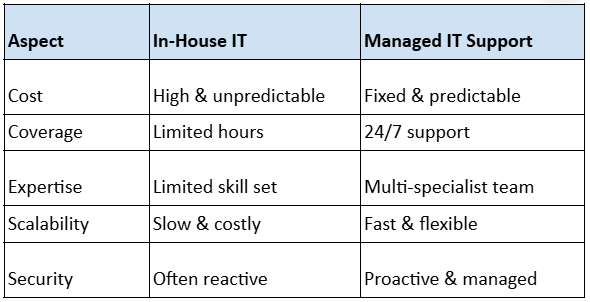
Managed IT Support vs In-House IT: A Practical Comparison
How Managed IT Services Support Long-Term Business Growth
Managed IT services play a strategic role in long-term business growth by aligning technology infrastructure with overall business objectives. Rather than simply maintaining systems, managed IT support enables organizations to use technology as a driver of efficiency, scalability, and competitive advantage.
Key ways managed IT services support sustainable growth include:
- Supporting digital transformation initiatives by modernizing legacy systems, integrating cloud solutions, and enabling automation that improves operational efficiency
- Enabling cloud-based scalability so businesses can quickly expand users, locations, and workloads without costly infrastructure upgrades
- Improving system reliability through proactive monitoring, preventive maintenance, and rapid issue resolution that minimizes downtime
- Strengthening cybersecurity posture with continuous threat monitoring, compliance support, and layered security controls to protect business-critical data
Industries That Benefit Most From Managed IT Support
Managed IT support services are particularly valuable for industries that rely heavily on secure, scalable, and always-available technology. Organizations experiencing rapid growth, strict compliance requirements, or complex operations gain the greatest advantage from outsourcing IT management.
Industries that benefit most from managed IT support include:
- Startups and scale-ups that need enterprise-level IT infrastructure, security, and support without the cost and complexity of building a large in-house IT team
- Professional services firms such as consulting, legal, and accounting practices that depend on reliable systems, data protection, and secure client collaboration
- Healthcare and finance organizations where compliance, data privacy, and cybersecurity are critical, and system downtime can have serious consequences
- E-commerce and SaaS companies that require high system uptime, cloud scalability, and performance optimization to support customer experience and growth
- Manufacturing and logistics businesses that rely on integrated systems, real-time data, and operational continuity across multiple locations
Choosing the Right Managed IT Support Partner
Selecting the right managed IT support partner is a critical decision that directly impacts your business performance, security, and ability to scale. The right provider should act as a strategic extension of your organization—not just a technical vendor.
When evaluating a managed IT provider, consider the following key factors:
- Proven experience with growing companies, ensuring the provider understands scaling challenges, evolving infrastructure needs, and long-term technology planning
- Clear service-level agreements (SLAs) that define response times, support coverage, and accountability for system performance and uptime
- Strong cybersecurity capabilities, including proactive monitoring, threat prevention, compliance support, and incident response
- Scalable service offerings that can easily adapt as your business adds users, locations, or new technologies
- Transparent pricing models that eliminate hidden costs and provide predictable monthly IT expenses
Common Myths About Managed IT Services
Myth 1: Managed IT is only for large enterprises
Reality: It is ideal for growing businesses that need scalable support.
Myth 2: Outsourcing IT means losing control
Reality: Businesses retain control while gaining expert management.
Myth 3: Managed IT is too expensive
Reality: It often costs less than maintaining an in-house team.
Conclusion: Why Managed IT Support Is a Smart Growth Investment with Affinity Smart
For growing companies, IT can either slow progress or accelerate success. Affinity Smart Managed IT Support Services provide the stability, security, and scalability needed to support long-term business growth. By outsourcing IT management to Affinity Smart, businesses gain expert support, predictable IT costs, stronger cybersecurity, and the freedom to focus on what matters most growing their business with confidence.










Sign in to leave a comment.