
Tokyo is an endlessly absorbing city. You could spend two weeks in it and still surface each morning with a list of things you hadn't gotten around to. But one of the less obvious things that makes Tokyo extraordinary is this: it sits at the centre of one of the richest collections of day-trip destinations in the world.
Within two hours of central Tokyo by rail, you can stand before a thousand-year-old shrine complex in mountain forest, walk the beach path between ancient Zen temples in a seaside town, watch steam rise from volcanic vents against a backdrop of Mount Fuji, eat your way through Asia's largest Chinatown, or wander cobbled streets that look almost exactly as they did two centuries ago. The shinkansen, local trains, and highway buses fan out from the city like spokes on a wheel, each one leading somewhere completely different.
This guide covers eight of the best day trips from Tokyo what makes each one worth the journey, how to get there, and how to make the most of the time you have.
Tokyo Day Trips: Quick Reference Guide
| Destination | Travel Time | Top Highlight | Best For | Recommended Duration |
|---|---|---|---|---|
| Nikko | ~2 hrs | Toshogu Shrine & Kegon Falls | History & nature lovers | Full day |
| Kamakura | ~1 hr | Great Buddha & Zen temples | Culture & coastal walks | Full day |
| Hakone | ~1 hr 30 min | Mt Fuji views & open-air museum | Scenery & onsen seekers | Full day / overnight |
| Yokohama | ~30 min | Chinatown & harbour skyline | Food & urban exploration | Half to full day |
| Kawagoe | ~30–50 min | Edo kurazukuri storehouses | History & quiet streets | Half day |
| Mt Fuji Area | ~2 hrs | Fifth Station & Fuji Five Lakes | Iconic scenery & hiking | Full day |
| Izu Peninsula | ~1.5–2 hrs | Coastal onsen & fresh seafood | Nature & relaxation | Full day / overnight |
| Narita | ~1 hr | Naritasan Temple & Omotesando | Hidden gem seekers | Half day |
1. Nikko: Mountain Shrines and Cascading Waterfalls
Nikko sits about two hours north of Tokyo in the mountains of Tochigi Prefecture, and the contrast with the city you left behind is immediate and total. Where Tokyo is flat, dense, and horizontal, Nikko is vertical — cedar forests climbing steep valley walls, stone lanterns lining winding paths, and the sound of river water everywhere.
The Toshogu Shrine complex is the main draw, and it justifies the journey entirely on its own. Built in the early 17th century as the mausoleum of Tokugawa Ieyasu, the founder of the Edo shogunate, it is one of the most elaborately decorated buildings in Japan — every surface carved, lacquered, or gilded with an extravagance that deliberately broke from the restrained aesthetic typical of Japanese religious architecture. The famous carving of the three wise monkeys (see no evil, hear no evil, speak no evil) is here, on the stable building, and looks nothing like the tourist reproductions you have seen elsewhere. The Yomeimon Gate, encrusted with over 500 sculpted figures, is genuinely jaw-dropping at close range.
Beyond the shrine complex, Nikko National Park rewards the walker. The Kanmangafuchi Abyss, a short walk from town along a riverside path lined with mossy stone Jizo statues, is serene and slightly otherworldly. Kegon Falls, accessible by a short bus ride to Lake Chuzenji, drops 97 metres into a mist-filled gorge and ranks among Japan's most spectacular waterfalls.
Take the Tobu Nikko Line from Asakusa Station for the most direct and affordable connection. The Nikko Pass, available to foreign tourists, covers both the train and most local buses, and is significantly cheaper than buying tickets individually.
2. Kamakura: The Great Buddha, Ancient Temples, and the Sea
Kamakura, about an hour south of Tokyo on the Yokosuka Line from Shinjuku or Ofuna, is one of the most consistently rewarding day trips in the region — and one of the most visited, which means timing matters. Arrive early on a weekday if you can. Arriving late on a sunny weekend means navigating crowds that somewhat undercut the contemplative atmosphere the temples were built to provide.
The Kotoku-in Great Buddha is the centrepiece: a 13.4-metre bronze Amida Buddha cast in the 13th century, sitting serenely in an open-air setting that makes it feel even more monumental than indoor equivalents of similar scale. You can enter the hollow interior for a small additional fee the experience of standing inside a medieval bronze casting is quietly surreal.
Kamakura's real texture, though, is in its walking trails. The Daibutsu Hiking Course connects the Great Buddha to Kita-Kamakura Station through forested ridgelines, past small Shinto shrines and panoramic lookout points, in about 90 minutes at a comfortable pace. The Tenen Hiking Trail links Kamakura's central temple area to the north of the city with similar ridge-top walking and ocean views appearing between the trees.
Engaku-ji and Kencho-ji, both Rinzai Zen temples in the Kita-Kamakura area, are among the most architecturally significant Zen complexes in Japan. Tsurugaoka Hachimangu, the city's main shrine, approached through a long park lined with cherry trees, anchoring the central area. Finish the day at Yuigahama Beach, a 15-minute walk from the central station there is something genuinely pleasant about ending an ancient temple walk at the sea.
3. Hakone: Mount Fuji Views, Volcanic Landscapes, and Legendary Onsen
Hakone is the most scenically dramatic day trip within reach of Tokyo, and on a clear day — when Mount Fuji appears in full above the lake and forested hills — it delivers one of the most iconic views in Japan. The operative phrase is 'on a clear day.' Fuji is famously shy, and cloud cover obscures the summit more often than not, particularly in summer. Autumn and winter tend to offer the clearest views; late February and March before cherry blossom season can be excellent.
The Romancecar limited express from Shinjuku reaches Hakone-Yumoto in about 85 minutes without transfers — comfortable seats, panoramic windows, and a journey that becomes more dramatic as it climbs into the mountains. The Hakone Free Pass, available from Odakyu railway, covers unlimited travel on all Hakone transport — the mountain railway, the ropeway, the lake cruise, and local buses — and represents excellent value for a full-day visit.
The Hakone Open-Air Museum is one of Japan's finest art spaces in any category, not just outdoor sculpture. The permanent collection includes major works by Henry Moore, Auguste Rodin, and Niki de Saint Phalle arranged across hillside grounds with Fuji as a backdrop. The Picasso Pavilion houses over 300 works. It is worth three to four hours of anyone's time.
The Owakudani volcanic zone — reached by ropeway over active sulphur vents — is dramatic and slightly eerie, with the sharp smell of sulphur, steaming grey earth, and vendors selling kuro-tamago (eggs hard-boiled in volcanic springs, turning black in the process, allegedly adding seven years to your life). Lake Ashi below provides the classic Fuji reflection shots from the deck of one of the lake cruise boats.
Hakone has world-class ryokan with private onsen. If your schedule allows a night here, the extra time lets you experience the mountains at dawn before the day-trip crowds arrive — a significant upgrade.
4. Yokohama: Cosmopolitan Harbour, Asia's Largest Chinatown, and Waterfront Design
Yokohama is Japan's second-largest city and, at just 30 minutes from Shibuya on the Tokyu Toyoko Line or 25 minutes from Shinjuku on the Shonan-Shinjuku Line, it barely qualifies as a day trip — it is closer to central Tokyo than many of Tokyo's outer wards. But Yokohama has a genuinely distinct character that makes it worth a dedicated visit rather than a rushed appendage to something else.
Yokohama's Chinatown is the largest in Asia and one of the most atmospheric in the world. Over 600 restaurants and shops crowd a twelve-block area anchored by ornate ceremonial gates on each side. Dim sum in the morning, roast duck in the evening, and endless street food in between — pork buns, sesame pancakes, egg tarts, and skewered meat sold from small kiosks by vendors who have been doing this for decades. It is a food destination in its own right, not merely a sightseeing stop.
The Minato Mirai 21 waterfront district is a completely different register — a modern urban development of sweeping plazas, the Landmark Tower (with the fastest elevator in Japan leading to a 69th-floor observation deck), the striking Yokohama Museum of Art, and a Red Brick Warehouse complex converted into market halls, restaurants, and event spaces. The harbour view from the waterfront promenade, with the Yokohama Bay Bridge in the background, is one of the more unexpectedly cinematic in the region.
The Cup Noodles Museum — exactly what it sounds like — is a genuinely entertaining 90 minutes. You design your own cup noodle flavour and packaging to take home. It is inexplicably enjoyable.
5. Kawagoe: Little Edo, One Train Stop from Tokyo
Kawagoe is 30 minutes from Ikebukuro on the Tobu Tojo Line or 45 minutes on the Seibu Shinjuku Line — and it is one of the least crowded, most rewarding half-day trips in the region. While Nikko and Kamakura draw large international crowds, Kawagoe's visitors tend to be domestic day-trippers, which gives the place a quieter, more local atmosphere than you might expect from somewhere so historically distinctive.
The kurazukuri district, a street of preserved clay-walled merchant storehouses built in the Edo period is the reason most people come. These squat, dark-tiled buildings with thick walls (designed to be fireproof) date from the late 19th century, when wealthy merchants rebuilt the town after a major fire using the most resilient construction materials they could afford. Walking the main street feels like walking through a film set, except the storehouses are real and many of them are still functioning as shops, cafes, and restaurants.
The Toki no Kane (Bell Tower), a landmark since the 17th century, still rings four times a day by electric mechanism a small but charming continuation of a tradition that once governed the rhythms of the town. Kashiya Yokocho (Candy Alley) is a narrow lane lined with small sweet shops selling traditional Japanese confectionery, particularly popular with families and intensely nostalgic for Japanese visitors of a certain age.
Kitain Temple, a short walk from the main district, preserves five centuries of history in a compact garden complex and houses 540 stone statues of disciples of the Buddha, each with a different expression — ranging from serene to genuinely comical. It is one of those places that rewards slow, attentive looking.
6. Mount Fuji: The Icon Up Close
Mount Fuji at 3,776 metres is Japan's highest peak and its most recognisable natural symbol — a near-perfect volcanic cone visible from both Tokyo and Yokohama on clear days, depicted in thousands of years of Japanese art, and climbed by hundreds of thousands of people each year. Seeing it from a distance is one thing. Standing at its base, or on its slopes, is another.
The official climbing season runs from early July to early September, when the mountain huts and summit facilities are open and the trail is safest. Four main trails ascend the mountain; the Yoshida Trail from the Subaru Fifth Station on the north side is the most popular and best-serviced, accessible by highway bus from Shinjuku Station (approximately 2 hours). From the fifth station at around 2,300 metres, the views are already extraordinary even without climbing higher the forest drops away below, the summit rises above, and on a clear day the plains of central Japan spread out to the horizon.
For those who want to summit, the hike from the fifth station takes 5–7 hours up and 3–4 hours down. Starting the ascent in the late afternoon and climbing through the night to reach the summit for sunrise (goraiko) is the classic approach, but it requires warm layers, proper footwear, and reasonable fitness. Mountain sickness affects some climbers above 3,000 metres; ascend slowly and rest regularly.
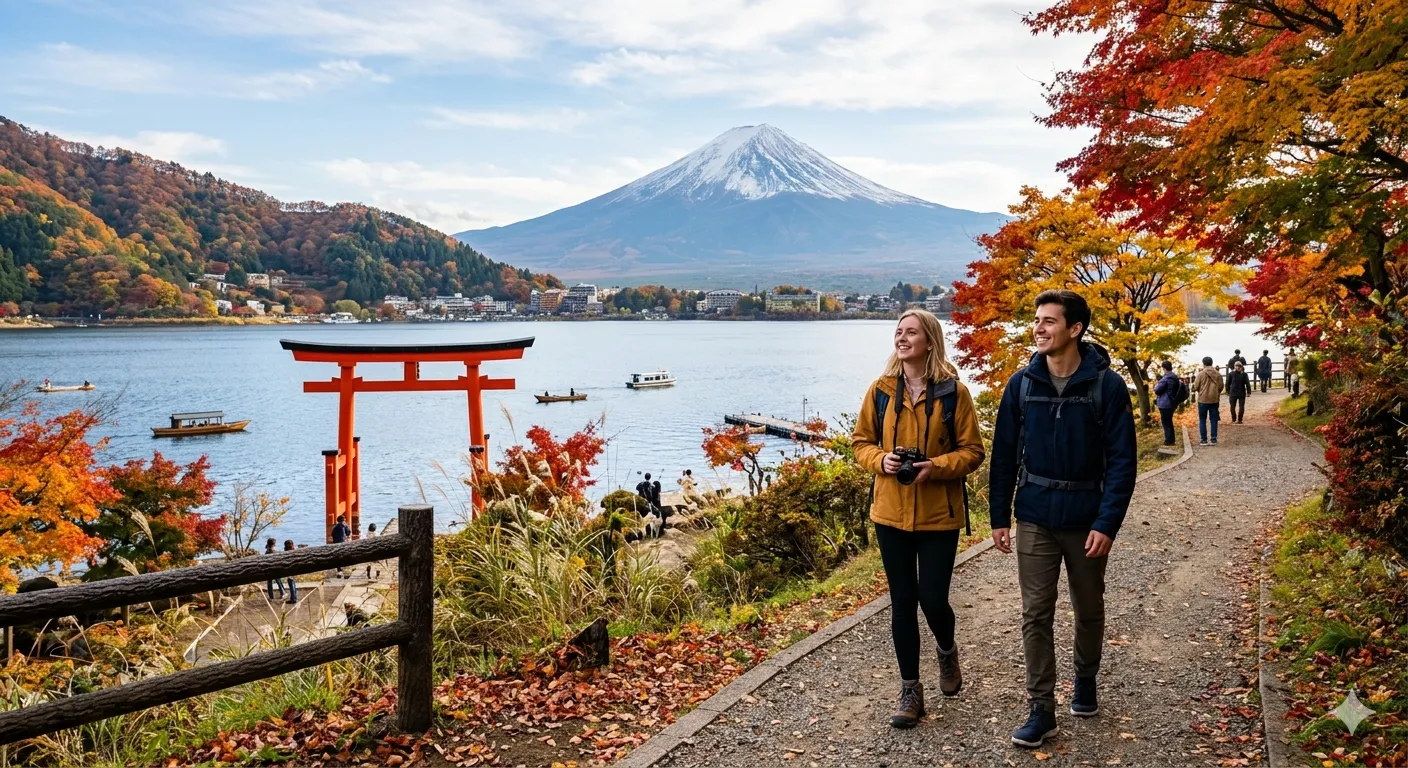
The Fuji Five Lakes area particularly Lake Kawaguchiko is the best place for the classic Fuji reflection photographs, with the mountain rising behind the lake and cherry blossoms or red maples in the foreground depending on season. The area has good cycling infrastructure and several accessible trails that provide close Fuji views without requiring a full summit ascent.
7. The Izu Peninsula: Hot Springs, Wild Coast, and Exceptional Seafood
The Izu Peninsula juts south from the base of Mount Fuji into the Pacific, and it has been a favourite escape for Tokyo residents since the Edo period. The combination of volcanic hot springs, rugged coastline, dense cedar forests, and a seafood culture supplied by two of Japan's most productive fishing grounds makes it one of the richest natural day-trip destinations in the region.
Atami, at the northern tip, is reached in about 50 minutes from Tokyo Station by shinkansen and offers easy access to ocean-view onsen ryokan and the MOA Museum of Art one of Japan's lesser-known but genuinely world-class collections, built into a hillside above the sea with escalators connecting levels through art-lined corridors. Ito, slightly further south, has a well-developed onsen resort area and is the departure point for ferry services to Oshima Island.
Shimoda, at the peninsula's southern tip, is a 2-hour journey by limited express and rewards the longer travel time with exceptional beaches, clear water, historical connections to the opening of Japan to foreign trade in the 1850s (Commodore Perry negotiated here), and a relaxed pace entirely unlike the mainland. The Rendaiji onsen district just outside Shimoda town has some of the peninsula's best ryokan.
The seafood throughout Izu is outstanding, including kinmedai (splendid alfonsino), abalone, and fresh wasabi grown in the cold mountain streams are the regional specialties. Find them at any of the small restaurants near fishing ports, where the quality far exceeds the prices.
8. Narita: The Temple Town Behind the Airport
Most travellers experience Narita only as a transit point — the airport they pass through on arrival and departure. Almost none of them make time for the town itself, which is a pity because Narita is home to one of Japan's most significant and atmospheric Buddhist temple complexes, a perfectly preserved pilgrimage town, and a set of traditional streets that feel genuinely undiscovered by international tourism.
Naritasan Shinshoji Temple, founded in 940 AD, is one of the most visited temples in Japan by domestic visitors, drawing over 12 million people annually, including enormous crowds during the New Year period. The temple complex covers 165,000 square metres of gardens, pagodas, gates, and halls, with a three-storey pagoda and a great main hall that is impressive in both scale and atmosphere.
The Omotesando approach to the temple, an 800-metre street of old wooden buildings housing eel restaurants (unaju is the local speciality), traditional sweet shops, craft stores, and tea houses, is one of the most intact traditional shopping streets in the greater Tokyo area. It costs nothing to walk and rewards slow exploration.
Narita is reached by the Keisei Narita Line from Ueno (about 75 minutes) or the JR Narita Express from Tokyo Station (about 55 minutes). If you are arriving or departing through Narita Airport, budget two to three hours before your transfer and walk into town — it is a 20-minute bus ride from the terminal and gives a first or last impression of Japan that the airport cannot.
Staying Connected on Tokyo Day Trips
Every destination in this guide sits outside Tokyo's central transport network, and navigating them efficiently depends on having reliable mobile data in hand. Bus timetables change seasonally. Station exits at unfamiliar stops require real-time map checks. Temple opening hours, last train times, and hiking trail conditions all need to be looked up on the ground. A working internet connection is not a comfort it is the practical foundation of a smooth day trip.
The most convenient option for international visitors is a travel eSIM. An eSIM is a digital SIM plan that downloads directly to your compatible smartphone before you leave home. There is no physical card to collect, no airport counter to queue at, and no gap in coverage between landing and getting your bearings. You activate it before departure and it starts working automatically when your phone connects to a Japanese network — which means you step off your flight at Narita or Haneda with Google Maps already running.
A travel eSIM covers Japan's nationwide 4G and 5G networks, including coverage on shinkansen lines, in smaller towns like Kawagoe and Narita, and on the mountain approaches to Fuji. For a trip centred on day trips from Tokyo, a plan offering 5–10GB is usually more than sufficient. Most plans are data-only, which suits the majority of tourists who rely on messaging apps for calls.
If you prefer a physical card, a Japan SIM card for tourist is available at Narita and Haneda airports from multiple providers — IIJmio, OCN Mobile, and b-mobile are among the most reliable — as well as at electronics chains like Yodobashi Camera and BIC Camera in the city. Tourist SIM cards typically offer data-only plans from 3GB to 50GB with validity periods of 8 to 30 days, covering the same national network as eSIM alternatives.
When comparing options before travel, look for the best eSIM for Japan based on your trip length and usage habits. Providers including Airalo, Holafly, and Unigi, consistently receive strong reviews for coverage reliability across both urban centres and rural areas. For visitors spending a week in Tokyo with several day trips built in, a 10GB plan typically provides comfortable coverage without the need to monitor data usage closely.
Whichever option you choose, a digital eSIM or a physical Japan SIM card, the difference between having reliable data and relying on intermittent Wi-Fi becomes most apparent on day trips. In Nikko's mountain trails, on Kawagoe's backstreets, waiting for a bus in Hakone, or navigating the Izu Peninsula's coastal roads, your own data connection is what keeps the day running smoothly rather than turning into a series of improvised guesses.
Planning Tips for Tokyo Day Trips
- Leave early major sites like Kamakura, Hakone, and Nikko see their heaviest crowds from mid-morning; arriving by 8:00–9:00am gives you 2 hours of relative peace
- Check the weather forecast specifically for your destination — Hakone and Nikko have different microclimates from central Tokyo and can be significantly colder or wetter
- Buy a Suica or Pasmo IC card for seamless tap-in, tap-out travel on local trains and buses at every destination in this guide
- Destination-specific passes (Nikko Pass, Hakone Free Pass) offer genuine savings. Check them against your planned activities before buying
- Return trains to Tokyo on weekend evenings fill up, aiming to head back by 4:00–5:00 pm to avoid standing for the full journey
- Carry cash even if you normally rely on cards. Rural restaurants, temple entry fees, and local buses often remain cash-only
- Download offline maps for your destination via Google Maps or Maps.me. The evening before, mountain areas and coastal routes can have intermittent signal
Final Thoughts
Tokyo's genius as a base lies not just in what it contains but in what it connects to. The city is the hub of a day-trip network that covers active volcanoes, medieval shrine complexes, ancient seaside towns, mountain hot springs, and harbour cities all within two hours by rail.
Pick destinations that match your pace. If you want meditative quiet and forest walking, go to Nikko or Kamakura on a weekday morning. If you want dramatic scenery and the best views of Japan's most famous mountain, go to Hakone and hope for clear skies. If you want to eat magnificently and walk by the water, Yokohama delivers it all in 30 minutes.
Sort out your transport pass and your mobile data before you leave your accommodation. After that, Japan's infrastructure handles the rest. All you have to do is show up.



















Sign in to leave a comment.