
Machine learning (ML) has emerged as one of the most in-demand skills in the rapidly evolving digital world of today. ML is changing industries at an unprecedented rate, from retail and autonomous cars to healthcare and banking. Getting certified in machine learning can help you advance your profession in data science or artificial intelligence.
In addition to demonstrating your expertise, certifications enhance your reputation and may lead to new career prospects. The top certifications for professional advancement will be discussed, including globally renowned courses like IABAC, Coursera, Udemy, and others.
Why Machine Learning Certifications Matter
Professionals now greatly benefit from machine learning certificates for some reasons:
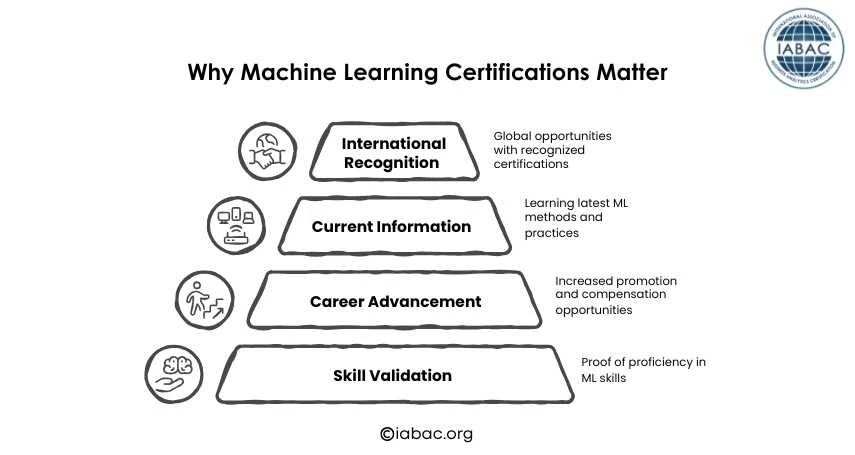
- Validation of Skills: Employers want proof that you are capable of working with algorithms, data preprocessing, and machine learning models. Certifications serve as evidence of your proficiency.
- Career Advancement: You may be more likely to get promoted and receive better compensation packages if you have a recognized qualification that makes you stand out from the competition.
- Current Information: A lot of certificates are made to teach the newest methods, resources, and best practices in machine learning.
- International Recognition: You can obtain international opportunities by obtaining certain certificates, such as IABAC, which are recognized globally.
A certification can define your skills and offer an organized learning path, even if you have previous programming or data science experience.
Top Machine Learning Certifications for Career Growth
The following is an in-depth review of some of the most reputable certifications that can advance your career:
1. IABAC Machine Learning Certification
Provider: International Association of Business Analytics Certification (IABAC)
Level: Beginner to Advanced
Duration: Self-paced, typically 3-6 months
Format: Online
Professionals and students who wish to develop strong foundations in machine learning might benefit from the IABAC Certification. It covers fundamental subjects such as neural networks, regression, classification, unsupervised and supervised learning, and model evaluation methods.
Why Choose IABAC:
- Globally recognized in the fields of AI and business analytics.
- Provides practical projects that assist you in applying machine learning techniques to actual issues.
- Beginners and seasoned experts can benefit from it.
You are a great contender for positions like Data Scientist, ML Engineer, and AI Consultant after earning the IABAC certification, which proves your ability to create, implement, and assess ML models.
2. Coursera – Machine Learning by Stanford University
Provider: Coursera (Andrew Ng)
Level: Beginner
Duration: 11 weeks (flexible)
Format: Online
One of the most well-liked and approachable certifications in the world is this one. This course, which was developed by AI pioneer Andrew Ng, covers case studies, unsupervised as well as supervised learning, and best practices in machine learning.
Key Benefits:
- Taught by a professional with decades of experience in the field.
- Includes real-world tasks and Octave or MATLAB programming exercises.
- Recognized by leading tech companies.
For beginners wishing to launch a career in artificial intelligence or machine learning, this certification is great.
3. Google Cloud Professional Machine Learning Engineer
Provider: Google Cloud
Level: Intermediate to Advanced
Duration: Self-paced
Format: Online
Using Google Cloud services to create, develop, and produce ML models is the main focus of Google's ML certification. You will discover how to use TensorFlow, build scalable machine learning pipelines, and implement ML models in practical applications.
Why It’s Valuable:
- Highly esteemed and acknowledged in the industry.
- Focuses on cloud-based machine learning, which is important for contemporary AI applications.
- Interactive labs and projects support learning.
Professionals who wish to work on enterprise-level ML projects or with cloud ML solutions should get this qualification.
4. Microsoft Certified: Azure AI Engineer Associate
Provider: Microsoft
Level: Intermediate
Duration: Flexible, self-paced
Format: Online
The focus of the Microsoft Azure AI Engineer certification is on Azure-based AI solutions. Using tools like Azure Machine Learning, Cognitive Services, and Bot Services, you will learn how to create, deploy, and track machine learning models on the Azure platform.
Key Benefits:
- Focus on integrating cloud with AI, as this is a useful ability for enterprise apps.
- In the IT sector, Microsoft certifications are widely accepted.
- Case studies and hands-on laboratories improve learning.
If you are planning to work with Microsoft technologies or enterprise-level AI, this certification is highly recommended.
5. IBM AI Engineering Professional Certificate
Provider: IBM via Coursera
Level: Intermediate
Duration: 6 months (flexible)
Format: Online
ML, deep learning, and AI solutions are the main topics of IBM's AI Engineering certification. Python, data analysis, TensorFlow, and model deployment will all become more proficient to you.
Key Highlights:
- Hands-on projects and capstone assignments.
- Industry-recognized certificate by a leading AI company.
- Strong focus on real-world applications.
For professionals who wish to move into AI engineering roles, this qualification is appropriate.
How to Choose the Right Certification
Your learning style, professional objectives, and background all influence which certification is best for you. Here are some pointers:
- Beginner vs. Advanced: Take courses on Coursera or Udemy if you're new to machine learning. Obtain IABAC, AWS, or Google Cloud certifications if you have previous expertise.
- Industry Focus: Take into account the platform that your target industry uses the most. AWS or Azure certifications are useful for cloud machine learning positions.
- Practical Assignments and Projects: Certifications that incorporate practical assignments or projects assist you in applying ideas to actual situations.
- Global Recognition: If you want to work abroad, pick certifications like IBM, Google, or IABAC.
- Career Objectives: Match your qualifications to the position you want, such as cloud AI specialist, ML engineer, data scientist, or AI consultant.
Tips to Succeed in Machine Learning Certifications
Obtaining a certification is just the beginning. To get maximum benefit out of it:
- Practice Regularly: ML is practical. Work on projects and datasets to solidify your learning.
- Learn Programming: Python and R are the most common languages used in ML.
- Understand Algorithms: Don’t just memorize—they should be understood conceptually.
- Stay Updated: ML is evolving rapidly. Follow blogs, research papers, and online communities.
- Apply Knowledge: Build your own ML projects or contribute to open-source to gain hands-on experience.
By confirming your skills, expanding your employment options, and keeping you current of the most recent developments in artificial intelligence, machine learning certificates can greatly advance your career. Internationally recognized programs that offer practical experience, such as the IABAC Machine Learning Certification, are a great option for beginners as well as professionals.
Consistent learning and real-world application are crucial, regardless of the platform you select—Coursera, Google, AWS, Microsoft, or Udemy. You can establish yourself as a proficient machine learning specialist who is prepared to take on the difficulties of the data-driven world of the future by devoting your time to obtaining the appropriate certification.



























Sign in to leave a comment.