
Most night boating accidents don't happen because a boat has too little light. They happen because someone pointed bright deck lights the wrong way, straight into the operator's own eyes, and killed their night vision at the worst possible moment.
That's the real mistake. Not weak lighting. Misaimed lighting.
Picking the best marine lights for your boat isn't about buying the brightest thing on the shelf. It's about controlling where the light goes. Let's walk through why this trips up so many boaters, and how to fix it in one evening.
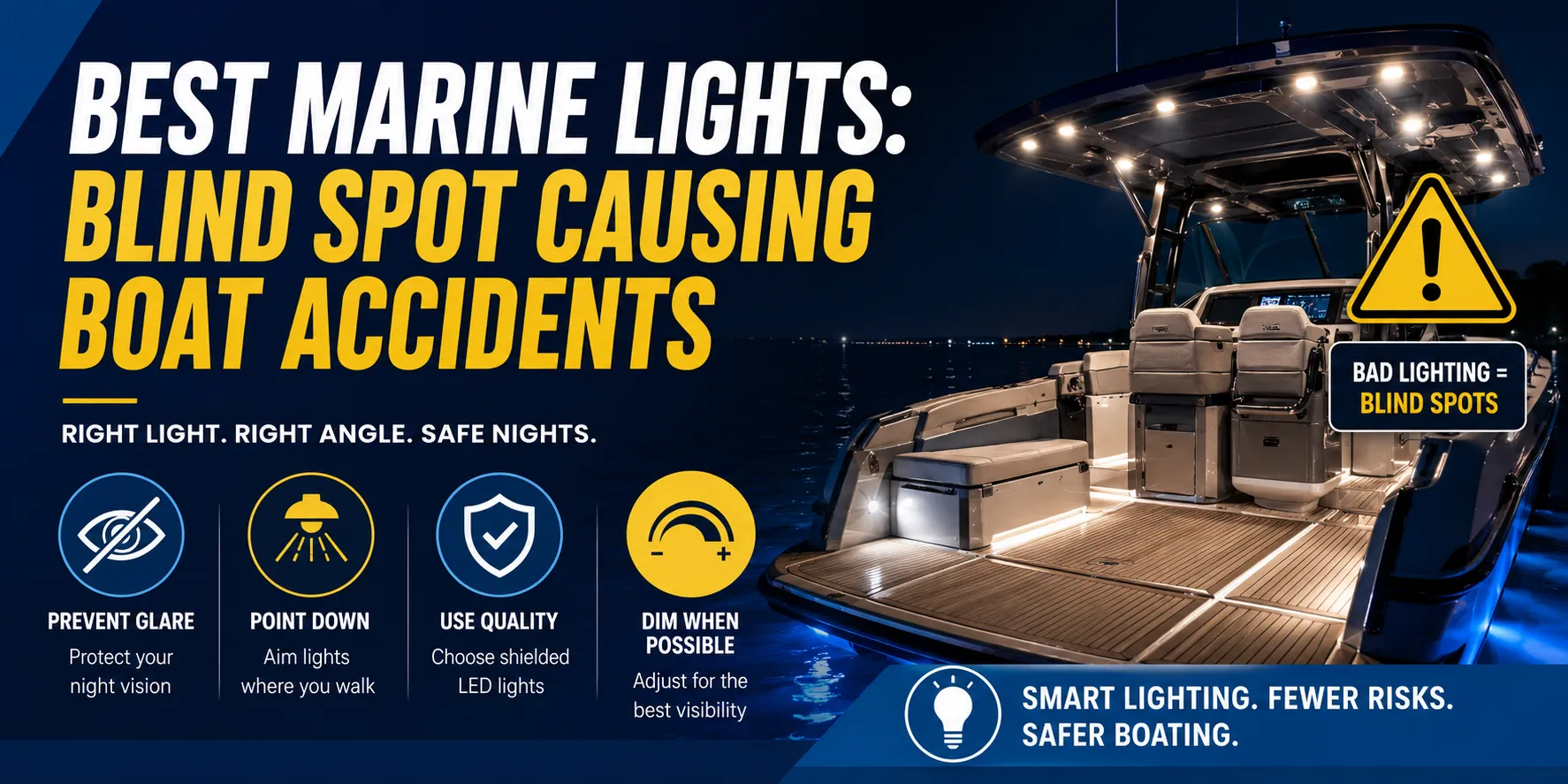
Why Does Bright Lighting Cause Accidents?
• Destruction of Night Vision: While your eyes need up to 30 minutes to adjust to the darkness fully, just one glance at a harsh white light can undo that progress in seconds, causing temporary "night blindness."
• Self-Inflicted Danger: Most boaters assume the danger comes from other vessels, but it usually stems from their own lighting setups.
• The Culprit is Glare: Bad lighting choices, like a stern light mounted too low, a floodlight blasting at full power, or a deck light aimed outward instead of down, bounce glare straight back at the operator.
• Blinded to Hazards: This glare forces you to stare at a bright blur instead of scanning the water for critical hazards like swimmers, buoys, or fast-approaching vessels.
• Control Over Raw Power: This is exactly why the best marine LED lights matter. Safe boating isn't a brightness contest; it's a beam-control contest.
The Glare Trap, Explained Simply
Picture your deck lit up at night. You added a few extra lights to feel safer. But now you've got sharp, bright spots sitting right next to dark shadows.
Your eyes lock onto the bright spot. The shadows around it go invisible.
Anything hiding in that shadow- a piling, a paddleboard, another boat with no lights- disappears completely.
Cheap, unshielded fixtures make this worse. Boat deck lights without a shield or a downward angle don't just light your deck. They light the air above it too, scattering glare into your eyes and everyone else's.
The fix isn't fewer lights. It's smarter placement, and that's the whole idea behind choosing the best marine lights in the first place.
5 Habits Behind Most Night Accidents
You don't need bad equipment to cause this problem. You need one of these habits:
• Deck lights aimed outward or up, instead of straight down
• Stern lights mounted too low, right at eye level
• Shiny rails or cleats bouncing light back into the cockpit
• Instrument panels left at full brightness
• A spotlight swept across the water and left pointed at other boats
Even the best marine lights money can buy will cause glare if they're installed wrong. Most owners mount their lights once and never check the angle again. That's how a small oversight becomes a season-long hazard.
How to Fix It (In Under 30 Minutes)
Good news: you don't need to rewire your whole boat or shop for the best marine lights overnight. A few small adjustments handle most of the problem right away.
1. Fix the angle first. Deck lights should sit low and point straight down at the surface you're walking on, not out into the air. This one change removes most of the glare problem instantly.
2. Check the fixture quality. This is where the best marine LED lights actually earn their name. Good fixtures use recessed housings or frosted lenses that send light exactly where it's needed. Cheap ones throw raw light in every direction because it's less work to build that way.
3. Dim what you can. Many modern boat deck lights now come with adjustable brightness. Full power feels reassuring while docking. Out on open water, it just blinds you.
4. Cover shiny surfaces. A polished bow rail or a chrome cleat can bounce light straight back at your eyes. A strip of matte tape or a slight angle adjustment solves this in minutes.
What to Look for When Buying New Lights
Think of this as a visibility decision, not a style choice. The best marine lights for your setup usually share these four traits:
• Shielded design: If you can see the bulb from the driver's seat, so can your eyes at a glance, and that's enough to wreck your night vision.
• Warm white tone, not cool blue: Cooler LEDs scatter more in humid marine air and reflect harder off water. Warm tones stay gentle on your eyes without losing visibility.
• Marine-grade housing: Saltwater and vibration wear down cheap fixtures fast. A cracked or fogged lens scatters light unpredictably, and the glare problem comes right back.
• A tight, downward beam: This matters more than lumens. A focused beam aimed at the deck beats a wide flood every time.
• Dimming control: Lower for open water, higher for docking. Fixed-output lights can't give you that flexibility.
A Two-Minute Habit That Prevents Most of This
Before you leave the dock at night, sit in the operator's seat. Look at every light on your boat: deck lights, cabin lights, instrument panels.
Ask one question: does anything here send light back at my own eyes?
If yes, that fixture needs a shield, a downward tilt, or a dimmer setting before you head out. This habit costs nothing and takes two minutes, and it directly fixes the exact problem behind most night-lighting accidents.
Pair It Right and Move On
Fixing this isn't complicated. Angle your fixtures down, choose shielded housing, dim what you can, and cover anything shiny nearby.
Night boating accidents rarely come down to too little visibility. They come down to poorly placed light stealing the operator's own night vision.
You don't need to gut your electrical system to fix this. You need to rethink where your lights point and how bright they need to be at any given moment.
When you're ready to upgrade, remember this: the best marine lights aren't the ones that shine the loudest. They're the ones that put light exactly where you need it, and keep it out of your eyes. To buy the best lights, DuraBrite is the best destination.
So, pair the lights with smart, downward-facing beams. Install your boat deck lights with intent, not guesswork. Do that, and you'll fix the one mistake responsible for more night accidents than almost anything else on the water.
FAQs
1. Do brighter lights make night boating safer?
No. Brighter isn't the same as safer. A powerful light aimed the wrong way creates more glare, not more visibility. The best marine lights control the beam, not just the wattage.
2. Are LED lights better than halogen for boat decks?
Usually, yes. Good LED fixtures run cooler, last longer, and can be built with tighter beam control. That's why the best marine LED lights are the standard choice on most boats today, as long as they're installed with the beam pointed down.
3. Where should boat deck lights be mounted?
Low, and angled downward toward the walking surface. Never at eye level, and never aimed outward across the water.



























Sign in to leave a comment.