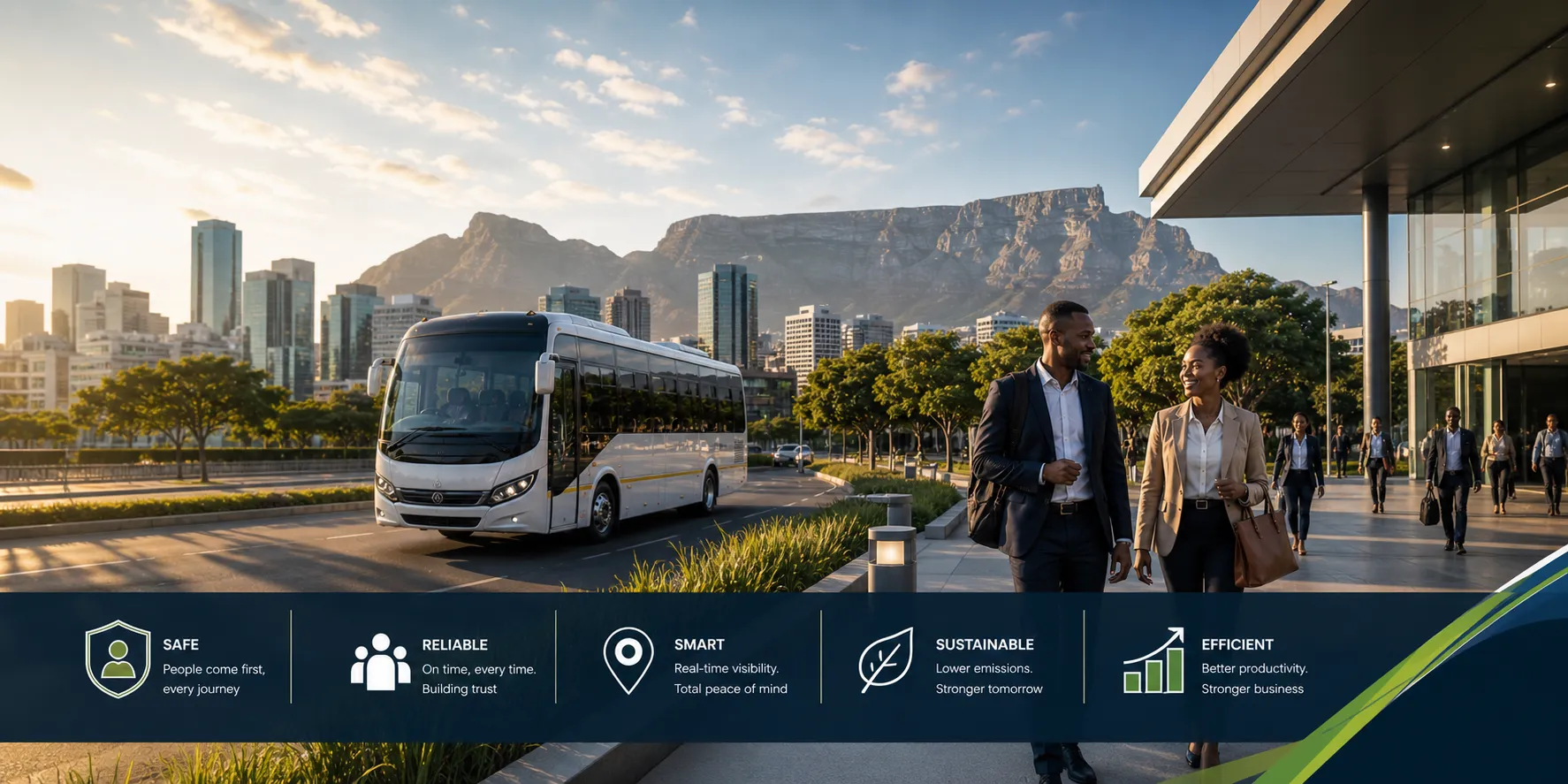

We have all been there. It’s 5:30 PM, you’ve just wrapped up a grueling day at the office, and now you face the dreaded "Second Shift": the commute home. For many in South Africa, this isn't just a minor inconvenience involving a podcast and some traffic.
It is a logistical nightmare often fraught with safety concerns, unreliable schedules, and rising costs. But what if the daily grind didn't have to grind us down?
The conversation around how we work has changed drastically in the last few years, yet the conversation around how we get to work is just catching up. We are seeing a quiet revolution in staff transportation, moving away from chaotic ad-hoc arrangements toward sophisticated, tech-driven solutions.
It’s no longer just about providing a bus; it’s about duty of care, efficiency, and leveraging data to make the workday better before it even begins.
Why "Just Getting There" Isn't Enough Anymore
For businesses, ensuring employees get to work is becoming a strategic priority rather than an operational afterthought.
This is particularly true in industries like BPOs, manufacturing, and healthcare, where shifts often start or end at odd hours.
The primary driver here is safety. In a landscape where public transport can be unpredictable, employers are stepping in to bridge the gap. But simply hiring a fleet of taxis isn't the solution. Without visibility, you have no guarantee of safety.
This is where advanced vehicle tracking enters the picture. Modern platforms have moved far beyond simple GPS dots on a map. We are talking about real-time safety compliance that protects employees actively.
Must Read: Employee-First Journeys from Commute to Desk
For instance, platforms like MoveInSync have integrated features specifically designed for high-risk scenarios.
They utilize SOS buttons and "safe reach" verification systems. This is especially critical for female employees traveling at night, ensuring that someone is watching over their journey until they are safely inside their front door.
When technology can alert a command center the moment a vehicle deviates from a planned route, staff transportation transforms from a perk into a vital safety net.
The Hidden Costs of Staff Transportation
Let's talk numbers, because the economics of transport are staggering. Did you know that in the South African context, approximately 85% of employees live between 20 and 35 kilometers away from their workplace? That is a significant distance to cover twice a day, every day.
For companies managing their own transport, the logistical complexity of covering these distances is a money pit.
Empty seats in shuttle buses, inefficient routes that circle the same neighborhood three times, and vendors overcharging for mileage are common issues.
Effective fleet management is the antidote to this financial bleed.
By using Artificial Intelligence (AI) to automate routing, companies aren't just guessing the best way to pick up staff; they are calculating it with mathematical precision.
MoveInSync, a platform managing employee commutes for over 104 Fortune 500 brands, notes that businesses can unlock a guaranteed cost reduction of over 20% simply by automating these workflows.
When you "right-size" your fleet—using the exact number of vehicles needed for that specific shift's demand rather than a fixed number—you stop paying for air and start paying for actual transport.
Tech Meets Asphalt: How It Works
So, what does this "future" actually look like on the ground? It looks remarkably like a ride-sharing app you might use on a Saturday night, but tailored for the corporate world.
Imagine an employee opening an app to schedule their ride for the week.
The system aggregates all requests, groups employees who live in the same zones, and assigns a vehicle. The driver gets an optimized route, and the transport manager gets a dashboard showing the live status of every trip.
This level of transport for staff eliminates the manual spreadsheets and frantic phone calls that plague traditional transport departments. It also addresses the specific geographical challenges we face.
South African terrain and city layouts are unique; a system that understands local traffic patterns and "complex geographies" ensures that staff aren't stuck in gridlock when they should be clocking in.
Real Stories, Real Impact
This isn't just theoretical tech-speak. Real companies are seeing tangible shifts in their operational culture.
Take Amazon South Africa, for example. Yonda Ndiki, their RE&F Program Manager for Commute, highlights how moving to a digital platform changed the game. "Its customizable analytics gave us operational visibility and improved efficiency," Ndiki notes.
“MoveInSync also streamlined scheduling and fleet optimization, delivering cost savings and competitiveness.” It’s a sentiment echoed by Kieran Davidson from HG Travelling Services, who points out that digitizing transport operations is a "great tool for increasing efficiency and reducing cost."
When major players in logistics and tech adopt these systems, it signals a shift in the standard. It proves that fleet management is no longer just about maintaining engines and tires; it’s about maintaining employee satisfaction and operational resilience.
The Green Bonus
Finally, we cannot ignore the environmental elephant in the room. Corporate commuting leaves a massive carbon footprint. However, when you optimize routes, you reduce mileage. When you reduce mileage, you reduce emissions.
Sustainable commuting is becoming a massive part of the Employee Value Proposition (EVP). Employees want to know their company cares about the planet. By tracking carbon emissions per ride and slowly integrating Electric Vehicles (EVs) into the fleet, companies can turn a daily necessity into a sustainability goal.
MoveInSync has even helped large banking clients transition entire fleets to 100% EVs, proving that green commuting is possible even at scale.
Rethinking the Road Ahead
The days of the erratic, unsafe, and unmanaged commute are numbered. As technology becomes more accessible, providing safe, reliable, and efficient transport for staff will likely become the norm rather than the exception.
Whether it’s the peace of mind provided by vehicle tracking or the bottom-line boost from smarter fleet management, the benefits are too loud to ignore. It is time we stopped looking at staff transport as just a ride to work, and started seeing it for what it really is: the engine room of a productive, happy, and safe workforce.



























Sign in to leave a comment.