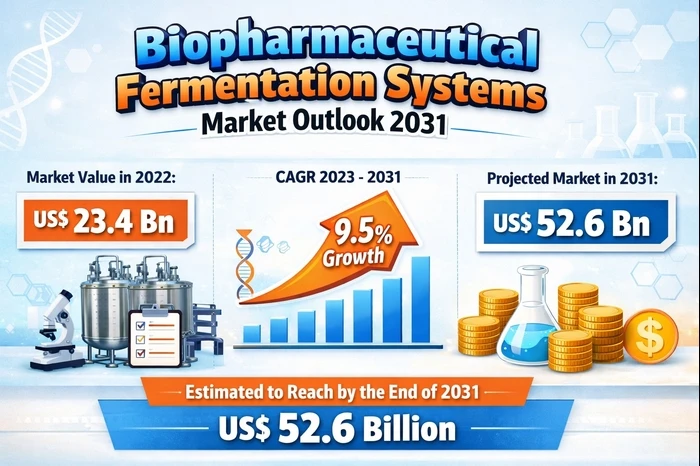

The global Biopharmaceutical Fermentation Systems Market is undergoing a significant transformation, fueled by the accelerating demand for biologics, increasing investments in biotechnology, and the shift toward more efficient and scalable manufacturing processes. With a market valuation of US$ 23.4 Bn in 2022, the industry is projected to reach US$ 52.6 Bn by 2031, expanding at a robust CAGR of 9.5% during the forecast period from 2023 to 2031.
Biopharmaceutical fermentation systems serve as the backbone of modern biologics production. These systems enable the cultivation of microorganisms and cells to produce complex therapeutic compounds, including monoclonal antibodies, recombinant proteins, vaccines, and enzymes. As the global healthcare ecosystem increasingly relies on biologics to treat chronic and life-threatening diseases, fermentation technologies are becoming indispensable.
Market Overview
Biopharmaceutical fermentation systems encompass a wide range of equipment and processes designed to support cell growth and product formation in controlled environments. These include upstream systems such as fermenters and bioreactors, as well as downstream systems for purification and recovery.
The market is witnessing a paradigm shift from traditional batch processing to continuous biomanufacturing. Continuous fermentation offers enhanced productivity, reduced operational costs, and improved consistency in product quality. This shift is being supported by regulatory agencies that encourage innovation and efficiency in pharmaceutical manufacturing.
Moreover, advancements in automation, process analytics, and real-time monitoring are enhancing the performance of fermentation systems. These innovations are enabling manufacturers to optimize production processes, reduce errors, and achieve higher yields.
Key Growth Drivers
1. Rising Demand for Advanced Biologics
The increasing prevalence of chronic diseases such as cancer, autoimmune disorders, and infectious diseases is driving the demand for biologics. Unlike conventional drugs, biologics offer targeted treatment with higher efficacy and fewer side effects.
Biopharmaceutical fermentation systems are essential for producing these complex molecules. The growing adoption of monoclonal antibodies and recombinant proteins in therapeutic applications is significantly boosting market demand.
2. Expansion of Personalized and Precision Medicine
Personalized medicine is reshaping the pharmaceutical landscape by focusing on patient-specific treatments. This approach requires flexible manufacturing systems capable of producing small batches of customized biologics.
Fermentation systems are being tailored to support the development of precision therapies, including gene therapies and targeted biologics. These systems provide the scalability and adaptability needed to meet the unique requirements of personalized medicine.
3. Technological Advancements in Bioprocessing
Continuous innovation in bioprocessing technologies is a major driver of market growth. Modern fermentation systems are equipped with advanced sensors, automation tools, and data analytics capabilities.
These technologies enable real-time monitoring of critical parameters such as temperature, pH, and oxygen levels, ensuring optimal conditions for cell growth. The integration of artificial intelligence and machine learning is further enhancing process efficiency and predictive capabilities.
4. Increasing Investments in Biotechnology
Governments and private organizations worldwide are investing heavily in biotechnology research and infrastructure. These investments are supporting the development of new biologics and improving manufacturing capabilities.
The establishment of biopharmaceutical manufacturing facilities, particularly in emerging markets, is creating new opportunities for fermentation system providers.
Emerging Market Trends
1. Adoption of Single-Use Technologies
Single-use systems are gaining popularity due to their cost-effectiveness and reduced risk of contamination. These systems eliminate the need for cleaning and sterilization, thereby saving time and resources.
They are particularly suitable for small-scale production and research applications, making them ideal for personalized medicine and clinical trials.
2. Focus on Process Optimization
Manufacturers are increasingly focusing on optimizing fermentation processes to improve productivity and reduce costs. This includes the use of advanced media formulations, improved cell lines, and optimized process parameters.
Process optimization is critical for achieving high yields and maintaining consistent product quality.
3. Growth of Contract Manufacturing Organizations (CMOs)
The outsourcing of biopharmaceutical production to CMOs is becoming more common. CMOs offer specialized expertise and infrastructure, allowing pharmaceutical companies to focus on core activities such as research and development.
This trend is driving the demand for fermentation systems, as CMOs expand their capabilities to accommodate growing client needs.
Detailed Market Segmentation
By Product Type
The market is broadly categorized into upstream and downstream products.
Upstream products include:
- Fermenters and bioreactors
- Bioprocess analyzers
- Process monitoring devices
- Culture media and preparation systems
These components are essential for initiating and maintaining cell cultures.
Downstream products include:
- Filtration and separation systems
- Chromatography equipment
- Consumables and accessories
These are used for purifying and isolating the final product, ensuring compliance with quality standards.
By Application
The market serves a wide range of applications, including:
- Recombinant proteins
- Monoclonal antibodies
- Antibiotics
- Probiotics
- Other biologics such as enzymes and amino acids
Among these, recombinant proteins accounted for the largest share in 2022, driven by their extensive use in therapeutic and industrial applications.
By End-user
Key end-users include:
- Biopharmaceutical companies
- Contract manufacturing organizations
- Contract research organizations
- Academic and research institutes
- Food and beverage industry
Biopharmaceutical companies remain the dominant segment, owing to their extensive use of fermentation systems in drug development and production.
Regional Analysis
North America: Market Leader
North America continues to dominate the global market, supported by a strong presence of leading biopharmaceutical companies and advanced research infrastructure. The region benefits from high healthcare expenditure and favorable regulatory policies.
The United States is a major contributor, with significant investments in biotechnology and a high prevalence of chronic diseases.
Europe: Strong Growth Potential
Europe is characterized by a well-established pharmaceutical industry and supportive government initiatives. Countries such as Germany, the United Kingdom, and France are key contributors to market growth.
Asia Pacific: Fastest Growing Region
The Asia Pacific region is emerging as a lucrative market, driven by increasing investments in healthcare and biotechnology. Countries like China, India, and Japan are focusing on expanding their biopharmaceutical manufacturing capabilities.
Lower production costs and a growing pool of skilled professionals are attracting global players to the region.
Competitive Landscape and Key Players
The biopharmaceutical fermentation systems market is highly competitive, with companies focusing on innovation, partnerships, and capacity expansion to strengthen their market position.
Prominent players include:
- GE Healthcare
- Thermo Fisher Scientific Inc.
- Danaher Corporation
- Sartorius Stedim Biotech
- Merck KGaA
- Eppendorf AG
- F. Hoffmann-La Roche Ltd.
- Nova Biomedical
- Lonza Group AG
- BD
These companies are leveraging advanced technologies and strategic collaborations to enhance their product offerings and expand their global footprint.
Strategic Developments
Recent industry developments highlight the growing emphasis on expanding production capabilities and enhancing technological expertise. Acquisitions and investments are playing a crucial role in shaping the competitive landscape.
For example, the acquisition of ADL BioPharma by Wacker Chemical Group reflects the increasing focus on expanding fermentation capacities and improving downstream processing capabilities.
Similarly, investments in research facilities and academic collaborations are fostering innovation and talent development in the industry.
Challenges and Restraints
Despite its growth potential, the market faces several challenges:
- High capital investment requirements
- Complex regulatory frameworks
- Technical difficulties in scaling up production
- Risk of contamination and process failure
Addressing these challenges requires continuous innovation, skilled workforce, and adherence to stringent quality standards.
Opportunities and Future Prospects
The market presents numerous opportunities for growth and innovation:
- Increasing demand for biosimilars
- Expansion into emerging markets
- Advancements in synthetic biology
- Integration of digital technologies
Companies that invest in research and adopt innovative manufacturing approaches are likely to gain a competitive advantage.
Future Outlook
The biopharmaceutical fermentation systems market is poised for sustained growth in the coming years. The increasing reliance on biologics, coupled with advancements in technology, will continue to drive demand for efficient and scalable fermentation systems.
The shift toward continuous manufacturing, combined with the adoption of digital tools, will further enhance productivity and reduce costs. As the industry evolves, fermentation systems will play a critical role in enabling the development and production of next-generation therapeutics.
Conclusion
The Biopharmaceutical Fermentation Systems Market is at the heart of modern biopharmaceutical manufacturing, enabling the production of complex and life-saving biologics. With strong growth drivers, technological advancements, and expanding global demand, the market is set to achieve remarkable progress in the years ahead.




















Sign in to leave a comment.