

India has strengthened its product regulatory framework to ensure safety, reliability, and quality of goods sold in the domestic market. One of the most critical compliance approvals required across multiple industries is certification from the Bureau of Indian Standards (BIS).
Whether you are a domestic manufacturer, foreign exporter, or importer, understanding BIS certification is essential for legal market access in India.
This detailed guide explains everything about BIS certification — schemes, process, documentation, foreign manufacturer requirements, benefits, and how professional consultancy support ensures smooth approval.
What is BIS?
The Bureau of Indian Standards (BIS) is the National Standards Body of India established under the BIS Act, 2016. BIS is responsible for:
- Formulating Indian Standards (IS)
- Granting product certification
- Implementing Quality Control Orders (QCOs)
- Conducting factory inspections
- Protecting consumer safety
- Ensuring product quality conformity
BIS certification confirms that a product complies with the relevant Indian Standard and regulatory requirements.
What is BIS Certification?
BIS Certification is a conformity assessment scheme that authorizes manufacturers to use the ISI Mark or BIS Standard Mark on products after verifying compliance with applicable Indian Standards.
If a product is notified under a Quality Control Order (QCO), BIS certification becomes legally mandatory before:
- Manufacturing
- Importing
- Distributing
- Selling in India
Non-certified notified products cannot legally enter the Indian market.
Types of BIS Certification Schemes
1️⃣ ISI Mark Certification Scheme
This is the most recognized BIS certification scheme. It applies mainly to:
- Steel products
- Cement
- Electrical appliances
- Automotive components
- Footwear
- Industrial materials
- Household safety products
Key Features:
- Mandatory product testing
- Factory inspection by BIS officials
- Verification of quality control systems
- Grant of ISI Mark license
2️⃣ CRS (Compulsory Registration Scheme)
This scheme mainly covers electronics and IT products such as:
- LED lights
- Power banks
- Laptops
- CCTV cameras
- Mobile phones
Key Features:
- Testing in BIS-recognized labs
- No factory audit (in most cases)
- Registration based on test reports
- Use of CRS Mark
3️⃣ FMCS (Foreign Manufacturers Certification Scheme)
For overseas manufacturers exporting products to India.
Under FMCS:
- The foreign factory is inspected by BIS officials
- Product samples are tested as per Indian Standards
- An Authorized Indian Representative (AIR) must be appointed
- License is granted for export to India
FMCS is mandatory for foreign manufacturers whose products are notified under QCO.
BIS Certification Process – Step-by-Step
Step 1: Identify Applicable Indian Standard
Each product falls under a specific IS number. Identifying the correct standard is crucial.
Step 2: Documentation Preparation
Prepare:
- Company registration documents
- Factory layout
- Manufacturing process details
- List of machinery
- Quality control procedures
- Testing equipment details
- Calibration certificates
Step 3: Product Testing
Samples must be tested at BIS-recognized laboratories.
Step 4: Application Filing
Submit the application through the BIS online portal along with prescribed fees.
Step 5: Factory Inspection (For ISI & FMCS)
BIS officials verify:
- Manufacturing capability
- In-house testing infrastructure
- Quality management systems
- Process controls
- Technical competence
Step 6: Grant of License
After successful compliance verification and test approval, BIS grants certification.
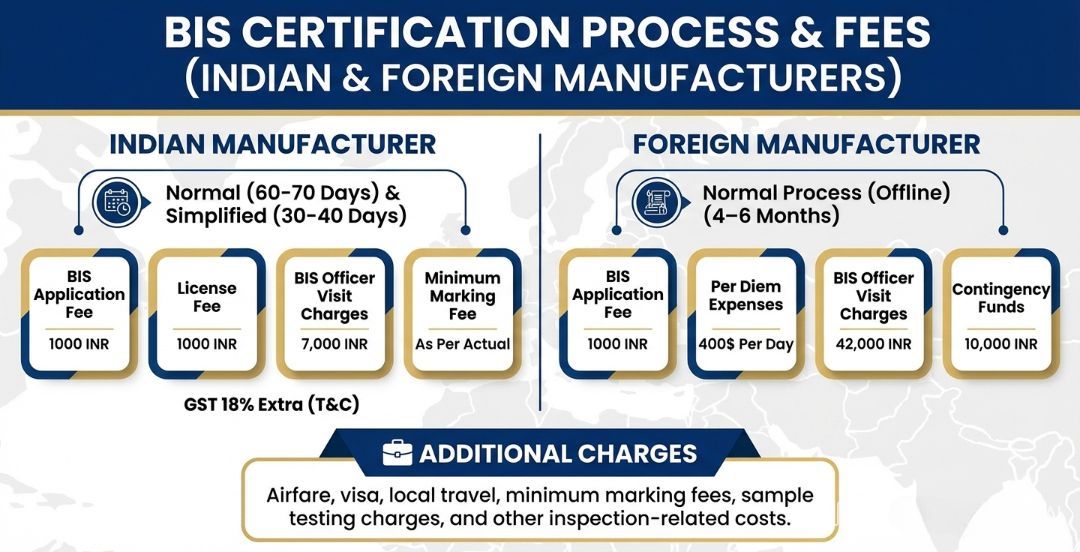
Documents Required for BIS Certification
Common documents include:
- Incorporation certificate
- Manufacturing license
- Factory layout
- Machinery list
- Raw material details
- Product test reports
- Quality manual
- Calibration certificates
Foreign manufacturers require additional FMCS documents and AIR appointment letter.
Validity and Renewal
- ISI License: Generally 1–2 years (renewable)
- CRS Registration: 2 years (renewable)
- FMCS License: As per BIS guidelines
Timely renewal is essential to avoid penalties or suspension.
Benefits of BIS Certification
✔ Legal market access in India
✔ Authorization to use ISI/BIS mark
✔ Enhanced consumer trust
✔ Competitive advantage in tenders
✔ Improved brand credibility
✔ Smooth customs clearance
✔ Reduced regulatory risk
BIS certification strengthens brand positioning and ensures regulatory security.
Consequences of Non-Compliance
Selling or importing notified products without BIS certification may result in:
- Heavy penalties
- Product seizure
- Customs detention
- Legal prosecution
- Business suspension
Compliance is mandatory, not optional.
Challenges in BIS Certification
- Incorrect standard identification
- Incomplete documentation
- Testing failures
- Factory inspection observations
- Delays in regulatory communication
Professional expertise significantly reduces such risks.
Why Choose Standphill India for BIS Certification?
Standphill India is India’s leading BIS Certification Consultant with over 20+ years of regulatory expertise.
We specialize in:
- BIS Registration
- ISI Mark Certification
- FMCS handling for foreign manufacturers
- CRS Scheme approvals
- PESO certification
- WPC approvals
- EPR compliance
Trusted by 1000+ brands, Standphill India helps manufacturers make their products market-ready with structured compliance strategies and documentation precision.
Our Strengths:
- Accurate standard identification
- Complete documentation management
- Pre-audit readiness preparation
- Coordination with BIS authorities
- Faster approval timelines
- Post-certification compliance support
We serve domestic manufacturers, importers, and global exporters targeting the Indian market.
Standphill India is your partner in global compliance.
Industries We Serve
- Steel & metal products
- Electronics & IT goods
- Footwear
- Construction materials
- Consumer appliances
- Automotive components
- Industrial machinery
Conclusion
BIS certification is a critical regulatory requirement for businesses operating in India. With expanding Quality Control Orders across industries, compliance with BIS standards has become essential for uninterrupted market access.
Understanding the certification process, documentation requirements, and scheme applicability ensures smooth regulatory approval.
With 20+ years of experience and trust from 1000+ brands, Standphill India continues to support businesses in achieving BIS certification efficiently, accurately, and without delays.
If your product requires BIS certification, professional guidance ensures faster approvals and long-term compliance security.










Sign in to leave a comment.