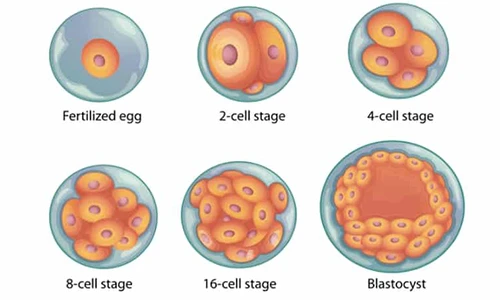

Blastocyst Culture and Day 5 Transfer
Blastocyst Culture and day 5 transferIn Vitro Fertilization with Blastocyst Culture and Day 5 Transfer
Blastocyst culture and day 5 embryos transfer for in vitro fertilization allows best selection of the best quality embryos for transferEmbryo quality is important with infertility selection of embryosWith blastocyst transfer, Doctor transfer fewer embryos to reducing multiple pregnancy risks, and maintain high IVF success rates. Blastocyst transfer have higher sucess rate as compare day 3 embryosDefinition of a blastocyst : Blastocyst culture
An embryo that has developed for five to seven days after fertilization and has 2 distinct cell types and a central cavity filled with fluid (blastocoel cavity) and lower quality embryos can’t survive till day 5The cells in a blastocyst have just started to differentiate and good for implantationThe surface cells that surround the cavity (just under the outer shell) are called the trophectoderm and will later develop into the placentaA more centrally located group of cells – the inner cell mass, will become the fetusBlastocyst culture and development
The most commonly used indications for assisted hatching with an in vitro fertilization case are:
The blastocyst usually forms on day 5 as fluid builds within the compacted morulaA healthy blastocyst often begins hatching from its outer shell, called the zona pellucida between day 5 to day 7 after fertilizationWithin 24 hours after hatching, embryo implantation after IVF (or a “natural” pregnancy) begins as the embryo invades into the uterine liningThe blastocyst releases HCG hormone (the pregnancy test hormone) which leaks into the mother’s blood as the embryo implantsBlastocyst formation rate
The goal of in vitro fertilization and embryo culture is to provide high quality embryos which are capable of continued development and result in live birthsHowever, under standard IVF culture conditions, only about 25 to 60% of human embryos progress to the blastocyst stage after 5 days of cultureThe low rate of embryo development has 2 main causes:A less than optimal culture environment in the lab dishThe inherent “weakness” of human embryosTherefore, in the past embryos were transferred to the uterus after 2 or 3 days
Advantages of blastocyst transfer for IVF
One problem with this is that 2 to 3-day-old embryos are normally n the fallopian tubes, not in the uterus. The embryo gets to the uterus about 80 hours after ovulation.Embryo implantation process begins about 3 days later – after blastocyst formation and hatching out of the embryonic shell have occurred.Therefore, if in vitro culture conditions are maximized so healthy blastocysts form at a high rate, then day 5 blastocyst embryo transfer can be done.The uterine lining on day 5 should be receptive to the arriving embryo – this a more “natural” time for the embryos to be in the uterus. It is the same timing as with a natural pregnancy.The transfer is done shortly before the time for actual invasion and implantationPregnancy rates and reduce risks for multiples : Blastocyst culture
Transferring blastocysts following IVF also provides another potential benefit – reducing possibility for multiple pregnancyMany 2 or 3-day-old embryos do not have the capacity to become high quality blastocysts and make a viable pregnancy. However, on day two or three of culture we don’t have methods to determine which embryos will be viable long-term, and which will soon arrest their development.By culturing embryos to day 5 we will find that some of them have not become blastocysts – allowing us an opportunity to choose the most competent embryos for transfer.We can then transfer fewer embryos and still obtain high pregnancy success rates – with very little risk for having high order (triplets or higher) multiple pregnancies.Extended in-vitro culture systems
In the past, it was difficult to get high quality blastocysts with in vitro culture systems – unless “feeder” cells were utilized – called coculture.However, since 1998 more advanced culture media have been commercially available that (if used properly) can yield high blastocyst formation rates.Now blastocyst embryo transfer is a viable IVF treatment option for many couplesDisadvantages of blastocyst transfer
If the IVF clinic is proficient at blastocyst culture and has excellent quality control in the laboratory, there is potentially no disadvantage to day 5 blastocyst transfer.However, if the culture environment is suboptimal, delayed embryo development and even embryonic arrest will occur in some cases.Therefore, if the culture system and laboratory quality control are inconsistent – good results will not be obtained with extended culture to day 5.Such programs will do better with day 3 transfers – putting back embryos earlier, before they are “stressed” excessively by the weak culture environment.Another possible disadvantage – some clinics charge more for day 5 transfer0











Sign in to leave a comment.