


The Blue Prism Associate Developer Exam, ADEV01, validates a candidate's foundational understanding and practical skills in developing robotic process automation (RPA) solutions using the SS&C | Blue Prism platform. This certification is essential for individuals aiming to establish their expertise in designing and building automated processes and objects within Blue Prism's Process and Object Studios. This comprehensive guide will illuminate the five most common pitfalls that aspiring Associate Developers encounter, equipping you with practical strategies to navigate the ADEV01 exam successfully and avoid these critical mistakes.
Demystifying the Blue Prism Associate Developer Credential
The Blue Prism Certified Associate Developer (ADEV01) certification signifies a professional's competence in building and implementing RPA solutions. It focuses on the core development aspects within the Blue Prism environment, ensuring candidates possess the technical acumen required for entry-level RPA development roles. Achieving this credential can significantly enhance career prospects in the rapidly expanding field of intelligent automation. This section outlines the structural elements of the examination itself, providing clarity on what candidates can expect.
The ADEV01 exam is designed to assess a developer's practical understanding rather than just theoretical knowledge. It covers the fundamental building blocks of Blue Prism automations, from individual object components to integrated business processes. Successful candidates demonstrate an ability to construct robust, efficient, and scalable automation solutions.
Exam Structure and Format
Understanding the logistics of the Blue Prism Associate Developer Exam is the first step towards a confident preparation. This credential, identified by the exam code ADEV01, sets a benchmark for foundational Blue Prism development skills.
Key details for the ADEV01 exam include:
• Exam Name: Blue Prism Certified Associate Developer
• Exam Code: ADEV01
• Exam Price: $140 (USD)
• Duration: 60 minutes
• Number of Questions: 50 multiple-choice questions
• Passing Score: 70%
This format emphasizes quick recall and accurate application of knowledge within a strict time limit. Candidates should familiarize themselves with the question types and time management strategies to perform optimally. For a detailed study roadmap, candidates often consult the comprehensive exam syllabus to ensure all topics are covered. You can also explore the official certification page for additional insights directly from the vendor.
Core Knowledge Areas for ADEV01 Success
The Blue Prism Associate Developer (ADEV01) exam curriculum is strategically divided into distinct development domains, each carrying a specific weight. Mastering these areas is crucial for a well-rounded understanding of the platform and for achieving a passing score. The syllabus reflects the practical application of Blue Prism in real-world automation scenarios, ensuring certified professionals are ready for deployment.
The examination's content is distributed across three primary domains:
• Object Development - 40%: This section focuses on the creation and configuration of Business Objects, which serve as reusable components for interacting with target applications. It encompasses understanding element identification, stage types like Navigate, Read, Write, Wait, and Exception handling within Object Studio.
• Process Development - 40%: This domain assesses the ability to construct, manage, and optimize business processes using Process Studio. Key topics include process flow, decision logic, loops, collections, work queues, and error handling at the process level.
• Process Implementation - 20%: This smaller but vital section covers the deployment and management aspects of developed automations, including scheduling, publishing processes, and environmental considerations. It tests the practical knowledge required to make automations operational.
A balanced approach to studying these areas, dedicating proportional effort according to their weightage, will contribute significantly to your exam readiness. Engaging with the broader Blue Prism community forums can also provide valuable context and real-world application examples for these concepts.
Avoiding Key Missteps on Your ADEV01 Journey
Many aspiring Blue Prism Associate Developers encounter common obstacles during their preparation or even during the exam itself. Recognizing and actively avoiding these pitfalls can significantly boost your chances of certification success. This section delves into five prevalent mistakes and provides actionable advice to circumvent them, ensuring a more efficient and effective study path. Understanding Robotic Process Automation principles broadly can also contextualize these Blue Prism-specific challenges.
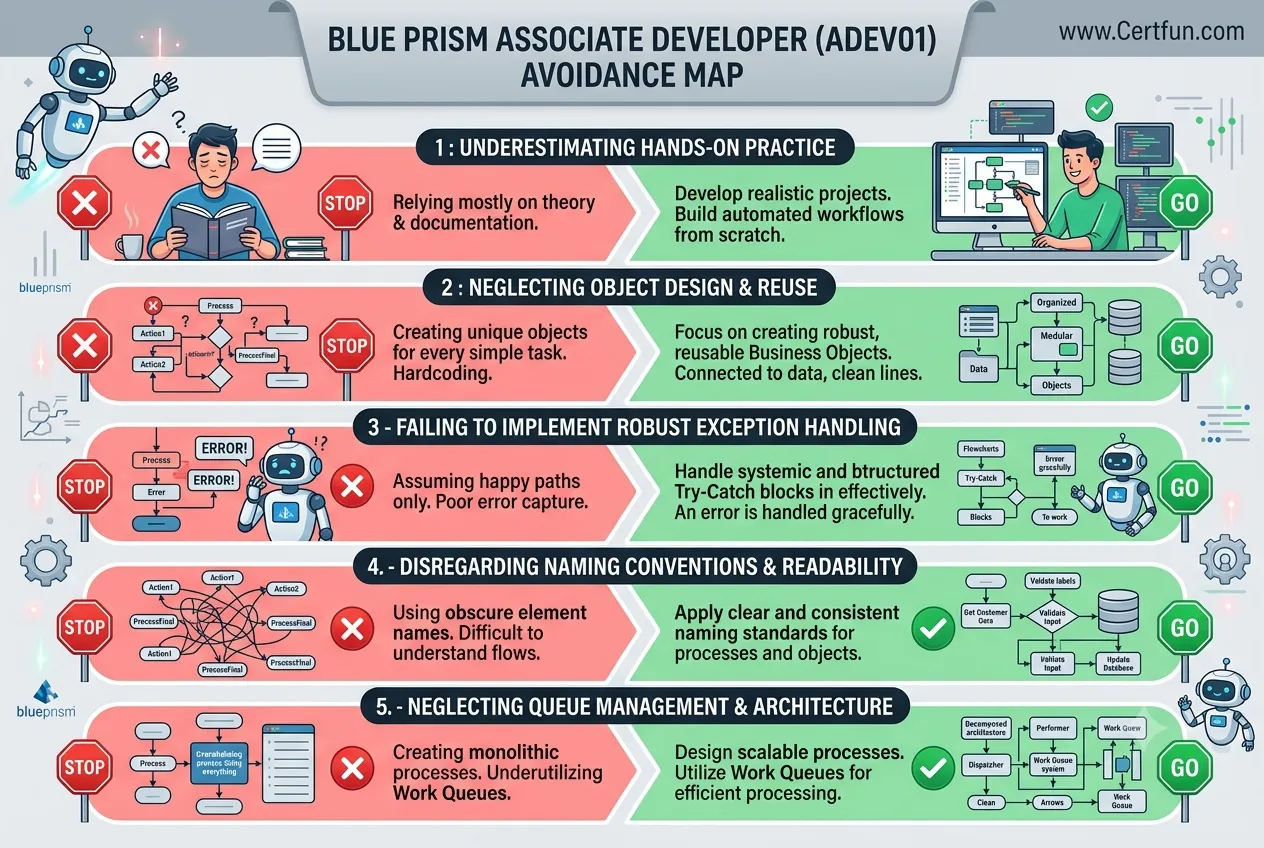
Mistake 1: Underestimating the Importance of Hands-on Practice
A critical error candidates often make is treating the ADEV01 exam as purely theoretical. Blue Prism is a practical development tool, and the certification heavily emphasizes the ability to apply concepts. Simply reading documentation or watching tutorials is insufficient without actively building and debugging automations. Many fail because they don't spend enough time in the Blue Prism client, configuring objects, designing processes, and resolving real-world automation challenges.
Remedy: Engage Directly with the Software
To avoid this mistake, ensure a significant portion of your study time is dedicated to practical application.
• Install Blue Prism: If possible, get access to a Blue Prism environment (e.g., a trial version or through your organization) and work through every exercise and scenario available in the official training.
• Build Sample Automations: Don't just follow instructions; try to build small, independent automations from scratch. Experiment with different stage types, element attributes, and control room functionalities.
• Replicate Complex Scenarios: Challenge yourself by attempting to automate a simple business process you are familiar with. This will highlight areas where your practical understanding might be weak.
Consistent hands-on engagement is the most effective way to internalize the concepts and develop the problem-solving skills the exam assesses.
Mistake 2: Neglecting Foundational Object Studio Concepts
Object Studio is the bedrock of Blue Prism automation, where reusable components (Business Objects) are created to interact with applications. A common mistake is to rush through Object Studio topics, assuming a surface-level understanding is enough. Candidates often struggle with advanced element identification, correct data item usage, and robust exception handling at the object level, leading to brittle and unreliable automations. The exam will test your meticulousness in these foundational areas.
Remedy: Deep Dive into Business Object Development
Dedicate ample time to mastering every aspect of Object Studio:
• Understand Stages Thoroughly: Ensure you know the purpose and best practices for each stage: Navigate, Read, Write, Wait, Code, Data Item, Calculation, and especially Exception.
• Element Identification: Practice identifying elements using various attributes (HTML Path, Name, Class, etc.) and understand the order of matching. Know how to handle dynamic elements effectively.
• Data Item Mastery: Grasp the scope and lifecycle of data items within an object. Understand input/output parameters for actions and how they facilitate data flow.
• Robust Exception Handling: Learn to implement error traps within objects using Recover and Resume stages. Understand how to configure exception types and messages for clear debugging.
Solidifying your knowledge in Object Studio will lay a strong foundation for building stable processes, a core requirement for the ADEV01 certification. Staying updated with vendor announcements on Blue Prism's official LinkedIn can sometimes provide context on evolving best practices.
Mistake 3: Overlooking Process Studio's Operational Nuances
While Object Studio builds the "how," Process Studio orchestrates the "what" and "when." A significant mistake is failing to appreciate the operational subtleties of Process Studio, especially concerning control flow, work queue management, and comprehensive error handling. Candidates may develop processes that function in isolation but struggle with scalability, resilience, or integration within a broader enterprise automation framework. The exam tests your ability to create processes that are not only functional but also efficient and manageable in a production environment.
Remedy: Embrace Scalable Process Design
Focus on the practical application of Process Studio concepts for robust automation:
• Process Flow and Logic: Practice building complex decision trees, loops, and collections to manage varied business rules and data sets. Understand how to link objects and integrate their actions seamlessly.
• Work Queues: Master the creation, configuration, and utilization of work queues. Understand how to add items, get next items, mark items as complete, and manage exceptions within a queue. This is fundamental for scalable and auditable processes.
• End-to-End Exception Management: Extend your exception handling knowledge beyond objects to the process level. Implement structured exception blocks, understand retry mechanisms, and learn how to log failures effectively.
• Process Publication and Scheduling: Grasp the concepts of publishing processes for external consumption and how to configure them for unattended automation via the Control Room.
A strong command of these Process Studio nuances ensures your solutions are ready for enterprise deployment, a key expectation for an Associate Developer.
Mistake 4: Insufficient Practice with Timed Sample Questions and Scenarios
Many candidates prepare by reviewing content but neglect to test their knowledge under exam-like conditions. This mistake leads to two primary issues: poor time management during the actual exam and unfamiliarity with the specific question styles. The Blue Prism Associate Developer Exam has a time limit (60 minutes for 50 questions), requiring candidates to quickly interpret questions, recall information, and select the correct answer. Without timed practice, even knowledgeable individuals can run out of time or misinterpret questions due to pressure.
Remedy: Simulate the Exam Experience Repeatedly
Incorporate rigorous, timed practice into your study routine:
• Utilize Practice Tests: Engage with quality practice questions. These are invaluable for familiarizing yourself with the question format, difficulty level, and common trick questions. You can find quality practice questions that align with the ADEV01 syllabus.
• Time Yourself Strictly: When taking practice tests, adhere to the 60-minute time limit. This will help you identify areas where you spend too much time and improve your pacing.
• Review All Answers (Right and Wrong): After each practice test, thoroughly review every question. Understand why the correct answer is correct and why your incorrect choices were wrong. This iterative feedback loop is crucial for learning.
• Work Through Scenario-Based Questions: Blue Prism exams often feature scenario-based questions that describe a problem and ask for the best automation solution. Practice dissecting these scenarios and applying your knowledge to find the most efficient and robust answer.
This disciplined approach to practice tests builds confidence and improves your performance under pressure, making you significantly more prepared for the ADEV01 exam.
Mistake 5: Failing to Leverage Official and Community Resources
A common oversight is to rely solely on one or two study guides while ignoring the wealth of official and community-driven resources available. The Blue Prism Associate Developer Exam tests against the vendor's best practices, methodologies, and current product features. Failing to consult official documentation or engage with the broader Blue Prism community can lead to outdated knowledge or a misunderstanding of recommended approaches, putting candidates at a disadvantage.
Remedy: Expand Your Resource Horizons
Actively seek out and engage with a variety of authoritative resources:
• Blue Prism University: This is the primary source of truth. Complete the official learning paths and review any supplementary materials provided for the Associate Developer certification. Refer to detailed course content and examples.
• Official Blue Prism Documentation: Dive into the product documentation for in-depth explanations of functionalities, stage properties, and best practices that might be tested. This is often overlooked but contains critical details.
• Blue Prism Community Blogs and Forums: Engage with the community. Review latest Blue Prism blog posts and discussion forums to see how real-world challenges are solved and to understand common issues and solutions. This provides practical context often missing from pure academic study.
• Vendor Blogs and Resources: Explore additional vendor resource blogs and the broader official Blue Prism University platform. These often share updates, tips, and deeper insights into specific features.
By integrating these resources into your study plan, you ensure your knowledge is current, aligned with industry best practices, and comprehensive enough to tackle the ADEV01 exam. Look specifically for Associate Developer training courses to target your study efficiently.
Cultivating an Effective Preparation Mindset
Beyond avoiding specific mistakes, adopting a strategic and resilient preparation mindset is crucial for the Blue Prism Associate Developer Exam. This involves a blend of consistent effort, self-assessment, and understanding the core competencies the certification aims to validate. Approaching the exam with confidence stems from thorough preparation, not just rote memorization, but a genuine understanding of RPA development principles as applied in Blue Prism. This section emphasizes a holistic approach to readiness, focusing on sustained learning and practical application.
Developing a robust mindset means viewing challenges as learning opportunities and actively seeking to deepen your understanding rather than just collecting facts. It involves embracing the iterative nature of development and problem-solving, which is central to RPA implementation.
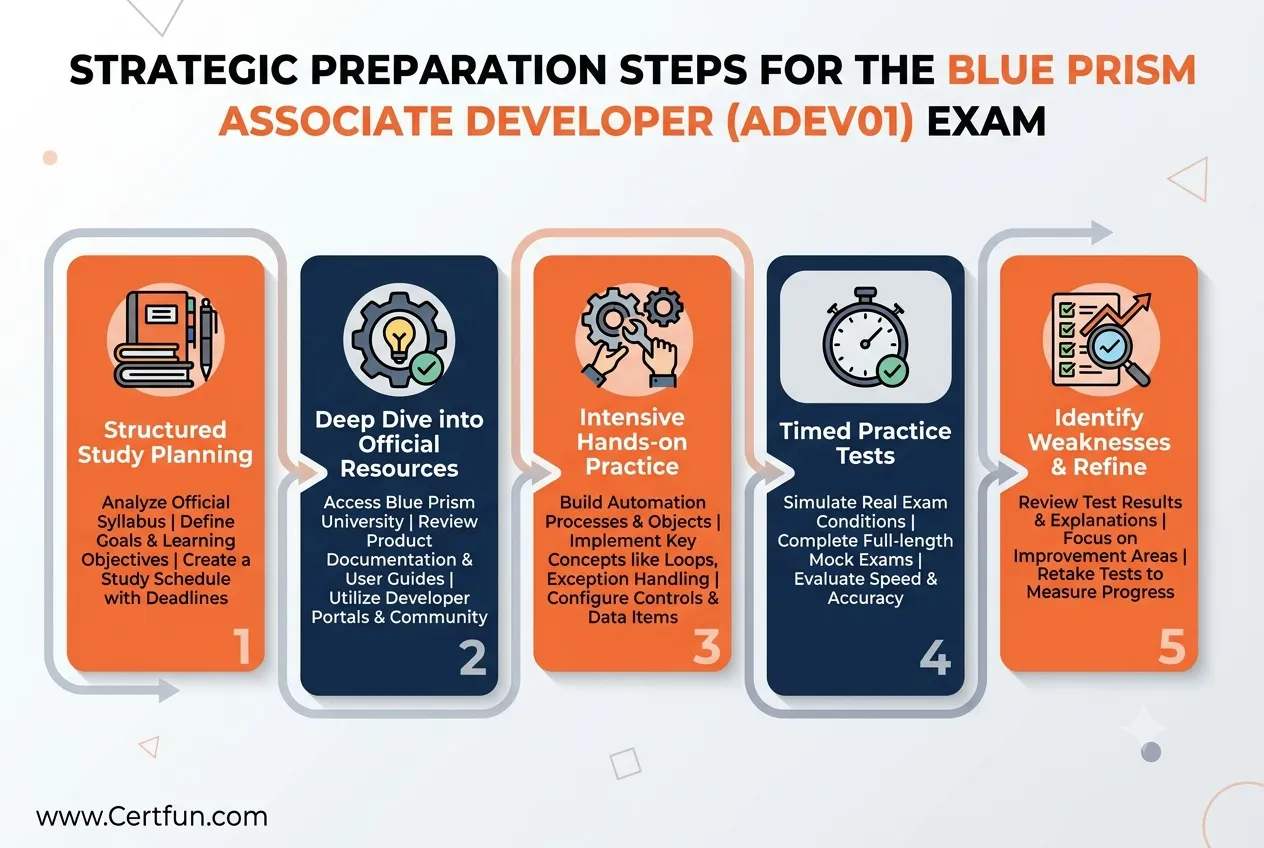
Structured Study Planning
Effective preparation for the ADEV01 exam requires a well-organized study plan. Instead of haphazardly jumping between topics, a structured approach ensures comprehensive coverage and efficient use of your time. This planning should factor in the weightage of each syllabus area, allowing you to allocate more time to Object and Process Development, which collectively account for 80% of the exam.
A structured plan might involve:
• Topic Prioritization: Start with Object Development and Process Development, dedicating significant blocks. Then move to Process Implementation.
• Daily or Weekly Goals: Set realistic study goals. For example, "Master Element Identification in Object Studio by end of week 1" or "Complete all Work Queue exercises by end of week 3."
• Regular Review: Schedule regular review sessions to revisit previously covered topics. This helps reinforce learning and identify areas that need more attention.
Consistency in your study schedule is more valuable than sporadic, intense cramming sessions.
Embracing Problem-Solving Approaches
The Blue Prism Associate Developer Exam is less about remembering definitions and more about applying concepts to solve automation problems. Therefore, your preparation should foster a problem-solving approach. This means not just knowing *what* a stage does, but *when* and *why* to use it in a specific scenario. Thinking like a developer, always considering efficiency, resilience, and reusability, will serve you well.
Consider these problem-solving tactics:
• Scenario Analysis: For any given automation task, consider multiple ways to achieve it. Analyze the pros and cons of each approach regarding performance, maintainability, and error handling.
• Debugging Skills: Actively practice debugging your automations. Understand Blue Prism's debugging tools, how to step through processes, and how to inspect data at various stages.
• Best Practices Integration: Always strive to incorporate Blue Prism best practices into your solutions. This includes modular design, comprehensive exception handling, and clear logging.
These skills are directly transferable to the exam's scenario-based questions and are invaluable in real-world RPA development.
Leveraging Certification Benefits for Career Advancement
Earning the Blue Prism Associate Developer certification is more than just passing an exam; it's a strategic move to validate your skills and open doors to new career opportunities in the burgeoning field of Robotic Process Automation. This credential signals to employers that you possess the practical expertise to contribute effectively to RPA projects. Understanding how this certification translates into career growth can be a powerful motivator during your preparation journey. The investment in time and resources for the ADEV01 exam pays dividends in professional recognition and expanded job prospects.
The Blue Prism Associate Developer certification often serves as a foundational step for those looking to specialize further in RPA, whether as senior developers, solution architects, or even RPA consultants. It demonstrates a commitment to professional development and a readiness to tackle the challenges of digital transformation.
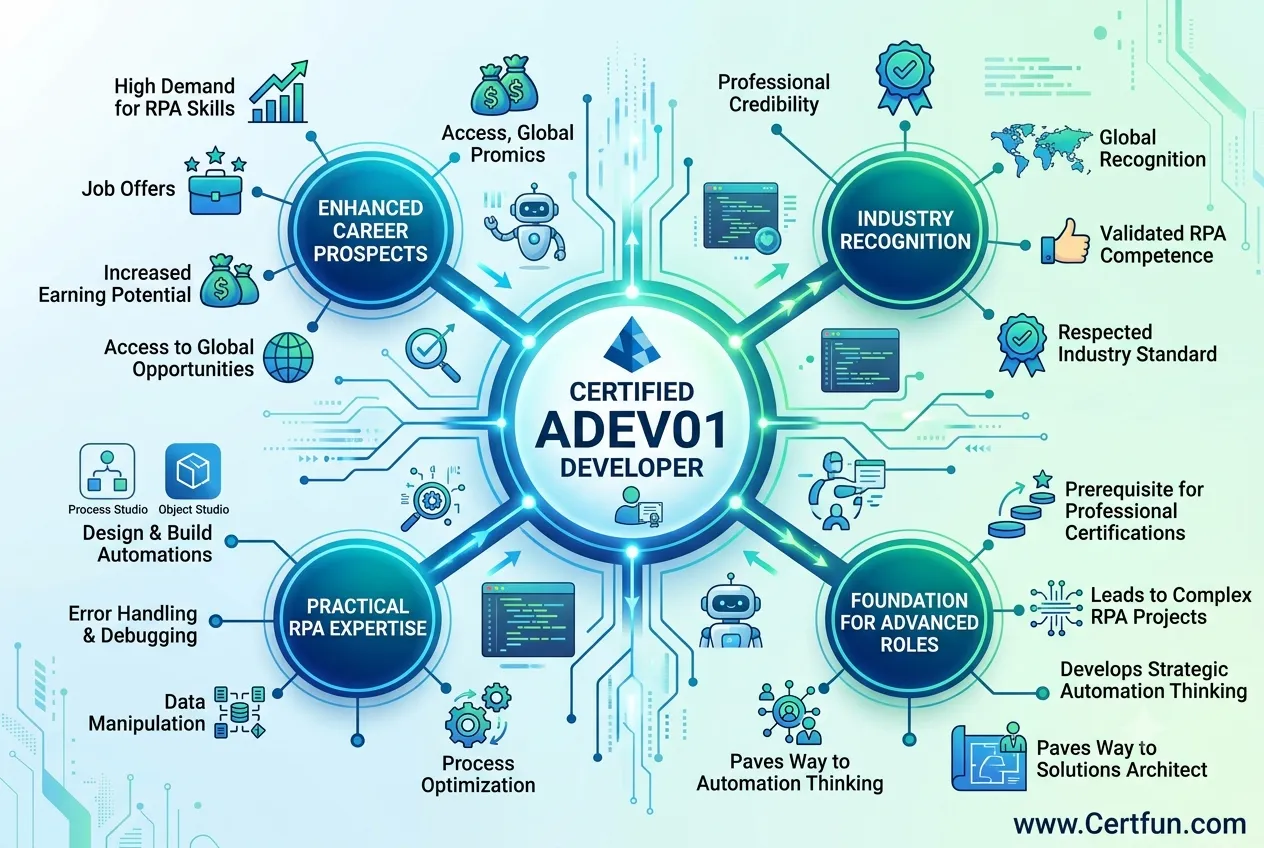
Validated Skills and Industry Recognition
The ADEV01 certification acts as a robust testament to your proficiency in Blue Prism's core development functionalities. It validates a specific set of skills that are highly sought after by organizations implementing or expanding their RPA initiatives. Employers recognize this credential as a benchmark for practical capability.
Key skills validated include:
• Designing and building robust Business Objects using Object Studio.
• Creating efficient and scalable business processes within Process Studio.
• Implementing effective exception handling strategies at both object and process levels.
• Configuring and managing Work Queues for high-volume automation.
• Deploying and managing automated solutions in a controlled environment.
This industry recognition translates into increased visibility in the job market and often commands higher earning potential.
Expanding Your Career Horizon
Possessing the Blue Prism Associate Developer certification can significantly broaden your career path within the RPA ecosystem. It positions you for a variety of roles, from an entry-level RPA Developer to a stepping stone for more advanced positions. The demand for skilled RPA professionals continues to grow across various industries, including finance, healthcare, manufacturing, and customer service.
Career opportunities that often favor ADEV01 certified professionals include:
• RPA Developer: Designing, building, and deploying automation solutions.
• Automation Analyst: Identifying automation opportunities and translating business requirements into technical specifications.
• Process Automation Consultant: Advising organizations on RPA strategies and implementation best practices.
The certification is also a prerequisite for advancing to higher-level Blue Prism certifications, paving the way for continuous professional development. Building your professional network and sharing your achievements on platforms like the Blue Prism community blogs can further amplify your career growth.
Sustaining Your Blue Prism Development Acumen
Achieving the Blue Prism Associate Developer certification is a significant milestone, but maintaining and growing your development skills is a continuous journey. The RPA landscape is dynamic, with new features, updates, and best practices emerging regularly. Sustaining your acumen involves ongoing learning, engaging with new challenges, and remaining connected to the Blue Prism ecosystem. This proactive approach ensures your skills remain relevant and valuable throughout your career, solidifying your position as a competent and knowledgeable RPA professional.
Continuous Learning and Skill Refinement
The world of Robotic Process Automation is constantly evolving. What is a best practice today might be superseded by a more efficient method tomorrow. To sustain your Blue Prism development acumen, continuous learning is not just recommended, but essential. This involves staying updated with Blue Prism's product releases, exploring new functionalities, and refining your existing skill set.
Strategies for continuous skill refinement include:
• Exploring New Features: Regularly check Blue Prism's official announcements for new versions and features. Understand how these updates can improve your automation design and efficiency.
• Advanced Training: Once comfortable with the Associate Developer skills, consider pursuing more advanced Blue Prism certifications like the Professional Developer or Solution Architect to deepen your expertise.
• Experimentation: Continuously challenge yourself with new automation projects, even small personal ones, to experiment with different approaches and problem-solving techniques.
This proactive engagement with the platform and its evolving capabilities ensures you remain at the forefront of RPA development. Engaging with the vendor resource blogs provides consistent updates and insights.
Contributing to the RPA Community
Active participation in the broader RPA community can significantly contribute to sustaining and enhancing your Blue Prism development acumen. Sharing your experiences, asking questions, and collaborating with peers exposes you to diverse perspectives and solutions, enriching your understanding of complex automation scenarios. It’s a powerful way to learn from others and contribute to the collective knowledge base.
Ways to contribute and engage:
• Online Forums: Regularly participate in Blue Prism community forums. Offer help where you can, and don't hesitate to ask questions when you encounter challenges.
• RPA Meetups and Webinars: Attend virtual or in-person meetups and webinars focused on Blue Prism or RPA in general. These events often feature expert speakers and provide networking opportunities.
• Knowledge Sharing: If your organization has an internal RPA community of practice, actively participate. Share your insights, present solutions, and learn from your colleagues' experiences.
• Official Training Paths: Continually refer back to the official Blue Prism University for structured learning, new courses, or refreshers on core concepts.
By staying connected and engaged, you foster a continuous learning environment that extends beyond your initial certification.
Conclusion
Achieving the Blue Prism Associate Developer certification is a commendable step in your RPA career, signaling a strong foundation in automation development. By understanding and actively avoiding the five common mistakes — underestimating hands-on practice, neglecting Object Studio fundamentals, overlooking Process Studio's operational nuances, insufficient timed practice, and failing to leverage official resources — you can significantly enhance your preparation and performance. Success hinges not just on knowledge, but on strategic application and a proactive learning mindset.
Embrace a comprehensive study plan that balances theoretical understanding with extensive practical application. Utilize practice tests to hone your time management and question-solving skills, and continually refer to Blue Prism's official documentation and vibrant community for the most current best practices. This holistic approach will not only secure your ADEV01 certification but also establish a solid foundation for a thriving career in Robotic Process Automation. To gain further insights into RPA development and explore more about Blue Prism certifications, you can explore the resources offered by expert insights into RPA development.
Frequently Asked Questions
1. What does the Blue Prism Associate Developer certification validate?
The Blue Prism Associate Developer (ADEV01) certification validates a candidate's foundational understanding and practical skills in developing Robotic Process Automation (RPA) solutions using the SS&C | Blue Prism platform, specifically focusing on Object Studio and Process Studio development.
2. How long is the Blue Prism ADEV01 exam, and how many questions does it have?
The Blue Prism ADEV01 exam has a duration of 60 minutes and consists of 50 multiple-choice questions. Candidates need to manage their time effectively to answer all questions within the given period.
3. What are the key syllabus areas covered in the ADEV01 exam?
The ADEV01 exam covers three primary areas: Object Development (40%), Process Development (40%), and Process Implementation (20%). A balanced study approach across these domains is crucial for success.
4. Is hands-on experience necessary to pass the Blue Prism Associate Developer exam?
Yes, hands-on experience is critically important. The exam is highly practical, assessing your ability to apply Blue Prism concepts to real-world automation scenarios. Relying solely on theoretical knowledge is a common mistake that candidates should avoid.
5. How can I best prepare for the ADEV01 certification beyond official training?
Beyond official training, effective preparation involves extensive hands-on practice with the Blue Prism software, rigorous timed practice tests, thorough review of both correct and incorrect answers, and active engagement with Blue Prism's official documentation and community forums.























Sign in to leave a comment.